The famous Victorian Monkey in Cliffside Toronto
The famous Victorian Monkey in Cliffside Toronto
Game Design: Larry Harris
Game Development: Kevin Chapman and Mons Johnson
Rulebook Development: Larry Harris and Kevin Chapman
Additional Playtesting: Jeffrey Auer, Eric Christoff, Mike Davis, Martin Frick, Randy Heath, Dan Kersey, Gregory Smorey, Kelly Thye, and Craig Yope
Editing: Kevin Chapman and Jennifer Clarke Wilkes
Art Direction: Ryan Sansaver
Cover Illustration: Jim Butcher
Graphic Design: Leon Cortez
Cartography: Todd Gamble
Photography: Allison Shinkle
Brand Management: Chris Lindsay, Liz Schuh and Brian Hart
Project Management: Neil Shinkle
Production Management: Godot Gutierre
Thanks to all of our project team members and the many others too numerous to mention who have contributed to this product
YOUTUBE VIDEO: 1940 GLOBAL INTRODUCTION…
https://www.youtube.com/watch?v=IlCNsElRYj4
YOUTUBE VIDEO: 1940 GLOBAL UNBOXING…
https://www.youtube.com/watch?v=LkMrMdDMYnI
Game Components
The Global Situation
The Setup
Summary of Play
How the War is Won
The Political Landscape
Order of Play
Purchase & Repair Units
Combat Move
Conduct Combat
Noncombat Move
Mobilize New Units
Collect Income
Winning the game
Unit Profiles
Global Rules
Axis & Allies game Piece Directory
AXIS & ALLIES 1940 GLOBAL 2nd EDITION - COMPONENTS LIST
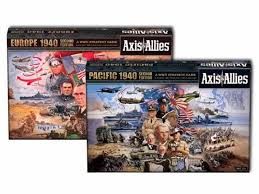
The following is a complete list of components you will get in Axis & Allies 1940 Europe and 1940 Pacific 2nd Edition (combined)
Game board:
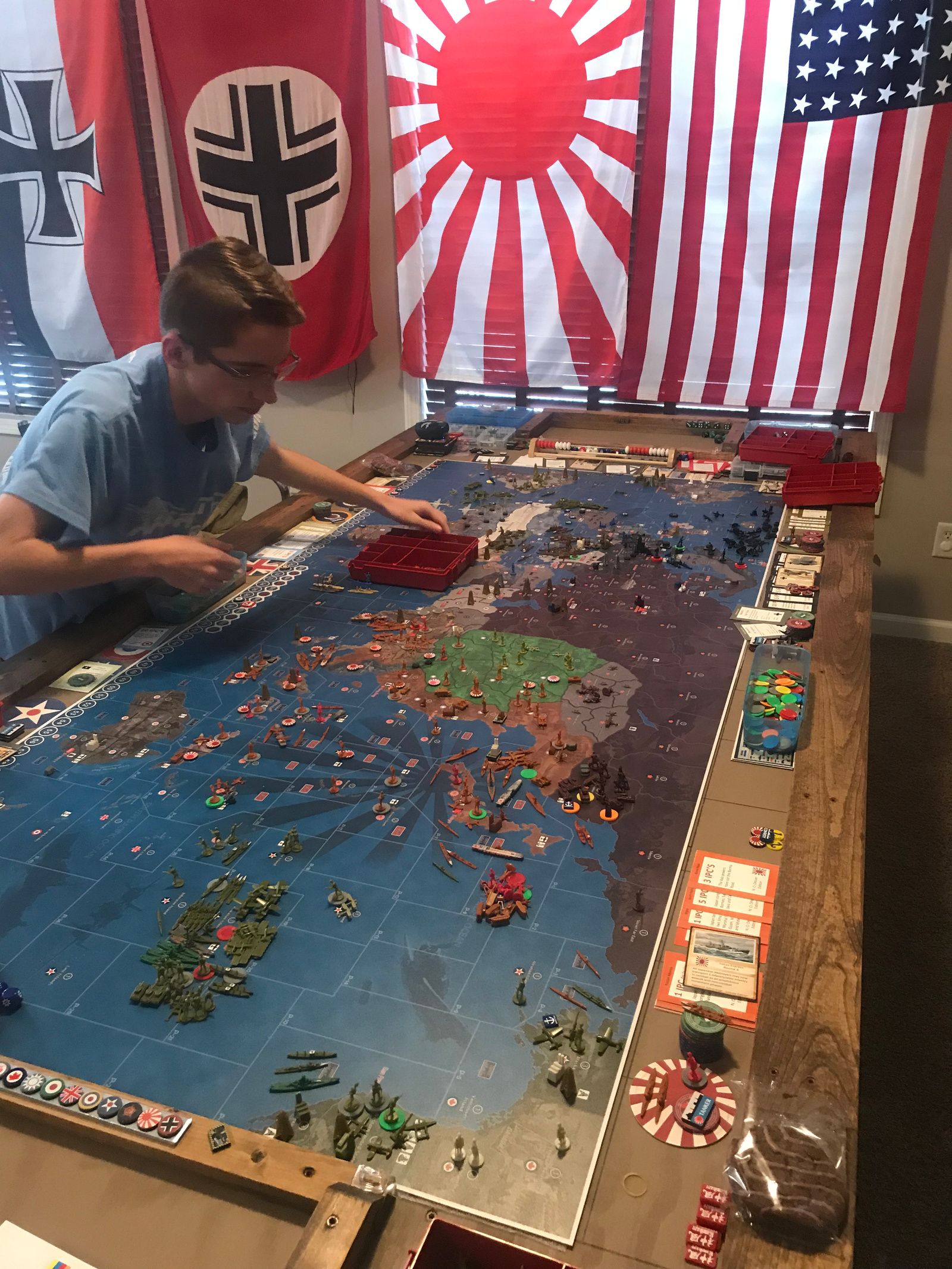
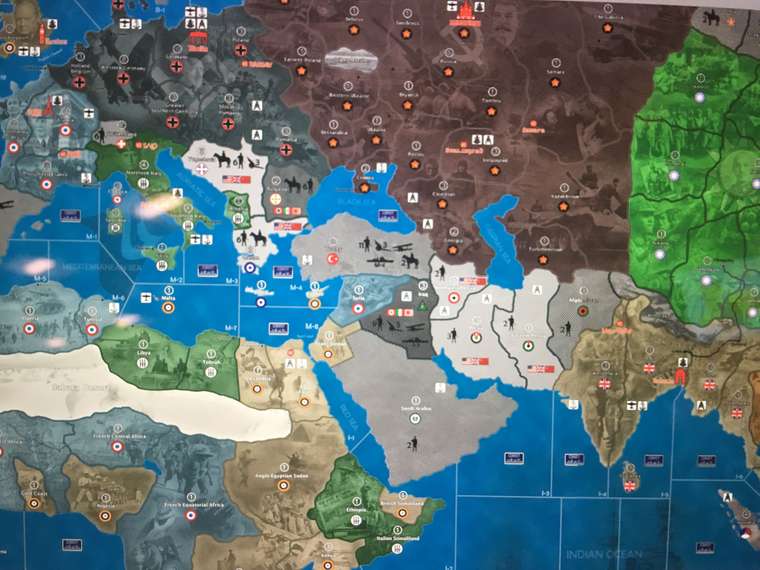
The game board is a map of the western hemisphere, circa 1940. It’s divided into spaces, either territories (on land) or sea zones, which are separated by border lines. The national production chart on the top of the game board tracks each power’s production level (income) during the game. The level is based on the combined Industrial Production Credit (IPC) values of each territory a power controls. Place one of your power’s control markers on the number on the tracker that matches your power’s starting IPC income. This is the power’s starting national production level. Each player should keep track of his or her power’s production level separately.
4 Piece folding boards (spans 70"X32")
18 - Major factories
20 - Minor factories
30 - Air bases
32 - Naval bases
6 - Kamikaze tokens
Plastic Chips:
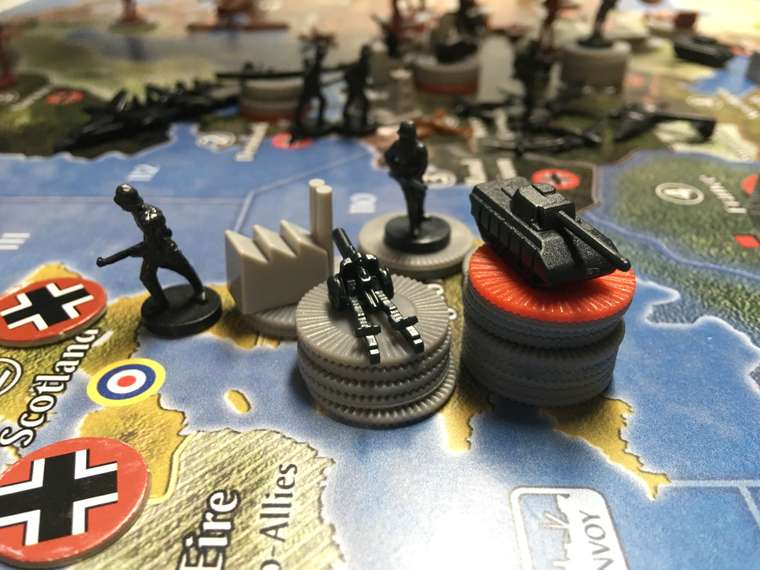
Use the chips to save space in overcrowded territories and sea zones. Gray chips represent 1 combat unit each, green chips represent 3 units each, and red chips represent 5 units each. For example, if you wanted to place 10 infantry on a space, you would stack up 1 red chip, 1 green chip, 1 gray chip, and 1 infantry unit on top. (If you don’t have enough pieces to top off all your stacks, use any identifying item, such as a piece of paper with the unit type written on it.) The number of stacks is not limited by the number of plastic pieces available.
110 - Gray plastic chips
30 - Green plastic chips
20 - Red plastic chips
Battle Strip, Casualty strip, & Dice:
The battle strip is a card with columns that list attacking and defending units and their combat strengths. When combat occurs, the players involved place their units on both sides of the battle strip. Combat is resolved by rolling dice. Casualties are designated by being moved behind the casualty strip.
1 - Battle Strip
1 - Casualty Strip
6 - Red dice
6 - Black dice
Research & Development Chart:
The Research & Development Chart is used for an optional rule when combining this game with Axis & Allies Pacific 1940. If you’re playing the combined games, whenever you develop a new technology, place one of your power’s control markers inside the appropriate advancement box on the chart.
1 - Research & Development Chart
2 - Rule books (Europe 1940 / Pacific 1940)
Combat forces:
Take the plastic pieces that represent your power’s combat units. Each power is color coded as shown in the following chart, which also shows the power’s starting income level and treasury in Industrial Production Credits (see below). Place all of your power’s starting units on the game board as listed on your power’s setup chart.
30 - Control Markers
40 - Infantry
8 - Artillery
9 - Mechanized Infantry
12 - Tanks
8 - Antiaircraft Artillery
8 - Fighters
9 - Tactical Bombers
4 - Strategic Bombers
6 - Transports
6 - Destroyers
6 - Submarines
4 - Cruisers
2 - Aircraft Carriers
2 - Battleships
30 - Control Markers
40 - Infantry
8 - Artillery
9 - Mechanized Infantry
10 - Tanks
8 - Antiaircraft Artillery
8 - Fighters
9 - Tactical Bombers
2 - Strategic Bombers
4 - Transports
4 - Destroyers
4 - Submarines
2 - Cruisers
2 - Aircraft Carriers
2 - Battleships
30 - Control Markers
40 - Infantry
12 - Artillery
9 - Mechanized Infantry
12 - Tanks
8 - Antiaircraft Artillery
16 - Fighters
9 - Tactical Bombers
8 - Strategic Bombers
12 - Transports
12 - Destroyers
12 - Submarines
8 - Cruisers
8 - Aircraft Carriers
8 - Battleships
30 - Control Markers
40 - Infantry
12 - Artillery
15 - Mechanized Infantry
12 - Tanks
16 - Antiaircraft Artillery
16 - Fighters
15 - Tactical Bombers
12 - Strategic Bombers
12 - Transports
12 - Destroyers
12 - Submarines
8 - Cruisers
8 - Aircraft Carriers
8 - Battleships
10 - Control Markers
30 - Regular Infantry
30 - Control Markers (including 2 Union Jacks)
40 - Infantry
12 - Artillery
12 - Mechanized Infantry
16 - Tanks
16 - Antiaircraft Artillery
16 - Fighters
12 - Tactical Bombers
12 - Strategic Bombers
12 - Transports
12 - Destroyers
12 - Submarines
8 - Cruisers
4 - Aircraft Carriers
8 - Battleships
30 - Control Markers
20 - Infantry
8 - Artillery
6 - Mechanized Infantry
10 - Tanks
8 - Antiaircraft Artillery
8 - Fighters
6 - Tactical Bombers
4 - Strategic Bombers
6 - Transports
6 - Destroyers
6 - Submarines
4 - Cruisers
2 - Aircraft Carriers
2 - Battleships
30 - Control Markers
20 - Infantry
6 - Artillery
6 - Mechanized Infantry
8 - Tanks
8 - Antiaircraft Artillery
8 - Fighters
6 - Tactical Bombers
6 - Strategic Bombers
6 - Transports
6 - Destroyers
6 - Submarines
4 - Cruisers
4 - Aircraft Carriers
4 - Battleships
30 - Control Markers
20 - Infantry
8 - Artillery
8 - Mechanized Infantry
10 - Tanks
8 - Antiaircraft Artillery
8 - Fighters
6 - Tactical Bombers
2 - Strategic Bombers
4 - Transports
4 - Destroyers
4 - Submarines
2 - Cruisers
2 - Aircraft Carriers
2 - Battleships
YOUTUBE VIDEO: 1940 GLOBAL COMPONENTS…
https://www.youtube.com/watch?v=2mK3NbTyEwQ&t=1s
It is spring 1940. Since the invasion of Poland nine months earlier, the United Kingdom and France have been at war with Germany. The Soviet Union and Germany have signed a secret protocol splitting Eastern Europe between them. In November of that year, the Soviets, using some false pretext, attacked
Finland. The Russians didn’t fare well in this war. 200,000 Finns managed to hold up a Soviet army of 1,000,000 troops. Eventually, the Finns had to sue for peace and several disputed territories were annexed by the Soviets.
The weakness and humiliating defeats suffered by the Red Army didn’t go unnoticed by the watching eyes of Nazi Germany. Before
long, these two great powers would be caught up in a life-and- death struggle for their very existence. Before that day, however, the rest of Europe had to be dealt with. First, Norway and Denmark
were invaded. Then, with an objective of nothing less than the total destruction of the British and French armies in northern France, Belgium
and Holland were quickly overrun. Outflanking the Maginot line, to the great surprise of the Allied armies, the German army poured into the Low
Countries. The Allied Expeditionary Force soon found its back to the sea and was forced to evacuate. During Operation Dynamo, the Allies, being forced into an ever-shrinking perimeter, made a desperate
withdrawal from Dunkirk. More than 300,000 Allied troops evacuated back to England. However, much of the BEF’s equipment had been lost or left back on the beaches of Europe.
During those desperate days, more than half of the French armor had been lost in Belgium. Now, with what was left and supplemented by some remaining Allied units, France is facing not only a larger German army, but an army whose tactics and way of conducting war are all too new and too effective. It’s at this point that you take command of one or more of the major powers and rewrite history. As an Allies player, can you stop this Axis momentum? As an Axis player, can you defeat France and/or Britain? Can you defeat the bear in the East? How are you going to deal with the awakening giant, the arsenal of democracy, the United States? Your task will not be easy, but world domination never is. Meanwhile on the other side of the world, Japan is at war with China, but not with any other country. Any attacks on British, Dutch, ANZAC (Australian-New Zealand Army Corps), or American territories or ships by the Japanese will be considered an act of war by all of the remaining Allied powers. A British or ANZAC attack on Japan, however, would not bring the U.S.
into the war. The Japanese player can elect to go to war with the Allies immediately. If Japan does, the United States will automatically kick into its wartime economy. With tensions already high due to Japan’s occupation of parts of
China, any further conquest in the Pacific will force the United States to go to war with Japan. Should Japan not attack immediately and use this time to better prepare and position its forces? This is
the question that the Japan player must answer
Setup Charts:
Take the setup chart for your power, located on the box top of the storage tray. It shows the name of the power, its units’ color, and its emblem. It also lists the starting numbers and locations of that power’s units on the game board.
Germany: 11 Infantry, 3 Artillery, 1 Tac Bomber, 2 Bombers, 3 AA guns, 1 Major IC
Western Germany: 3 Infantry, 1 Artillery, 4 Mech Infantry, 2 Fighters, 3 Tac bombers, 3 AA guns, 1 Major IC, 1 Naval base, 1 Airbase
Greater Southern Germany: 6 Infantry, 2 Artillery, 3 tanks
Slovakia/Hungary: 2 Infantry, 1 Tank, 1 Fighter
Poland: 3 Infantry, 1 Tank, 1 Tac Bomber
Romania: 2 Infantry, 1 Tank
Holland/Belgium: 4 Infantry, 2 Artillery, 3 Tanks, 1 Fighter
Norway: 3 Infantry, 1 Fighter
Denmark: 2 Infantry
Sea Zone 113: 1 Battleship
Sea Zone 114: 1 Cruiser, 1 Transport
Sea Zone 103: 1 Submarine
Sea Zone 108: 1 Submarine
Sea Zone 117: 1 Submarine
Sea Zone 118: 1 Submarine
Sea Zone 124: 1 Submarine
Russia: 1 Infantry, 1 Artillery, 1 Mech Infantry, 1 Tank, 1 Fighter, 1 Tac Bomber, 2 AA Guns, 1 Airbase, 1 Major IC
Novgorod: 6 Infantry, 1 Artillery, 1 Fighter, 2 AA Gun, 1 Airbase, 1 Naval Base, 1 Minor IC
Archangel: 1 Infantry
Karelia: 2 Infantry
Vyborg: 3 Infantry
Baltic States: 3 Infantry
Belarus: 1 Infantry
Eastern Poland: 2 Infantry
Western Ukraine: 1 Infantry, 1 Artillery
Bessarabia: 2 Infantry
Ukraine: 3 Infantry, 1 Minor IC
Volgograd: 1 Mech Infantry, 1 Tank, 1 Minor IC
Caucasus: 2 Infantry
Buryatia: 6 Infantry
Sakha: 6 Infantry, 2 AA guns
Amur: 6 Infantry
Sea Zone 115: 1 Cruiser 1 Submarine
Sea Zone 127: 1 Submarine
Japan: 6 Infantry, 2 Artillery, 1 Tank, 2 Fighters, 2 Tac Bombers, 2 Bombers, 3 AA Guns, 1 Airbase, 1 Naval Base, 1 Major IC
Korea: 4 Infantry, 1 Fighter
Manchuria: 6 Infantry, 1 Mech Infantry, 1 Artillery, 1 AA Gun, 2 Fighters, 2 Tac Bombers
Jehol: 2 Infantry, 1 Artillery
Shantung: 3 Infantry, 1 Artillery
Kiangsu: 3 Infantry, 1 Artillery, 1 Fighter, 1 Tac Bomber
Kiangsi: 3 Infantry, 1 Artillery
Kwangsi: 3 Infantry, 1 Artillery
Siam: 2 Infantry
Iwo Jima: 1 Infantry
Okinawa: 1 Infantry, 1 Fighter
Formosa: 1 Fighter
Palau Island: 1 Infantry
Caroline Islands: 2 Infantry, 1 AA gun, 1 Airbase, 1 Naval Base
Sea Zone 6: 1 Submarine, 2 Destroyers, 2 Carriers each with 1 Tac Bomber & 1 Fighter, 1 Cruiser, 1 Battleship, 1 Transport
Sea Zone 19: 1 Submarine, 1 Battleship, 1 Destroyer, 1 Transport
Sea Zone 33: 1 Destroyer, 1 Carrier with 1 Tac Bomber & 1 Fighter
Sea Zone 20: 1 Cruiser, 1 Transport
Eastern United States: 1 Infantry, 1 Fighter, 1 Artillery, 2 AA Guns, 1 Airbase, 1 Naval Base, 1 Minor IC
Central United States: 1 Infantry, 3 Mech Infantry, 1 Tank, 1 Bomber, 1 Minor IC
Western US: 2 Infantry, 1 Mech Infantry, 1 Artillery, 1 Fighter, 2 AA Guns, 1 Airbase, 1 Naval Base, 1 Minor IC
Hawaiian Islands: 2 Infantry, 2 Fighters, 1 Airbase, 1 Naval Base.
Philippines: 2 Infantry, 1 Fighter, 1 Airbase, 1 Naval Base.
Midway: 1 Airbase
Wake Island: 1 Airbase
Guam: 1 Airbase
Sea Zone 10: 1 Battleship, 1 Cruiser, 1 Destroyer, 1 Transport, 1 Carrier with 1 Tac Bomber & 1 Fighter
Sea Zone 26: 1 Submarine, 1 Destroyer, 1 Cruiser, 1 Transport
Sea Zone 35: 1 Destroyer, 1 Submarine
Sea Zone 101: 1 Cruiser, 1 Transport
Suiyuan: 2 Infantry
Shensi: 1 Infantry
Kweichow: 2 Infantry
Hunan: 2 Infantry
Yunnan: 4 Infantry
Szechwan: 6 Infantry, 1 Fighter
United Kingdom: 2 Infantry, 1 Mech Infantry, 2 Fighters, 1 Bomber, 4 AA guns, 1 Airbase, 1 Naval Base, 1 Major IC
Scotland: 2 Infantry, 1 Fighter, 1 AA gun, 1 Airbase
France: 1 Artillery, 1 Tank
Ontario: 1 Infantry, 1 Artillery
Quebec: 1 Infantry, 1 Tank, 1 Minor IC
New Brunswick Nova Scotia: 1 Naval Base
Iceland: 1 Airbase
Gibraltar: 1 Fighter, 1 Naval Base
Malta: 1 Infantry, 1 Fighter, 1 AA gun,
Alexandria: 2 Infantry, 1 Artillery, 1 Tank
Egypt: 1 Infantry, 1 Artillery, 1 Mech Infantry, 1 Naval Base
Anglo-Egyptian Sudan: 1 Infantry
Union of South Africa: 2 Infantry, 1 Naval Base, 1 Minor IC
West India: 1 Infantry
Sea Zone 106: 1 Destroyer, 1 Transport
Sea Zone 109: 1 Destroyer, 1 Transport
Sea Zone 110: 1 Cruiser, 1 Battleship
Sea Zone 111: 1 Destroyer, 1 Battleship, 1 Cruiser
Sea Zone 91: 1 Cruiser
Sea Zone 98: 1 Cruiser, 1 Destroyer, 1 Carrier with 1 Tac Bomber, 1 Transport
Sea Zone 71: 1 Destroyer
India: 6 Infantry, 1 Artillery, 3 AA Guns, 1 Fighter, 1 Tac Bomber, 1 Airbase, 1 Naval Base, 1 Major IC
Burma: 2 Infantry, 1 Fighter
Malaya: 3 Infantry, 1 Naval Base
Kwangtung: 2 Infantry, 1 Naval Base
Sea Zone 37: 1 Battleship
Sea Zone 39: 1 Destroyer, 1 Cruiser, 1 Transport
Northern Italy: 2 Infantry, 2 Artillery, 1 Tank, 1 Bomber, 2 AA Guns, 1 Major IC
Southern Italy: 6 Infantry, 2 Fighters, 2 AA Guns, 1 Naval Base, 1 Airbase, 1 Minor IC
Albania: 2 Infantry, 1 Tank
Libya: 1 Infantry, 1 Artillery
Tobruk: 3 Infantry, 1 Artillery, 1 Mech Infantry, 1 Tank
Ethiopia: 2 Infantry, 1 Artillery
Italian Somaliland: 1 Infantry
Sea Zone 95: 1 Destroyer, 1 Cruiser, 1 Submarine, 1 Transport
Sea Zone 96: 1 Destroyer, 1 Transport
Sea Zone 97: 1 Cruiser, 1 Battleship, 1 Transport
Queensland: 2 Infantry, 1 Artillery, 1 Fighter, 1 Airbase, 1 Naval Base.
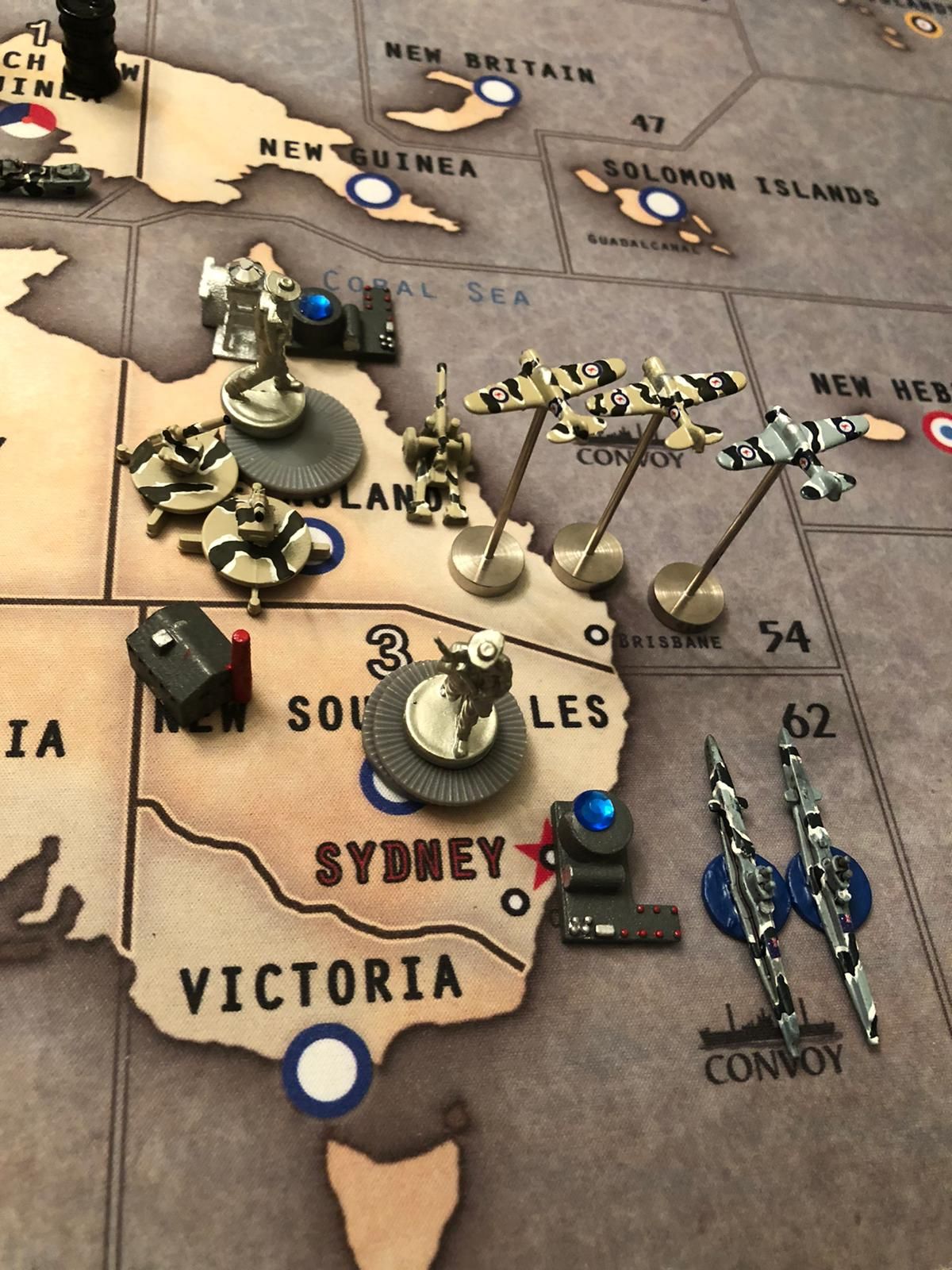
New South Wales: 2 Infantry, 2 AA guns, 1 Minor IC, 1 Naval Base.
New Zealand: 1 Infantry, 2 Fighters, 1 Airbase, 1 Naval Base.
Malaya: 1 Infantry
Egypt: 2 infantry
Sea Zone 62: 1 Destroyer, 1 Transport
Sea Zone 63: 1 Cruiser
France: 6 Infantry, 1 Artillery, 1 Tanks, 1 AA gun, 1 Fighter, 1 Airbase, 1 Major IC
Normandy/Bordeaux: 1 Infantry, 1 Artillery, 1 Naval Base, 1 Minor IC
Southern France: 1 Infantry, 1 Artillery, 1 Naval Base, 1 Minor IC
United Kingdom: 2 Infantry, 1 Fighter
Morocco: 1 Infantry
Algeria: 1 Infantry
Tunisia: 1 Infantry
Syria: 1 Infantry
French West Africa: 1 Infantry
Sea Zone 72: 1 Destroyer
Sea Zone 93: 1 Destroyer, 1 Cruiser
Sea Zone 110: 1 Cruiser
YOUTUBE VIDEO: 1940 GLOBAL SETUP…
https://www.youtube.com/watch?v=GgJzxTbyrzQ&t=22s
The rules in this hand book describe how to combine Axis & Allies Europe 1940 with Axis & Allies Pacific 1940 to play them together as a single game called Axis & Allies Global 1940.
This game can be played by two to six players. If you control more than one power, keep those powers’ income and units separate. You can conduct operations for only one power at a time. Split control of the powers between the players as follows:
Two players
Player 1: Axis powers
Player 2: Allied powers
Three players
Player 1: Axis powers
Player 2: Soviet Union, United States, and China
Player3:United Kingdom, ANZAC, and France
Four players
Player 1: Axis powers
Player 2: Soviet Union and France
Player 3: United States and China
Player 4: United Kingdom and ANZAC
Five players
Player 1: Germany and Italy
Player 2: Japan
Player 3: Soviet Union and France
Player 4: United States and China
Player 5: United Kingdom and ANZAC
Six players
Player 1: Germany
Player 2: Japan
Player 3: Italy
Player 4: Soviet Union and France
Player 5: United States and China
Player6:United Kingdom and ANZAC
Use the following order of play. Powers take their turns in this order regardless of which player controls them.
The powers start with the following IPC income levels and treasuries:
Germany - 30 IPCs
Soviet Union - 37 IPCs
Japan - 26 IPCs
United States - 52 IPCs
China - 12 IPCs
United Kingdom (Europe) - 28 IPCs
United Kingdom (Pacific) - 17 IPCs
Italy - 10 IPCs
ANZAC - 10 IPCs
France - 19 IPCs
The Axis wins the game by controlling either any 8 victory cities on the Europe map or any 6 victory cities on the Pacific map for a complete round of play (ending with the next turn of the Axis power that captured the final required city), as long as they control an Axis capital (Berlin, Rome, or Tokyo) at the end of that round.
The Allies win by controlling Berlin, Rome, and Tokyo for a complete round of play (ending with the next turn of the Allied power that captured the third capital), as long as they control an Allied capital (Washington, London, Paris, or Moscow) at the end of that round.
YOUTUBE VIDEO: 1940 GLOBAL BASICS…
https://www.youtube.com/watch?v=bRHxahObgeU
Territories:
The border colors of the territories on the game board show which power controls them at the start of the game. Each power has its own color and emblem (the United Kingdom controls the Canadian territories in addition to those with its own emblem). When the rules refer to the “original controller” of a territory, they mean the power whose emblem is printed on the territory. All other spaces are neutral and are not aligned with any power. Most territories have an income value ranging from 1 to 20. This is the number of IPCs the territory produces each turn for its controller. A few territories, such as Iceland, have no income value. Units can move between adjacent spaces (those that share a common border). Spaces that meet only at a point (such as United Kingdom and sea zone 111) are not adjacent to one another, as they do not share a common border.
All territories exist in one of three conditions:
Friendly: Controlled by you or a friendly power.
Hostile: Controlled by a power with which you are at war.
Neutral: Not controlled by any power, or controlled by a power on the other side with which you are not yet at war. Neutral territories, such as Switzerland, have white borders and do not have any power’s emblem on them. Most such territories also have a unit silhouette with a number, which indicates how many infantry units the territory will generate to defend itself when its neutrality is violated. The Sahara Desert and Pripet Marshes are impassable and may not be moved into or through by any units.
Sea Zones:
Sea zones are either friendly or hostile. Friendly sea zones contain no surface warships (this doesn’t include submarines and transports) belonging to a power with which you are at war. Hostile sea zones contain surface warships belonging to a power with which you are at war. (The presence of a surface warship belonging to an enemy power with which you are not yet at war doesn’t make a sea
zone hostile.
Note: The Caspian Sea (surrounded by Caucasus, Kazakhstan, Turkmenistan, Eastern Persia, Persia, and Northwest Persia) is considered to be a sea zone, even though it does not have a number.
Islands:
An island or island group is a single territory surrounded entirely by one or more sea zones. A sea zone can contain more than one island or island group, but each one is considered one territory. Each territory has a separate name and emblem on it. It’s not possible to split up land-based units so that they are on different islands in the same group.
For example, Sardinia and Sicily are both located in sea zone 95. These named islands can each have independent land-based units. However, West Indies, located in sea zone 89, is an island group (one territory), so any land units there are all together, not on separate islands. Islands that have no name label, such as the one in sea zone 114, are not game spaces and may not have units moved onto them.
Canals and Narrow Straits:
Canals and narrow straits are geographical features that can help or hinder sea movement, depending upon who controls them. Canals are artificial waterways that connect two larger bodies of water, while narrow straits are natural passages that do the same. In either case, control of the land territories surrounding these features gives the controlling power and its allies the ability to travel through them while denying access to enemy powers. There are two canals on the game board. The Panama Canal connects the Pacific Ocean to the Caribbean Sea (sea zones 64 and 89), while the Suez Canal connects the Red Sea to the Mediterranean Sea (sea zones 81 and 98). A canal is not considered a space, so it doesn’t block land movement. Land units can move freely between Trans- Jordan and Egypt. Central America, containing the Panama Canal, is one territory, so no land movement is required to cross the canal within Central America.There are three narrow straits on the game board. The Turkish Straits connect the Mediterranean and Black Seas (sea zones 99 and 100), the Strait of Gibraltar connects the Atlantic Ocean to the Mediterranean Sea (sea zones 91 and 92), and the Danish Straits connect the North and Baltic Seas (sea zones 112 and 113). Most narrow straits can’t be crossed by land units without the use of transport ships. However, Turkey is one territory that contains a narrow strait within it, so no land movement or transport ships are required to cross the straits within Turkey. If your side (but not necessarily your power) controlled a canal or narrow strait at the start of your turn, you may move sea units through it (you can’t use it in the same turn that you capture it). If a canal or narrow strait is controlled by a power not on your side, but with which you are not yet at war, you must ask permission to use it, which may be denied. You can’t move sea units through a canal or narrow strait that is controlled by a neutral territory or by a power with which you are at war. In order to control a canal or narrow strait, you must control its controlling land territory or territories. They are as follows:
Canal/Narrow Straits
Suez Canal Panama Canal Turkish Straits Strait of Gibraltar Danish Straits
Controlling Territories
Egypt and Trans-Jordan Central America Turkey
Gibraltar
Denmark
If there is only one controlling territory, the power that controls it controls the canal or strait. If there are two controlling territories, the side that controls both of them controls the canal or strait. If one side controls one territory and the other controls the other, the canal or strait is closed to all sea units. Turkey begins the game as a neutral territory, so neither side may move through the Turkish Straits until Turkey is captured.
Exception: Submarines of any power may pass through the Strait of Gibraltar regardless of which power controls it.
The movement of air units is completely unaffected by canals and straits, whether they are moving over land or sea. They can pass between sea zones connected by the canal or strait regardless of which side controls it.