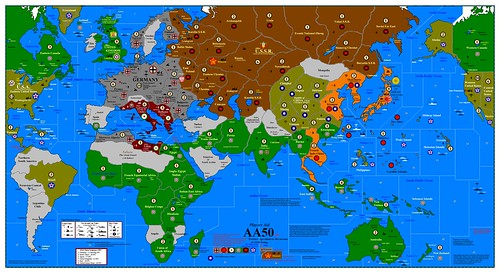
I see your points, and think that it seems pretty sound. I just cant help but be a little skeptical of too strong a reliance on one form of strategy. Don’t get me wrong, I agree that the conveyor system from WUS to Australia is critical, particularly if that region is going to be the emphasis of the game. And I see your point about HI and WUS being weak - but ultimately secure.
I also dont care for a single victory strategy for the Allies, but it’s all I’ve found so far. And I’m now working out a nonJ1 technique to stall the US production line for as long as possible. There doesnt seem to be any way to stop once it gets rolling.
I just wonder what the effect is if the system is stalled in Queensland by a Japanese player that has done more than just box in the UK, but essentially obliterated it and taken India. Seems the Japanese player can then concentrate his force out the DEI or the Philippines and begin a concentrated effort of rolling you back (assuming you’ve attempted to expand into DEI).
So far with my conveyor strategy, India and Burma have never fallen. If India is taken, I would say the game is over regardless of what is going on elsewhere in the world. Much like Russia in 1984 and Revised, the whole game pivots on keeping the country that has land position in the primary theatre alive. If they fall, then everything crumbles.
These approaches seem pretty sound. I wonder if people claiming the game is out of balance (in favor of Japan) have ever really encountered something like this.
I was one of those thinking it was horribly out of balance, but I was making mistakes and playing old school. At this point, I’ve put a lot of time into it, enough to realize it’s actually ridiculously well balanced. At the end of each side’s turn every round, it looks like they’re gonna win. I havent experienced that very much in prior A&A games. It’s like watching the superbowl and knowing in the first 10 minutes who’s going to win. Lame! I want it to be a head race all the way to a photo finish. This game, with all it’s complexity, does that. I really have to tip my hat to Larry.