Axis & Allies .org Forums
    • Home
    • Categories
    • Recent
    • Popular
    • Users
    • Register
    • Login
    1. Home
    2. The Janus
    3. Posts
    0%
    • Profile
    • Following 0
    • Followers 0
    • Topics 16
    • Posts 315
    • Best 73
    • Controversial 0
    • Groups 0

    Posts made by The Janus

    • RE: "East & West" by Imp Games - Discussion

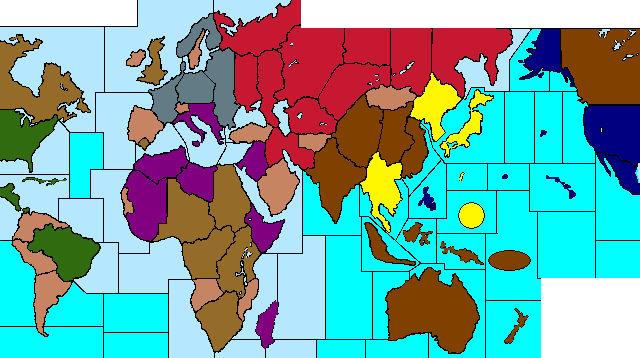
      Analysis of the Early Game

      So after getting resoundingly thumped by our forums’ very own @The_Good_Captain (in roughly half a dozen games) earlier this year, I find myself having another big think about E&W lately.

      (One thing I should mention was that we hadn’t yet dug up the Imp Games E&W FAQ while we were playing; probably the most significant rule clarification in there was that aerial retreats are allowed. So that will have an impact if/when I ever get rolling with an opponent again.)

      Anyways, what we learned is that is it is very plausible (with the round 0 bonus of 20 IPCs) to have the USSR capture basically all of the frontline territories on round 1:

      • Norway (2)
      • West Germany (4)
      • Greece (2)
      • Turkey (3)
      • Pakistan (1)
      • South Korea (2)

      What you end up with is an income tracker like this:
      USSR: 62 (+4 more, from China)
      WE: 21
      UK: 32
      US: 41

      Since this is a Classic-style IPM game, we can translate this pretty easily into units:

      33 inf for the USSR, vs.

      • 7 inf for WE
      • 9 inf, 1 arm for UK
      • 12 inf, 1 arm for US
        = 30 ground units for NATO

      NATO starts out the game with a sizeable advantage in infantry; even taking into account 10 inf being added in round 0, they’re ahead of the Soviets, 92-70. However, this advantage is largely flattened out through combat on the first round, and by the fact that US and UK are typically going to be producing transports on round 1, rather than landing many units in Eurasia.

      Where this starts to tip into imbalance is the fact that the USSR can begin attacking neutrals to increase their economy, right away on round 2. Conversely, it is difficult for NATO to be taking territory away from the USSR by round 2, because they are reliant on transports to do so – in both Siberia and Scandinavia.

      I’ll qualify this by saying I haven’t attempted a full-blown Scandinavia focus as NATO in these most recent games (although this is what I’m looking into now.) But with that being said, I’m essentially counting on the aerial retreat rule to tip the balance enough in NATO’s favour, that other house-rules won’t be needed; I’m skeptical that this will be the case.

      I think that having some reliability in the round 1 outcomes is important, but it’s becoming clear that maybe the USSR shouldn’t get to win all of the battles. My first instinct is to tinker a bit with the initial setup, but possibly a better starting point is to go back to playing the game without any purchases on round 0, and then slowly start adding a “bid” back in, to see where the numbers fall.

      Turkey is probably the hardest nut to crack in the starting setup, and the Soviets using control of the straits to defend their backline has been a cornerstone of the game for the longest time. It’ll be interesting to see if the game still “works,” under a paradigm where the USSR isn’t expected to take Turkey right away. The larger problem is that if every battle on round 1 is a 50/50 proposition between clearing the territory and strafing it, NATO can potentially end up with a lot more air power (i.e. South Korea, Greece, and West Germany) – and that would also throw the balance completely out the window. It might just be time to shake up the status quo.

      posted in Other Axis & Allies Variants
      The JanusT
      The Janus
    • RE: "East & West" by Imp Games - Discussion

      Tech/Spying revamp: Breakthroughs

      Coming back to this, the 2nd half of my previous house rule thread outlines what I call the “breakthrough” system; this replaces both the spying and technology phases.

      Each nation can make a number of free breakthrough rolls equal to:

      the number of free tech rolls they get, under the baseline rules + the maximum number of spies they can have on the board at a time, under the baseline rules

      This gives us the following numbers:

      • USSR: 3
      • WE: 1
      • UK: 1
      • US: 2

      Each nation may also purchase a number of additional breakthrough rolls on their turn, up to the number of free breakthroughs roll they can make; the cost of an additional breakthrough roll is equal to the cost of an infantry, for that nation (2 for USSR, or 3 for any of the NATO powers.) Being that E&W is fundamentally still an IPM game, this is intended to make purchasing breakthroughs competitive with purchasing infantry.

      Breakthrough results:
      on a roll of 1, you may do one of the following:

      • gain a diplomatic success at a neutral alliance (OAS, Arab League, or China)
      • gain a full step in one technology tree

      on a roll of 2, you may do one of the following:

      • gain a diplomatic success at any minor/independent neutral
      • gain a half-step in one technology tree

      You may only apply one breakthrough to any tech tree, per turn.


      Optional rules:

      • The USSR may use a 2 to influence China
      • (revised NATO tech sharing) If a NATO partner uses a 1 to gain a technological advancement, both other NATO partners may each gain a half-step in that same tech tree. This is still not allowed for the nuclear weapons tech tree.
      • (revised USSR counter-intelligence) The USSR may make one free counter-intelligence roll on their turn; if the result is a 1 or 2, this roll can be used to foil a matching NATO breakthrough on the same round, only. The USSR may also purchase 1 additional counter-intelligence breakthrough on each of their turns.

      These optional rules combined, would in theory make it easier for the USSR to keep China in the fold, since it also encourages NATO to use their 1s on technology rather than diplomacy.

      Essentially, I’ve come to the conclusion lately that nuclear tech is supremely important for the USSR, and the only viable NATO counter is diplomacy. The problem is that the USSR gets free tech rolls AND free rolls to foil NATO’s spies (i.e. their attempts at diplomacy.) In my opinion, this is where the late-game imbalance lies, and short of just completely removing tech/spying from the game (or imposing nerfs on the USSR) the only other real fix is to move towards something where all sides can make any type of rolls they want (i.e. in the base game, US having a free tech roll when they really need a free diplomacy roll, IMO.) Allowing for more rolls overall, should also decrease the randomness by flattening the bell curve. It’s also just fun (in my experience) to get to see more techs in play by more countries, and more neutrals getting active – and allowing that to play into your strategies more reliably.

      posted in Other Axis & Allies Variants
      The JanusT
      The Janus
    • RE: 1941 "limited" scenario for A&A Classic

      @barnee re: testing

      Since the Axis each have a starting income that is divisible by 3, originally I had the mechanics for merging theatres as a function of the Axis country either increasing their income by 2/3rds more than their starting income, or decreasing it by 1/3rd less than their starting income. (Which sort of dovetails into the “2 out of 3” rule for Victory Cities.)

      This effectively worked out to:
      Germany: +14/-7
      Italy: +8/-4
      Japan: +10/-5

      Changing it to a uniform +10/-5 made the math a little bit more intuitive, but it also means the USSR doesn’t have to get beat up so much (down half their income, possibly even losing their capitol) before the US/UK are able to jump in and help.

      In terms of territorial gains/losses, this typically works out like…
      +10 Germany = Karelia, Ukraine, Caucasus, Persia
      -5 Germany = Finland/Norway, Eastern Europe

      +10 Italy = all of Africa, plus Brazil or Eastern Canada
      -5 Italy = all of Africa (except for one territory), or losing Southern Europe

      +10 Japan = all Chinese territories, plus India or Philippines
      -5 Japan = Indochina/Burma, Manchuria


      So, Italy probably has the toughest time (as one might expect) but none of these scenarios are completely out of the realm of possibility.

      posted in House Rules
      The JanusT
      The Janus
    • RE: 1941 "limited" scenario for A&A Classic

      @the-janus said in 1941 "limited" scenario for A&A Classic:

      some of the “limited” scenarios (where not all nations were used/played) on thrasher’s A&A site

      Just as a fun bit of context, I dug up one of the scenarios that I believe had influenced my ideas here:
      https://web.archive.org/web/20020416082827/http://www.wargamer.com/axisandallies/original/scenarios/historical/1939/scenario_1939_battleplan_perrintong.html

      This scenario has both China and (what particularly stood out in my memory) “South Pacific Forces” as separate powers from the US and UK. With the timeframe of 1941 (China already at war with Japan, and the UK already at war in the West) it made more sense to me to slot China in with the UK rather than the US. This means Chinese units wouldn’t be subject to the early game restrictions that the US has, and also gives “China” enough of an economy to really be a meaningful world power in this setup (albeit as a sub-faction of the UK, rather than a truly independent power.)

      posted in House Rules
      The JanusT
      The Janus
    • RE: 1941 "limited" scenario for A&A Classic

      @barnee
      I tested it quite a bit (just solo play) way back when I first wrote it; that’s how the various Axis buffs / Allied restrictions more or less got hammered out.

      Probably the Pacific part would still be the most rough, if I had to point to one area. I do recall at one point I just had it as “all original Japanese naval units are still Japanese in this setup” but eventually changed that (hence the big discount in cost of naval units on Round Zero.) Also, at one point I had it as NO allied AA guns firing during Round Zero, but India was falling too easily/reliably, so that’s when it was changed to just US/USSR having that restriction.

      I also tinkered with the turn order a bit (and with the possibility of not having US/USSR act at all, during round one), but with the “impulse” turn being what it is, you can’t quite let Germany have two full turns before Russia can react; much the same for Japan. So, there was some thought and testing that went into hewing closer to the original turn order (not just “keep it the same, for the sake of keeping it the same.”)

      Having Persia under the USSR helps make the sea zone split a little easier to manage, but also gives Germany an alternate attack route, without having to mix the threatres together at all.
      Similarly, I had considered giving Western Canada to the Pacific US (since it doesn’t quite feel right being part of “China”) – and in the original A&A Pacific game, Western Canada is a 0-IPC territory, so it doesn’t matter much who owns it. I definitely think it makes more sense being part of “UK Pacific” in the context of playing the global game.

      Were there any specific rules or changes you had any questions about? I’m happy to answer :)

      posted in House Rules
      The JanusT
      The Janus
    • RE: 1941 "limited" scenario for A&A Classic

      Turn Order:
      (With the intention of keeping as close to the original turn order, while still slotting in the added countries)

      1. USSR
      2. a) Italy (and Vichy France)
        b) Germany
      3. a) UK (Atlantic)
        b) China (includes India, Dutch, ANZAC, etc.)
      4. Japan
      5. a) US Pacific
        b) US Atlantic

      Round Zero / “Impulse”:
      Prior to the first full round, the Axis get one round to act. This should be played out in the turn order described above, omitting the Allied turns.

      The Axis conduct all phases of their turns during this round, with some very important bonuses added:

      • Infantry & Armor: attack power is increased by 2, costs are reduced by 1 IPC
      • Fighters & Bombers: attack with 2 dice instead of 1, costs are reduced by 2 IPC
      • Naval units: attack power is increased by 1, costs are reduced by half

      During this round, Allied units defend as per normal, with one notable exception: since they are not yet at war, AA guns belonging to the USSR and USA do not fire.

      Axis Advantage / “Russia Restricted”
      On the first round, the USSR and the US (both Atlantic and Pacific) may only conduct the following phases of their turns: Purchase Units, Place Units, Collect Income.

      In addition to the bonuses on Round Zero, all three Axis countries gain these benefits:

      • all Axis battleships are 2-hit battleships
      • all Axis powers have Super Submarine technology
      • all Axis powers have Jet Power technology

      Setup & Territorial Changes:
      The original setup for Classic is used, however changes in ownership of a territory also govern changes in the nationality of ALL units listed for that territory (including naval units) with the following exceptions:

      • All German naval units are given to Italy (including any newly purchased units)
      • All Soviet naval units are given to the UK; the USSR may not produce naval units in this scenario

      45d781be-417a-41b8-9b35-f20d24a4fed4-image.png

      As you can see from the map above, the sea zones are broken down into two sections:

      1. those bordering the territories of USSR, Germany, Italy, UK, and US Atlantic – to be used only by the navies and air forces of those countries
      2. all other sea zones – to be used by the navies and air forces of China, Japan, and US Pacific

      You’ll note that this limitation creates one sea zone in the mid-Atlantic which is effectively impassable; feel free to adjudicate this differently, if you find a change to be helpful.


      Industrial Complexes / “Victory Cities”:
      Add an AA gun and Industrial Complex to the following territories:

      • Ukraine SSR
      • South Africa
      • India
      • Australia

      No new industrial complexes may be built.

      In this scenario, the number of units a complex can produce is limited to the IPC value of the territory in which it is located (including capitols.) As such, you may only purchase a number of units up to the total IPC value of the industrial complexes which you have controlled since the start of your turn. For example: the UK has an industrial complex on their capitol (8 IPCs) as well as in South Africa (2 IPCs) meaning they can purchase a maximum of 10 units on their turn.

      Further to this, the number of naval units you may purchase is limited not only to the IPC value of your coastal/island complexes, but also by whether the adjacent sea zones are clear of enemy ships. For example: Since Japan only has an industrial complex in their capitol, if the islands are surrounded by Allied naval units at the start of the Japanese turn, Japan may not purchase any naval units on that turn.

      A nation who loses their capitol may continue to collect IPCs from any territories they still control, provided they also still control at least one industrial complex after the Combat Phase of their turn. If a nation controls no industrial complexes after any nation’s Combat Phase, they must surrender their IPCs to the nation whose turn it currently is. They also can no longer collect IPCs, until they regain control of at least one industrial complex.

      Victory is achieved when either side controls at least “2 out of 3” Axis and “2 out of 3” Allied starting Industrial Complexes (8 Industrial Complexes in total) at the end of any round of play.

      Theatres of War
      It is intended that each theatre may be played separately, as their own sort of “mini-game” but they may also be played in concert, and merge together under certain circumstances of victory or defeat. A nation may not attack nor move units into any territory which is not a part of their theatre, until those theatres merge together.

      • Atlantic Theatre: UK, Italy, US Atlantic
      • European Theatre: USSR, Germany
      • Pacific Theatre: China, Japan, US Pacific

      If Germany or Italy collects an income of at least 5 IPCs less than their starting income, the Atlantic and European theatres merge at the start of the following round. This also happens if Germany collects an income of at least 10 IPCs more than their starting income.

      If Italy or Japan collects an income of at least 10 IPCs more than their starting income, the Atlantic and Pacific theatres merge at the start of the following round. This also happens if Japan collects an income of at least 5 IPCs less than their starting income.

      If playing any theatre individually, the Axis country wins if they collect an income of at least 15 IPCs more than their starting income; the Allies win if the Axis country collects no income.

      Starting Incomes:

      1. USSR - 28 IPCs
      2. a) Italy - 12 IPCs
        b) Germany - 21 IPCs
      3. a) UK - 18 IPCs
        b) China - 18 IPCs
      4. Japan - 15 IPCs
      5. a) US Pacific - 18 IPCs
        b) US Atlantic - 17 IPCs

      Mergers and Restrictions
      Whenever the European and Atlantic theatres merge, Germany and Italy combine their cash on hand, and effectively become one nation.

      Whenever the Atlantic and Pacific theatres merge, the same happens with the UK and China, as well as with US Atlantic and US Pacific. Additionally, when this merger takes place, the restrictions on naval movement end; the navies of all nations can enter any sea zones on the map.

      Unlike most global Axis & Allies games, in this scenario Japan and the USSR may never attack each others’ territories or naval units. However, if the Pacific and European theatres have merged (i.e. all 3 theatres must have merged, for this to happen) the following actions are permitted:

      • Soviet units may enter Allied-controlled territories (such as those belonging to China)
      • Japan may destroy Soviet units in Allied-controlled territories, on Allied aircraft carriers, or aboard Allied transports.

      Other Recommended Rules

      1. No invading neutrals
      2. No technology advancement

      I’ve decided to leave out most of the “errata”-type changes I had written up in my earlier draft, since those are mostly down to a matter of taste; generally sticking to the 2nd Edition rules will be perfectly fine. But if anyone is interested, I’ll be happy to add those to the thread.


      If you have any questions or comments, please post them down below :)

      posted in House Rules
      The JanusT
      The Janus
    • RE: Applying Casualties Question

      @krieghund said in Applying Casualties Question:

      The rules do say on page 18 that the defender resolves combat “as the attacker did”, but they go on to say that the attacker’s casualties are “immediately removed from the battle board” and that “They are immediate casualties because they have already fired.” This clearly indicates that they are treated differently from the defender’s casualties in this regard, but the process is the same in all other regards.

      Herein I think lies a chunk of the issue: the word “casualties” is being used to describe two mechanically different concepts.

      • a Defender’s casualties which are expressly “behind the casualty line” and are allowed to fire back
      • an Attacker’s casualties, which are neither moved behind a casualty line, nor are allowed to fire back (i.e. “immediate casualties”)

      I also think the fact that the description of the counterattack being resolved “as the attacker did” then jumps to “units that are hit are immediately removed” allows for some vagueness/confusion as to the ways in which the counterattack is similar, and what the actual order of operations is, for doing everything that occurs during/between those two steps. (I suspect your contention would be they are only similar in the manner that combat is resolved by columns, but I don’t believe the text is specific enough to say that, definitively.)

      So, we’re treating defender “losses” and attacker “casualties” as being the same (and defender casualties and attacker casualties as being different)? If so, then I would say that if we accept the contention that defending losses are determined after all attackers have fired (and keeping in mind that the counterattack is resolved “as the attacker did”) then it stands to reason that attacker’s “casualties” should be determined at the same point in the sequence as defender’s “losses” i.e. “immediately” after all defending dice have been rolled, as per the contention.

      Now, I think we disagree on that fundamental contention, and that’s fine. I merely want to demonstrate how I can understand why the contention has been made in the past. I think your explanation of how the rules are meant to work is more straightforwardly supported by the text.

      posted in Axis & Allies Classic
      The JanusT
      The Janus
    • RE: Applying Casualties Question

      @andrewaagamer

      I completely understand the arguments you are making, and I agree with you.

      posted in Axis & Allies Classic
      The JanusT
      The Janus
    • RE: Applying Casualties Question

      In short, my point is that I can read the text of the book and draw different conclusions about what the implications of the text are.

      I’m not even saying you’re wrong, I’m saying I can understand why there’s different interpretations of the text.

      posted in Axis & Allies Classic
      The JanusT
      The Janus
    • RE: Applying Casualties Question

      @andrewaagamer said in Applying Casualties Question:

      Also, not all opposed dice are rolled before a unit becomes lost.

      Please read the example combats I cited from the rule book.

      posted in Axis & Allies Classic
      The JanusT
      The Janus
    • RE: Applying Casualties Question

      @krieghund said in Applying Casualties Question:

      It’s simply because, unlike the defender’s casualties, the attacker’s have already fired, and don’t need to stick around any longer.

      Correct. So here is a further question: the rules on page 5 say “The defender now rolls for a counterattack, just as the attacker rolled.” (I believe roughly the same wording is used on page 18 or 19, as well.)

      If we grant that there is a distinction in the text between a “casualty” and a unit that is “lost” (and that units are only ‘lost’ after all of the opposed dice have been rolled) would it not then follow that all defending dice must be rolled, before attacking units are designated as “lost”?

      This would follow from the assertion that the defender rolls “just as the attacker” and also would not put the defender at a distinct advantage over the attacker when deciding casualties (as you suggest it would, if the defenders hits were inflicted by columns, but attackers weren’t.)

      I also believe this would explain why there is a distinction between defender’s casualties vs. attacker’s (i.e. the word literally appearing on the battle board, on the defending side, but not the attacking side.) There is still a line for “hit” attackers to be moved behind, but they are not behind a “casualty line” because “behind the casualty line” implies the mechanic of being able to shoot back, after being hit (which attackers cannot.) This might also make it more clear why one side’s “casualties” are removed on the counterattack phase, and another’s are removed on the “remove all casualties” phase.

      posted in Axis & Allies Classic
      The JanusT
      The Janus
    • RE: Applying Casualties Question

      @krieghund said in Applying Casualties Question:

      In fact, if it were the intent that casualties be finalized after all of the attacker’s dice are rolled, it would be much simpler for the rules to instruct you to keep track of all hits and choose casualties after all dice are rolled. Why specify choosing them column by column only to change them later? It just doesn’t make sense.

      Again, what I said is that moving units behind the casualty line is a method to keep an accurate accounting of how many hits are scored – under the assumption that you’re rolling a maximum of 12 dice at a time.

      If you don’t implement a system to manage this in a face-to-face environment, you’re going to end up with a situation where you’re miscounting or not correctly adding up all of the hits which are scored (I think of it like that “Did he fire 6 shots or only 5?” scene from Dirty Harry.)

      It basically forces the players to agree that a number of units are being moved behind the casualty line, corresponding to the number of hits that were scored – before moving on and rolling more dice. It’s to reduce the possibility of errors or cheating.

      posted in Axis & Allies Classic
      The JanusT
      The Janus
    • RE: Applying Casualties Question

      So here’s a question.

      If there is no distinction between a “hit” or “lost” unit and a “casualty”, then why are attacker’s “casualties” immediately removed in the counter-attack phase, and not in the “remove all casualties” phase? That seems unintuitive.

      It may very well be that the defender DOES get a distinct advantage over the attacker (for some reason)
      I do think there is a reason for rolling by columns (as I’ve outlined) I just think it’s possible that the mechanic is being misapplied here.

      Edit: I would contend that "After the defender’s counterattack, the defender removes all of his or her casualties that were behind the casualty line of the battle board and places them back in the tray.” implies that there is a gray area. All this is saying is that once the defender rolls, their casualties are now lost, and cannot be changed. It does not say “all decisions about which units are behind the casualty line are final, and you must now roll dice.” If you allow that there is a distinction between designating a casualty and losing a unit, then it stands to reason that the final determination happens sometime after attacking rolls are final and before defending rolls have begun. This is the gray area in which I think it would be possible to change your casualty selection.

      posted in Axis & Allies Classic
      The JanusT
      The Janus
    • RE: Applying Casualties Question

      @andrewaagamer said in Applying Casualties Question:

      As I mentioned this is very important in the first battle when Russia attacks the German fleet in the Baltic. If the sub hits and the defender takes the transport than the German sub is dead and the planes are at no risk as the Russian sub will just withdrawal and let the planes finish off the lone sub.

      Couple problems with your example here:

      A submarine “first strike” is expressly resolved separate from other attacking units, and anything hit is lost – it does not get the option of being a “casualty” and firing back. (Page 19: “the defender’s chosen casualties are not placed behind the casualty line. Rather, they are immediately removed from play and placed back in their tray because they do not get a chance to counterattack an attacking submarine!”) THEN you start worrying about resolving other attacking units (Step 4.)
      This is not a case of “this unit is lost because that’s how resolving combat by columns works” – that’s not what is taking place with submarine attacks. You’re conflating two different ideas together.

      Second, the Russian sub can withdraw after a “round” of combat (defined as “attacker and defender fire” i.e. in Step 7.) So even if the defender chose to keep their sub and lost the transport, that sub still has one opportunity to hit the Russian sub, before it can withdraw. This is not a situation where the Russian sub is at “no risk.”

      posted in Axis & Allies Classic
      The JanusT
      The Janus
    • RE: Applying Casualties Question

      I’ve been mulling this question, and I feel like it’s finally time that I got around to laying out my thoughts, because I am of the dissenting opinion.

      I think there are 3 key things which need to be discussed:

      • what is actually happening when a defender is hit
      • what is the reasoning for resolving combat one column at a time
      • when is the decision made to lose a unit

      I’ll go in reverse order, because I believe the 3rd point is the most pivotal. Now, this may seem like nitpicking, but in order to instill some sort of reasonable doubt I need to make this point clear: there is a distinction in the text between a) moving a unit behind the casualty line, and; b) losing a unit. My main contention is that the assertion that a determination about which units are lost is made after each column is rolled does not, in fact, conform to the text of the rules.

      From page 5 of the 2nd Ed Rules:
      “B. Attacker rolls first tossing one die for each unit in his or her column 1. The attacker does the same for the next three columns. With each hit, the defender moves one of his or her units behind the casualty line. Misses are ignored.”

      Note that the verbiage here does not indicate that these units are “lost.” This is reinforced by the well-known rule later on: (page 18) "These casualties are not out of the game yet. They will be able to counterattack[…]”
      Now the assumption most people make is that all this means is “yes, casualties get to fire back before they are lost.” I would contend that there is at least room for interpretation, to suggest that this also means a unit is not lost at the time it is selected as a casualty.

      Getting back to page 5:

      Attacker Fires
      Germany rolls 1 die for the infantry and tosses a “4,” a miss.
      Germany rolls 1 die for the tank and tosses a “2,” a hit. United Kingdom chooses to lose its infantry and moves it behind the casualty line.”
      […]
      Attacker Fires
      Germany rolls 1 die for the infantry and rolls a “1,” a hit.
      United Kingdom must lose its last remaining piece. Its tank is moved behind the casualty line.

      Note that in this example, the rules say “United Kingdom chooses to lose it’s infantry, and moves it behind the casualty line.” There are two very important takeaways in this sentence:

      1. The final determination as to which units are to be lost, is only made AFTER all of the attacking dice have been rolled.
      2. There is a clear delineation between the mechanics of losing a unit, and of moving it behind the casualty line – demonstrated by the fact that these two ideas are called out separately in the text.

      The text of the second round of fire further reinforces this.
      I should stop here to summarize my point: the only two instances when a unit is LOST are when a) after all attackers have fired, or; b) the attacker has scored enough hits that all defenders are behind the casualty line.

      This assertion is further reinforced on page 25:

      AREA 1 COMBAT SPHERE […]
      Attacking fighter fires and rolls a “3,” a hit. Defending American chooses the carrier as the casualty and places it behind the Casualty line.
      Attacking battleship fires and rolls a “2,” a hit. Defending American must lose its last unit, the fighter, and places it behind the casualty line.

      Note that with the first hit, the carrier is not lost, it is only moved behind the casualty line; once a 2nd hit is scored, the defender must “lose its last unit” (in this instance) because all attacking dice have been rolled, and also because the attacker scored enough hits that all defenders are behind the casualty line.

      AREA 2 COMBAT SPHERE [America defending Midway with a single infantry]

      The American defender must lose the infantry and places it behind the Casualty line.

      Again, because the attacker has scored enough hits that all defenders are behind the casualty line. and also because all attackers have fired, only then does the text say the “defender must lose” a specific unit (in this case, their only unit.)

      And just to really hit this home:

      AREA 3 COMBAT SPHERE […]

      The second wave of firing begins. Japan fires for 1 infantry and rolls a “1,” a hit. Defending U.S.S.R. must lose its last unit, a tank, and move it below the Casualty line. Japan does not need to continue the attack, because all U.S.S.R. units have been eliminated.

      So, the USSR “must lose” a specific unit, because the defender cannot absorb any more casualties – it only has one unit to lose.

      What is the reasoning for resolving combat one column at a time?
      My assertion is that this is simply done to set a baseline for how the dice are to be rolled, in order to prevent cheating – it is not a mechanic linked to when defending units are lost.

      Here is the example I would provide, and I’ll start by citing page 18:

      Resolve combat in Column 1 first, then column 2 and so on. For example, if Column 1 had 4 infantry, you would roll 4 dice to fire. […] Please Note: if you had more units than dice, roll 12 dice first to determine any hits, then reroll as many dice as needed for the remaining units in the column. Each time a hit is scored, the defender must choose one of his or her units as a casualty and must move it below the casualty line in the same column on the battle board.

      (Worth noting again, there is no mention of these units being “lost” only that they are behind the casualty line)

      The rules (in this exact passage about resolving combat by columns) are specifically referencing the fact that the original, physical boardgame came with only 12 dice (6 red, and 6 white) and this is critical.

      So, imagine it’s 1989 and you’ve got your VHS tape of “Back to the Future” playing in the background, while you and your 8-year-old brother (“Timmy, the cheater”) are in the basement playing a game of A&A with the actual physical dice that came with the game.

      Let’s say Timmy is attacking you with (for easy figuring) 12 infantry and 6 tanks.
      Timmy (the cheater) picks up the 6 red dice and 6 white dice and rolls them all at once; the white dice come up with 5s and 6s, but the red dice all come up with 2s and 3s.

      You triumphantly declare that Timmy has missed with all of his infantry, and now that column 1 is done, he should move onto column 3 (armor). But Timmy, the cheater has other ideas: he says “Nuh uh, cuz, the red dice were my tanks because tanks are my favourite and red is my favourite and so I got like 6 hits on you!”

      What can you do?
      Well, you can pull out the rule book and now explain to Timmy (the cheater) that actually the rules say you must roll the dice for column 1 before moving onto the other column – meaning what Timmy did is against the rules (also known as cheating) and he’s not allowed to do it that way. The rules governing rolling dice by columns exist to create a clear understanding of which dice correspond to what units, and act as a baseline expectation between the players – not to determine when defending units are lost. That is not the function of this mechanic within the rules, I would contend.

      What is actually happening when a defender is hit?
      Simple: you are using your defending units as a visual representation to keep a fair and accurate accounting of how many hits the attacker has scored, as these hits are scored. Again, you are not making a determination as to which units are “lost.”

      Just to hammer home page 18 again: “Each time a hit is scored, the defender must choose one of his or her units as a casualty and must move it below the casualty line in the same column on the battle board. These casualties are not out of the game yet.” As you might suspect, this also is done to prevent people from cheating.

      I’ll use another example (it’s a bit silly, but works best, for the sake of simplicity.)
      Let’s say you’re attacking Timmy, the cheater with 6 aircraft carriers and 2 fighters; he is defending with 1 transport, 1 sub, and 1 carrier.

      You roll your 6 dice for column 1, and get 2 hits! That was lucky. Timmy (the cheater) is pretty sure he wants to lose the transport, so he moves it behind the casualty line. Then he spends the next 10 minutes hmmming and hawwwing over which other unit to “”“lose”“”. So you get frustrated and think “whatever, I’ll just roll my fighters and I’ll probably kill his last unit anyway, so it won’t matter.” You roll the two dice and… both miss.

      So Timmy, the cheater picks up the dice and starts rolling them one by one, and then only removes the transport after all of his counter-attacks have been fired. “What the hell, Timmy, I got two hits on you!” To which he replies “Uhhhh actually I only see one unit behind the casualty line…? So clearly, not.”

      Alright, so what can you do?
      Let’s rewind the tape to just after you’ve rolled your two hits. Timmy is still pondering, and taking way too long. So you say “Timmy, the units you move behind the casualty line aren’t necessarily lost, we just have to move them so that we keep track of how many hits I got; you can change it after I roll all my other dice, as long as you do it before rolling your counter-attack.”

      Grudgingly, Timmy moves the transport and the sub behind the casualty line. Your two fighters miss, meaning Timmy can save one of his ships; the lightbulb goes on, and Timmy remembers that his defending sub can withdraw (after surviving this round of combat) so he says, “Is it ok if I switch these two?” Timmy puts one hand on the carrier, and one hand on the sub; the sub is slid forward, and the carrier is slid back, behind the casualty line. He has still made a proper accounting of the two hits that were scored, and is selecting which units to “lose” after all attacking dice have been fired (as proscribed by the text.)

      (Side note: This also dovetails nicely into the fact that subs can only hit ships and not aircraft, but attacking submarines are resolved first; this helps to avoid the possibility of attacking submarine hits erroneously being applied to aircraft.)

      Conclusion
      Now, I will concede that none of the examples in the rulebook demonstrate the defender switching their casualties in this manner – but that is because the examples used don’t really allow for it, or it doesn’t make sense to do it in those situations. (The closest case is one where the defender is illustrated as having one infantry and one armor defending, but… who’s going to do the big-brain tactic of moving an infantry behind the casualty line, then changing their mind and losing the tank instead – perhaps if they have a complete misunderstanding of the IPM tactic?) ;)

      I will however say, that the text does not expressly forbid what I’m describing. That, coupled with the text making a clear distinction between losing units vs. moving them behind the casualty line, should at least plant some reasonable doubt about the mechanics of resolving combat by columns, in the manner in which it has been put forth here.


      posted in Axis & Allies Classic
      The JanusT
      The Janus
    • RE: "East & West" by Imp Games - Discussion

      Minor gameplay adjustments:

      Having had the opportunity to start playing E&W regularly again, I would like to share a few observations:

      1. I think the Soviets are capable of winning under the standard rules/setup, but they must play a very strict, 100% IPM strategy. Also, using the straits rule and not allowing aerial retreat from amphibious assaults greatly benefits the USSR.
      2. The “Operation: Underbelly” India strategy for the Soviets is (at best) a pyrrhic victory; you’re required to dedicate so many resources to the battle, that you cannot possibly win the war.
      3. The Soviets are strongly incentivized to start attacking China, if China is not providing income to the USSR – even in a case where the Soviets are still doing well in the game.

      To address some of these things, I have a few suggestions for minor gameplay changes which (if not necessarily capable of fixing any perceived imbalance) could at least open up more gameplay options, and thus allow the game to be fun for longer:

      • Change the Soviet’s free counter-intelligence roll to be a free spying roll of any kind.
      • Start the Arab League at +0 Soviet, instead of neutral; change the Suez rule such that the canal is only closed to your alliance if the Arab League is contributing income to the other alliance.

      In concert, these changes address a few issues.
      Since the Soviets cannot really afford to invest in spying (while NATO has an easier time of doing so – and I would argue they must invest in it, to some degree) changing the counter-intelligence roll allows the USSR to participate in the diplomacy game. It also makes it so that this roll is usable even if NATO chooses not to purchase spies. Changing the Suez rule also brings it more in line with the general rules for moving through neutral territories; it always seemed like kind of a weird outlier to me.

      This also opens up two distinct options for the USSR: focus on influencing China to increase your income (and maintain the other benefits that come with it), or start influencing the Arab League in order to provide a route of attack into Africa.

      Typically, if there is any action in this region of the world, it is the USSR invading the Arab League as basically a “game ender” towards the objective of an economic victory. It is difficult to do a complete, successful surprise attack on the Arab League, since the USSR likely has no navy after the first round or two. By making the Arab League easier to bring under Soviet influence, a different Africa strategy now becomes more viable. I think this is important for gameplay variety, knowing what we now know with regards to going after India or attacking China.

      posted in Other Axis & Allies Variants
      The JanusT
      The Janus
    • RE: Classic game using d10 dice

      Can you lay out the formula for how you’re generating the decimal numbers, for me? I keep staring at it and trying to figure out how to get those numbers out of the cost/att/def values and I can’t make heads or tails of it.

      FWIW I do agree with your suggestion of testing infantry @ A1/D3 and A2/D3 as well as tanks @ A5/D5

      Honestly, I think the starting point (as weird as it sounds) would be to run the game with just using d10 for infantry defense, and keep everything else using d6 with their default values. If you can test that and it seems to have some meaningful impact on the IPM, then you can go from there; if not, then you need to look at whether to go completely to d10, including adjusting infantry attack down to 1, and bumping things like tanks upwards.

      posted in House Rules
      The JanusT
      The Janus
    • RE: Avoiding Infantry blobs. Change their Cost to 3.2!

      FWIW My context is A&A Classic (IMO transports function as the naval fodder/intermediate surface ship in that game) where subs are still the cheapest unit, but rather than 6, they cost 8 – the same price as a transport.

      posted in House Rules
      The JanusT
      The Janus
    • RE: Avoiding Infantry blobs. Change their Cost to 3.2!

      @general-6-stars said in Avoiding Infantry blobs. Change their Cost to 3.2!:

      Yes I was involved in that d8 game. Some guys weren’t happy with inf being to weak on defense @2.

      If 25% is too weak when it’s “2 on a d8” then I have to imagine it’s still too weak when it’s “3 on a d12”… right?

      That’d be my basic justification for going with “3 on a d10” – it’s a decrease from “2 on a d6” but not all the way down to that 25% mark.

      You had mentioned that a d10 sub @ A4/D3 seemed “pretty strong”; did the rest seem ok at least?

      posted in House Rules
      The JanusT
      The Janus
    • RE: Avoiding Infantry blobs. Change their Cost to 3.2!

      @general-6-stars

      I think there might be value in doing a mixed d6/d10 system
      (Maybe have ground & air units use d10 for defense and d6 for attack, with ships being the inverse)

      If I were going strictly with d10 (just to keep it simple, and avoid potential confusion) I think it’d probably be something like this…
      Battle board would have the following numbers:
      attack values: 1/4/5/7
      defense values: 1/3/4/7

      (A&A Classic units, att/def)
      inf 1/3
      arm 5/4
      ftr 4/7 (jets 5/8?)
      bmb (7/1)

      trn (0/1)
      sub (4/3) (super 5/4?)
      CV (1/4)
      BB (7/7)

      Edit: if anything, you might boost the inf/CV attack to 2, especially in a system where you’re mixing in artillery bonuses as well.

      posted in House Rules
      The JanusT
      The Janus
    • 1
    • 2
    • 7
    • 8
    • 9
    • 10
    • 11
    • 15
    • 16
    • 9 / 16