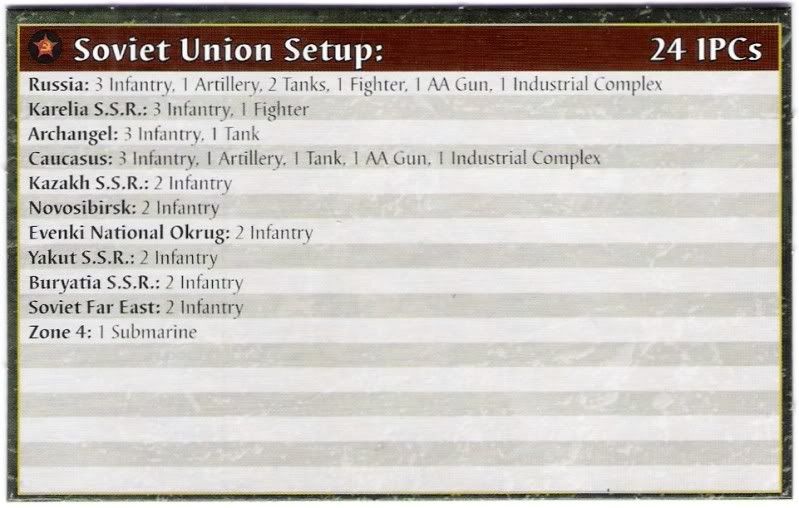
I can imagine a situation where a player might exploit this rule. Say that you have 36 IPC on hand and can only place 8 units, then you could buy 7 infantry and 3 tanks, and await the combat results before deciding which units to place.
Admittedly, this is rather far-fetched and unlikely to occur in practical play.

Posts made by KaLeu
-
RE: AA42 Questions & Answersposted in Axis & Allies Spring 1942 Edition
-
RE: Industrial Complexes?posted in Axis & Allies Spring 1942 Edition
So, I’ll help out a bit in this joint effort on rules clarification!
The units the industrial complex produces, do they get placed ONLY in the same territory as the complex, or do you spot them whatever territory you own? For example: Berlin produces 10 units. Do they then stay in the Berlin territory until the next turn when they have to use their movement points to go where you want them, as in real world logistics or do you just drop them someplace like France where you need reinforcements without having to move them overland? The same for sea borne units.
It depends on the type of unit you’re buying:
1. All land and air units must be placed in the same territory as the industrial complex. So that includes infantry, artillery, tanks, fighters, bombers, and also: antiaircraft guns.
2. All sea units must be placed in a sea zone directly adjacent to the land zone where the industrial complex is. If multiple zones are available, you may choose one at the time of placement.
3. There is one interesting complication about aircraft carriers and fighters. During the non-combat move, you may move fighters into a sea zone, then build a new carrier in that zone (if the zone is adjacent to an industrial complex, of course), and land the fighters on it. Conversely, you may also place newly built planes on a carrier that is already in a sea zone adjacent to your industrial complex. And you may also build the fighters and the carriers together, and place all of them in the adjacent sea zone.
4. You can also buy a new industrial complex, and place it in any territory that you own at the start of your turn.In order to put a Japanese infantry unit on an island I would expect them to be “created” in Japan then have to be placed on a transport next turn to be shipped where needed.
Yes, that’s correct. On the next turn, you can move them onto the transport, then move the transport, and unload them (or keep them aboard if the journey is too long).
The second issue is also logistics based. If you have an industrial complex in territories that the circled numbers total say 15, do you only get 15 units to place on the board that turn even if you could “afford” 20 according to IPC total on the sliding chart? In plain language do the complexes limit the number of units produced vs what you could afford from the treasury? If you could have 35 IPC points in the “bank” at the beginning of the turn and got all inf @ 3 IPC’s each that would be a total of 11 inf units afforded. Your complex total is only 9 so you only get to place 9 units on the board at the end of that turn.
Yes, that’s right. The number of units is indeed limited, and if this becomes a problem because your income is large enough to buy more units than you can place, then you probably need to buy another industrial complex. However, in a typical game you would also be spending money on more expensive units than just infantry, so this is not normally a problem unless you’re doing really well. And, of course, the sweetest way to gain another complex, is to conquer one of your opponent’s!
To make life a little more complicated here: the number of units that can be placed may be limited by strategic bombing raids on the industrial complex. When the complex is damaged by such a raid, it will produce less, or nothing at all, until it is repaired.The rule book is not real clear on the actual purpose and limitations of the industrial complex.
I agree with you there - why this rule exists is not particularly clear to me either. But the game has been carefully balanced by its designers over many years, so I’m sure it was done for a reason related to that. It’s main effect is, probably, to hold back the UK and Japan a bit if either of those nations is doing particularly well.
Have a good time playing the game!
-
RE: Major power commanderposted in World War II History
@221B:
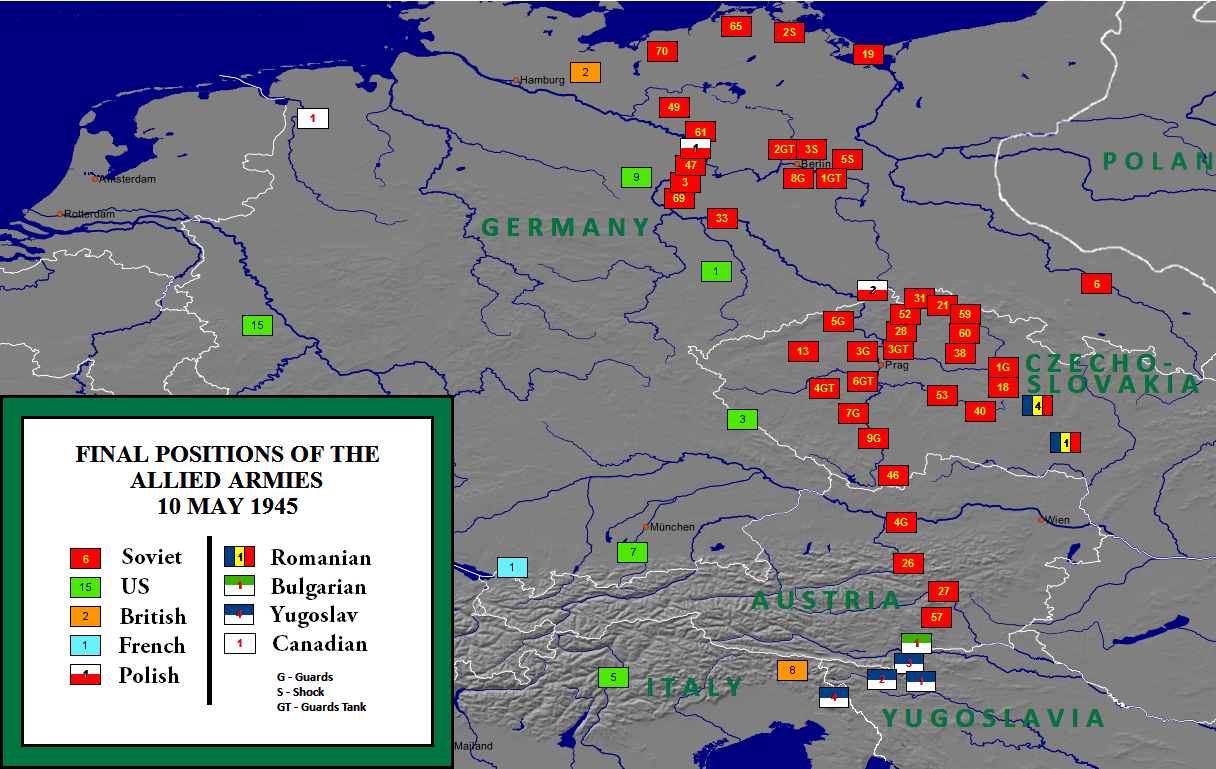
after the titanic struggle with Germany, Russia would/did have a shortage of manpower
Errrrh…. I suppose you haven’t seen this map:
-
RE: J1 latest trend: SZ52 Skippingposted in Axis & Allies Spring 1942 Edition
In response to a US fleet building program aimed at the conquest of the “money islands”, I’m considering that maybe Japan should place its fleet in SZ 49. The US will then, in most cases, need two separate blocking ships to separate its fleet from the Japanese. Also, with so much US money being spent on ships in the Pacific, Germany may be able to afford a bomber in FIC, provided that Japan securely holds that area. The presence of that bomber would make any blocking attempt very risky because the blocking ship may be destroyed on the German turn.
-
RE: Camp that held Rommel's men surrenders its secretsposted in World War II History
I suppose that if you’re a POW, there are worse places to be held than that camp. I wonder if any of these men stayed in Canada after the war, if that option was available.
-
RE: Who's at the top of the box ?posted in Axis & Allies Spring 1942 Edition
I was reminded of this old topic when seeing this picture:

So the pilot shown just above the British flag on the box top, would be James Doolittle.
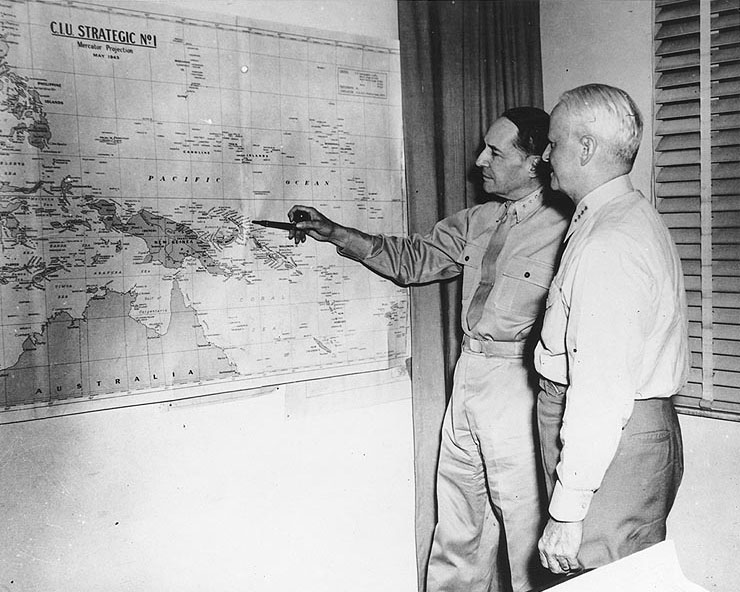
And of course the two people looking at the map are MacArthur and Nimitz, the original photo being:
-
RE: Hans Litten: The man who annoyed Adolf Hitlerposted in World War II History
I saw the film but missed the documentary.
A very brave and principled many indeed. But dying for those principles instead of fleeing the country was not the best choice if you ask me. There was little he could do anymore in Germany as Nazi power grew, and with his expertise and the knowledge gained during the trial, he could have played a role abroad to reveal the truth about the Nazis early on, where during the 1930s, many still saw Hitler as the statesman that Germany needed.
-
RE: The Schlieffen Planposted in World War II History
Well, it’s all here: http://en.wikipedia.org/wiki/Schlieffen_Plan
The main difference is, that in reality the Germans didn’t make their right wing as strong as it should have been according to the original plan. The plan called for a particularly massive German right flank sweeping through the Low Countries and North West France, and reaching as far as the Channel. The center (Alsace-Lorraine) as well as the Eastern front (against the Russians) would be relatively weak. The idea was, to defeat France before Russia could mobilize in force.
So that entire plan is very different from the 1870 Franco-German war, when Germany first defeated an initial French advance into the Rhineland, and then won a series of victories in Northern France. But I don’t think that the plan as originally conceived, would have met with great success. The main flaws in the original Schlieffen plan were, imho:
(a) It banked on a slow Russian mobilization - in reality, the Russians invaded soon, and while they were soundly defeated, their initial advance required an answer of course.
(b) It called for an invasion of the Netherlands, which would not have contributed much to the main purpose of defeating France and would have consumed valuable additional resources to defeat the Dutch.I hold it for possible that a different modification of the plan would have been more successful, however. If the right flank had been reinforced at the cost of Alsace-Lorraine, while still meeting the Russians and invading Belgium only, then the Germans might have reached the Channel ports in time, and it could have been more difficult for the British to land in great numbers. But that’s still pretty tough, considering the available roads and means of transportation.
Anyway, that wouldn’t be the original Schlieffen plan, so the answer that most closely resembles my view on the original plan would have been “Germans get slowed down and get defeated near Paris, while the Russian horde takes East Prussia”. -
RE: Whats the best WWII film ever?posted in General Discussion
@Young:
I’m going to edit the poll, what do you think should replace “Tora Tora Tora” on the list?
Editing the poll at this stage, would be a bad idea. People have already determined their choice based on the options that are offered now, and they can’t change it. So suppose you now replace Tora Tora Tora with a different movie, then there’s no way of telling how many votes that movie would have gotten if it had been in the poll from the beginning.
-
RE: "Two Fer One" questionposted in Axis & Allies Spring 1942 Edition
Suppose your two land units are an infantry and a tank, then you could just load the infantry onto the transport to benefit from the bombardment, and send the tank overland. That still gives you the option of retreating the tank if necessary.
-
RE: Could WWII have been avoided?posted in World War II History
@CWO:
Another thing to wonder about is how relations between Germany and the U.S. in the late 19th century would have been affected if Annie Oakley had indeed shot and killed (albeit accidentally) Kaiser Wilhelm II, and whether this might have even led to a war between the two countries about 25 years before the historical start of WWI.
It’s quite a bit off the original topic of the thread, but I don’t think that Wilhelm II was a decisive influence in bringing about World War I to the same degree that Hitler was in the case of World War II. Overall, I believe that World War I was far from inevitable, and that the existing tensions between the nations of Europe might have been resolved in a more peaceful way.
Thanks for sharing the anecdote about Annie Oakley and the Kaiser. Suppose she had indeed shot him - well, it would have been a major diplomatic disaster of course, and I don’t think Ms Oakley or Buffalo Bill would have left Germany any time soon after the incident. But a war between Germany and the US around 1890 would have been entirely pointless, because neither party would have had a clear strategic objective, and each lacked the possibility to militarily attack the others homeland. Any conflict would probably have been limited to remote possessions (Samoa comes to mind). -
RE: Battleships In Bulkposted in Axis & Allies Spring 1942 Edition
Welcome to the boards!
Focusing on battleships is not the optimal strategy for the US. When you (as Japan) see a US battleship fleet coming your way, you could buy a few aircraft carriers and put some fighters on them. The carriers are cheaper than the battleships and the planes will also be useful for other battles. Besides, Japan already has an initial advantage in capital ships (2 BB + 2 AC vs. 1 BB + 1 AC, and on top of that you’ll sink the US carrier in seazone 52 if you attack there on Japan’s first turn), and starts with plenty of fighters.
On top of that, even if the US manages to defeat Japan’s home fleet, they would also need to buy enough transports and troops to take Japan itself, which can easily be stacked with Japanese forces to defend it.There’s more to it, but there’s no need to change any of the rules to counter this - just change your strategy and you’ll be able to counter this.
-
RE: Could WWII have been avoided?posted in World War II History
Thanks for yet another interesting WW II background story. Without Hitler, would there still have been another World War? We’ll never know, but it seems quite possible.
-
RE: Das Boot!posted in General Discussion
If you liked “Das Boot” you should really watch “Die Brücke” (h t t p://en.wikipedia.org/wiki/Die_Br%C3%BCcke_(film)). Critics say, that it’s one of the hardest, most bitter anti-war films ever shown in cinemas.
Thank you for recommending this. By pure chance, I stumbled upon a broadcast of “Die Brücke” on ARD last night and though the film had already started, saw most of it. Very impressive indeed.
-
In which World War 2 army you should have fought?posted in World War II History
You can find the answer here: http://quizfarm.com/quizzes/new/Puukkoo/in-which-world-war-2-army-you-should-have-fought/
I was mildly shocked at my own result:
You Scored as France, Free French and the Resistance
Your army is the French army. You are prefer to win your enemies by politics than by sheer action, but when the war has started you will fight to the end with those resources you have and believe in freedom and victory in the end.
France, Free French and the Resistance 81%
Germany 81%
British and the Commonwealth 63%
United States 56%
Poland 44%
Soviet Union 44%
Finland 38%
Italy 38%
Japan 19% -
RE: Spitfire plucked from peat bog reveals astonishing story of World War IIposted in World War II History
That’s a remarkable story.
I suppose the British wanted to avoid even the slightest risk of compromising Irish neutrality - so if the Irish put someone in a camp and the British acknowledge their status as a neutral and non-belligerent country, then it follows that they would honor the laws and regulations of that country and return the escapee. But I don’t think they would have followed the same reasoning if Mr Wolfe would have been a British subject.
-
RE: Whats the best WWII film ever?posted in General Discussion
My vote, obviously, went to Das Boot. As for the others in the poll - my next choice would probably be Tora! Tora! Tora!
But as mentioned by many, there are lots and lots of WW II movies. Someone compiled a list on IMDB with nearly 900 of them: http://www.imdb.com/list/RA6D_dhsP-Y/