
Well what the news does is take the very worst thing that happened in the world that day and plaster it all over the place, because that’s what gets ratings. In a nation of over 300 million people, there will be some mentally unstable ones. Combine that with access to deadly weapons, and you have what we saw. IMO it really has nothing to do with what comic books are read or how modern society is. This guy was really intelligent - a doctorate student. Some people are just messed up and things like this will happen. We never heard about all the billions who didn’t get shot last week.

Posts made by Der Kuenstler
-
RE: What it was that made James Holmes go nuts.posted in General Discussion
-
RE: Industrial Complex Questionposted in Axis & Allies Pacific 1940
A clearer wording of the question might be: can I build an industrial complex on my ally’s territory if I am controlling it while his capital is in enemy hands?
-
Industrial Complex Questionposted in Axis & Allies Pacific 1940
The rules say that if you liberate a territory whose capital is in enemy hands, you can gain the income from that territory and use any aa gun or Industrial complex there until your ally regains his capital. But can you build a new IC there if you want? Then it would go to your ally when his capital is restored?
-
RE: Sea battle questionposted in Axis & Allies Pacific 1940
I understand your point. It seems simple, yet the exact wording from the manual, P. 17 says
“Roll for units with the same attack value at the same time. For example, roll all units with an
attack value of “3†at the same time. An attacking unit scores a hit if you roll its attack value or
less. After the attacking player has rolled for all attacking units, the defender chooses one unit
for each hit scored and moves it behind the casualty strip.”This certainly implies to me that the attacker does not roll separately for each type of unit in the column. “Roll for units with the same attack value at the same time.” Subs and DDs have the same attack value. Then it looks to me like the defender then takes the hit total and decides himself which attacker hit and where he wants to assign those hits. Of course he must apply every hit to something if possible. (could be one hit on the fighter from the DD and one hit on the carrier from one of the subs, two hits on the carrier, or one hit on the DD and one hit on the carrier.) See my confusion here? Â :?
-
RE: Sea battle questionposted in Axis & Allies Pacific 1940
@P@nther:
In your example it does not matter. The attacker scored two hits. The defender has to assign two hits. As subs cannot hit planes the defender has to assign the two hits to the carrier/destroyer.
Couldn’t the defender assign one hit to his fighter (from the attacking DD) � and the other to his carrier (from one of the attacking subs)?
-
Sea battle questionposted in Axis & Allies Pacific 1940
Sorry for all the questions but I’m trying re-teach myself these rules the right way. In the rules under General Battle sequence it says: “Roll for units with the same attack value at the same time. For example, roll all units with an attack value of “3†at the same time.”
Say I have two subs and a destroyer attacking - the other side has a destroyer, a carrier, and a fighter, so my subs have to roll along with the DD. If I roll the three dice in the two column at the same time and get two hits, how do I know which hit was from the subs and which was from the DD, since subs can’t hit planes? How does the defender know what he has to remove? Â
-
Victory conditions?posted in Axis & Allies Spring 1942 Edition
The rules say:
“The standard victory condition is if your side controls nine (9) victory cities at the end of a complete round of play (after the completion of the U.S. turn), you win the war.”
I’m not totally clear on this - does this mean you play an entire round once victory conditions are met (i.e. each country gets another turn) or does it mean you just finish the round you are in? (i.e. the UK takes the winning victory city, then Japan and US go, then it’s over) If the second is true, then in the case of the UK taking the winning city, it would be pointless for the US to take their turn, right? Â
-
RE: How to make Axis and Allies more diffucultposted in House Rules
That doesn’t sound like any fun at all. “Hey you guys in the next room -are we winning?” “I don’t know - can’t see your board” “Got any more pretzels over there?” “Yes but we’re out of AA Guns” “Bill has to go to the bathroom - we’ve got to blindfold him” “It’s time to do a battle! Meet me out on the patio at the battleboard”
-
RE: Amphibious Assault Bonusposted in House Rules
In actuality, even with the extensive defensive preparations of the Japanese, the casualties they inflicted upon the Americans were rarely better than 30-50% of their own; often, the Japanese would suffer 10x US casualty rates in these encounters.
Yes, but this was in the face of OVERWHELMING US firepower. For instance, there were 18 US carriers around Okinawa. Not to mention all the BBs, cruisers, and other sea units. If you bring that much firepower you should win easily, even with hit chips. But one battleship and one transport with two infantry on it should not be able to take an island with fanatic Japanese defenders on it without getting hurt badly or repelled.
Your rule will, inevitably, favor one side over the other. The Axis, as an early-game attacker, will be punished by it when they try to equalize their IPCs, and the Allies, as a late-game attacker, will be punished by it when they go in for the final kill. Overall, my feeling is that this will harm the Axis far more than the Allies, by taking the edge off of their attacks in a game wherein they already seem to be systematically disadvantaged (AA40 v.3.9)… This is my main beef with it.
I haven’t extensively gametested this, and am working with an AA 1942 map, but I suspect it will even out or even help the Axis. At the beginning of the game the Axis are generally trying to expand over land anyway - trying to take out Russia and China. Operation Torch would be delayed a couple of rounds. (in the AA '42 setup now the USA can take West Africa rather easily in the first round!) The Atlantic wall would become a real challenge for the Allies. In short, I think Germany and Japan would benefit from it, as they wouldn’t have to “watch their back” so much while concentrating on China and Russia.
As for buying entrenchment, no chips are ever put on the map in my idea. The chips are just put on the battleboard as a consequence of making a pure amphibious assault without land support. They are a penalty to the attacker, not an advantage to the defender that can be bought. The chips are the deep water, the pounding surf, the water soaked equipment, the seasickness, the confusion and the wide open beach. If a landing force is defeated and there are still chips left, the chips just go back in the tray. If the island is attacked again next turn, it resets to five chips again, because the chips represent the attackers ineffectiveness, not the defensers effectiveness.
-
RE: Amphibious Assault Bonusposted in House Rules
It is inherently hard to do an amphibious assault. It should be hard in the game also. In the current rules, it’s not hard at all. In fact it is easier than attacking a land zone because you get to fire with battleships and cruisers that are immune from counter fire. With just a few U.S. battleships and cruisers running loose in the Pacific, it’s as easy taking Japanese islands as dropping your kid off for soccer practice.
Also, for some reason people continually want to add paying extra IPCs for something like this. Why? Why pay extra IPCs to make an island harder to take? It should already be harder to take without paying anything. The attackers are seasick, they are losing their rifles in the surf, landing boats getting caught on coral reefs, and pinned down on wide open beaches with no cover. The hit chips accurately represent this opening stage of confusion and bedlam for the attackers.
-
RE: Hidden Sub Roleposted in House Rules
Interesting idea but it seems to me like it would take a lot of bookkeeping.
-
RE: Amphibious Assault Bonusposted in House Rules
@SS:
In are games, all infrantry defend at 3 on any island. Thats strong enough for us. Put more infrantry on islands if you want to hold them longer.
The solution to me is not to make the defenders shoot better. They already shoot better by defending at 2. The issue in an amphibious assault is that the attacker shoots worse. Men are seasick, jumping off Higgins Boats into excessively deep water, getting hung up on coral reefs, getting pinned down on wide open beaches, etc. But you can’t attack at less than 1. The solution is to make the attacker ineffective in the opening round(s) until the beach begins to be secured. To me this is modeled well by using the hit chips.
“put more infantry on islands” is easier said than done with the US navy prowling around. Japan had to make do with what men they had by tunneling and entrenching.
-
Amphibious Assault Bonusposted in House Rules
I believe one big problem with Axis and Allies is the Amphibious Assault. Battlehips and cruisers are able to fire a one-shot support attack before troops land, which actually makes it EASIER to do an AA than it does to do a conventional land attack. How many times have we seen the lone Japanese soldier on Okinawa simply blown aside by naval fire and 2 US infantry land like it was all a breeze. Historically amphibious attacks were much more difficult to do. They required tons of extra equipment and special planning.
A simple solution is to give units defending against a pure amphibious attack (not combined with any land attack) a defensive bonus. Set a section up on the defense side of the battleboard that looks something like this:
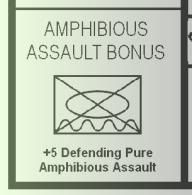
Stack up five chips in this square when facing a pure amphibious assault. These chips do not fire, but they will will soak up hits from the attackers and represent the difficulty in wading to shore under confusion and duress. Only after the five chips are gone does the defender start taking regular casualties. The defender gets no bonus if the assault is combined with a land attack.
Under a game test I first attacked the lone Japanese defender on Okinawa with a large US force and had zero losses. With the bonus, however, the US still took the island, but it cost them an infantry and a fighter. Much more realistic, IMHO.
-
RE: Amphib landing against subposted in Axis & Allies Global 1940
With nothing to attack with, your units would have to retreat.
-
RE: Some basic questions.posted in Axis & Allies Revised Edition
Also, if i were to buy an A&A, which would most suggest. I want a more complex, but still lots of fun one. Im thinking 42.
If I was you I would wait until the end of the month and buy the new AA 1942 revised game that is coming out. Then you’ll be right up to date. The other questions I’ll have to leave to someone who knows your edition better, but this site also has a very good search feature.
-
The Indestructible Neutral Colored Units: Why??posted in House Rules
Why is it so important that ICs not be destroyed? Or AA Guns for that matter.
Why can’t you tear down your own factory? :? The Russians did and moved them East while the Germans were threatening them. And an AA Gun - your telling me a soldier can’t stick some dynamite down the barrel and blow it up? What are these things made of, some rare grey/white alloy from space can’t be hurt?
We use a house rule where you can remove any IC or AA Gun during non-combat movement that you have controlled since the beginning of your turn. You can also remove an IC if bombing damage was done to it that you don’t want to pay for. Simple and logical.
Some might say ICs represent many different buildings. OK - so do the other plastic pieces. This rule goes so against common logic and the general principles of unit interaction in the game I don’t see how it can continue long in future editions. I saw in Alpha 3 rules that at least AA Guns will be destructible.