
To follow up on a post I added to a different thread yesterday, here’s something I put together last evening: a home-made war rake, also known as a croupier stick. It’s made from a 12" x 3/8" wooden dowel (the arts and crafts section of my local dollar store sells them at $1.25 for a pack of six), a coffee stir stick sawn in half, and a drop of white glue. Unit cost: about 20 cents; assembly time: about five minutes (not counting the time it took for the glue to dry). The edge produced by the saw cut wasn’t completely smooth, so I used a nail file as improvised sandpaper to touch it up. To produce a good bond, I used two heavy books to press the components together while the glue was drying, since the glue company’s recommended practice of “clamping” is a bit difficult for an object that’s a foot long and less than half an inch wide. The end of the rake can be used either vertically to move individual sculpts, or horizontally to move massed formations of units. One pack of dowels and three stir sticks will produce six war rakes, which will serve the basic needs of a six-player game of Global 1940; two packs and six stir sticks will produce rakes for all nine Global player nations (with three spares which could be used for neutrals and for house-ruled additional player nations). An added refinement would be to paint the sticks in the appropriate national sculpt colours, if a deluxe version of the rakes is desired. 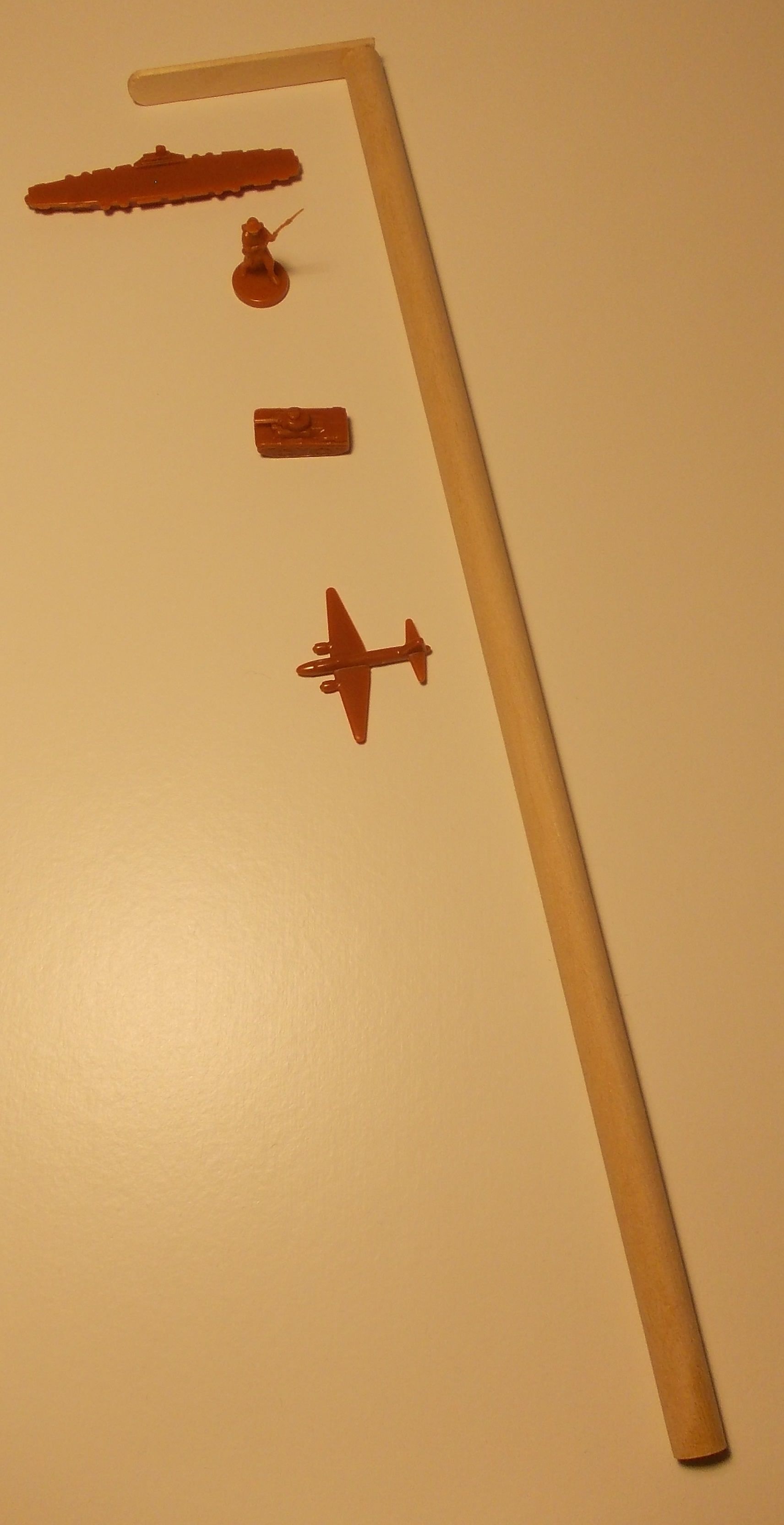
Posts made by CWO Marc
-
Home-Made War Rakesposted in Customizations
-
RE: Flags and Army Moversposted in Customizations
I like the concept of putting national leader office title cards on the component boxes; I don’t think I’ve ever seen that particular idea used anywhere else. “Army movers” are also known as “croupier sticks” in the casino industry and in A&A circles as “war rakes” (a much cooler term than croupier stick). Yours seems to be made of bamboo skewers (I have some at home), and one potential upgrade you might consider giving them is to use short sections of wooden popsickle sticks (sawn into thirds or quarters) to put a horizontal scoop at the end of each skewer base.
-
RE: 1914 Battle Reportposted in Axis & Allies 1914
@DoManMacgee said in 1914 Battle Report:
Whoops! Totally didn’t realize that it was you @CWO-Marc and not the OP. If France was as lackadaisical in WW1 as they were in WW2’s opening months, the Central Powers would have had it easy.
No problem about the mistaken identity, and good point about the contrast between the WWI and WWII performance of France early in each war. I’m not sure if this is widely known, but France briefly invaded the Saar region of Germany in early September 1940 – taking advantage of the fact that most of the Wehrmacht was in Poland at the time – then withdrew after Poland fell. All that France got out it was some useful propaganda footage. I once saw a British newsreel whose narrator was enthusiastically describing the scenes filmed on German soil, at one point commenting “Here is a captured German railway station!” Quite a change from what General Foch is reputed to have communicated to his superiors during the Battle of the Marne in 1914, as I recall, it was: “My left flank is driven in; my right flank is giving way; the situation is excellent – I attack!”
-
RE: 1914 Battle Reportposted in Axis & Allies 1914
@DoManMacgee said in 1914 Battle Report:
Thoughts below:
- France was entirely too passive. They need to be more aggressive with Germany to keep them out of France’s IPCs
For a moment, before I saw the context of the post, I thought this was a historical reference to France in the September 1939 - June 1940 period, rather than a gaming post about A&A WWI 1914. :) I’ve been watching a DVD of the two Battlefield series episodes on the Battle of France, so at the moment this subject tends to catch my attention.
-
RE: Is This Alleged D-Day Footage Authentic?posted in World War II History
Another detail that could be checked by someone who has expertise in landing craft design (I don’t know the subject well enough) would be to see if the craft used in the footage are of the correct vintage. It’s been noted that the landing craft used in the early-1960s D-Day movie The Longest Day are the models which the US Navy was using at the time the movie was made, not the ones which were used in WWII.
-
RE: You May Be A WWII Junkieposted in World War II History
@Caesar-Seriona said in You May Be A WWII Junkie:
If you actually know what the War of 1941 is.
And if you know that there were two of them: the Russian one and the American one.
Also, if you know in which country you can (supposedly) find a few small commemorative monuments to the war of “1939-1940”.
-
RE: I am a new player and have a few questions from my first game.posted in Axis & Allies Anniversary Edition
@Gary-Mark-Scott-Cooper said in I am a new player and have a few questions from my first game.:
- The people i was playing with had problems identifying some of the types of ships. Is there a quick way to identify them or a reference document that can help me out?
This thread…
https://www.axisandallies.org/forums/topic/21626/a-a-unit-identification-charts
…provides unit identification charts. The charts can be clicked to expand them to full size for easy viewing, and you can also print them out for consultation during a game; I keep mine in a ring binder.
To identify ships at a glance, I’d recommend this approach, which partially works by process of elimination:
The easiest ships to identify are the aircraft carriers (they have flat decks), the submarines (which are very slender, with some of them looking almost like toothpicks), and the naval transports (most of which have two or three prominent masts). That eliminates half the ship types right away.
The three remaining types are the surface-combat vessels: the battleships, the cruisers and the destroyers. The destroyers are the easier group to pick out: they’re the smallest, and many have square sterns (the rear part of the ship) rather than pointed or rounded sterns, which is a useful detail to look for. This leaves just the battleships and cruisers, which are the hardest to distinguish at a glace – not surprisingly, because of all the ship types in the game, the battleships and cruisers are conceptually the most similar ones (as they were in real life) – so those are the ones you may have to memorize or look up in the charts. The battleships are a bit larger, which is fine if you see one alongside a cruiser, but some of the battleships or cruisers by themselves can be a little hard to identify, even to sculpt enthusiasts (and naval history buffs) like me. Fortunately, some of them have very distinctive designs; the Russian Gangut-class battleship (with its freakish funnel structure) and the Japanese Yamato-class battleships (with its highly pointed stern) are impossible to mistake for any other unit.
-
RE: Larry Harris' website had been shut down - and is back again!posted in News
Many thanks to Krieghund for posting the list here yesterday:
https://www.axisandallies.org/forums/topic/33671/list-of-sculpts
-
RE: How to tell Classic first from secondposted in Axis & Allies Classic
The cruiser and generic AAA units in the first printing of Guadalcanal similarly got colour-switched. It made no difference for the AAA sculpts, since they were a generic common design, but in the case of the other unit the game had a Japanese-orange American-design Portland-class cruiser and an American-green Japanese-design Takao-class cruiser.
It’s too bad that the colour-switched green German and grey American infantry units are rare production errors, and thus aren’t widely available: they would be perfect for use in A&A Battle of the Bulge as house-ruled special units representing Otto Skorzeny’s disguised infiltration units.
-
RE: Happy 4th of July Americaposted in General Discussion
As a trivia note, Roland Emmerich’s 1996 alien-invasion blockbuster was officially titled Independence Day but is also known (and I think was marketed) as ID4, so there’s an element of the 4th of July designation in the marketing tagline.
In an odd coincidence, by the way: on the July 1st long weekend for Canada Day, I was watching an old British movie on DVD which happened to contain an unexpected (and slightly humourous) reference to the American Revolution. The film was the 1959 murder mystery Jack the Ripper, and there’s a scene where Inspector O’Neill from Scotland Yard, accompanied by a U.S. police detective (Mr. Lowry, a long-time friend of O’Neill), is speaking with Dr. Tranter, one of the many suspects in the case. Tranter is a stiff and pompous aristocrat, and when he hears Lowry’s accent he asks O’Neill if Scotland Yard has started recruiting “colonials.” O’Neill politely answers that Mr. Lowry is an American. “I fail to see the difference,” says Tranter frostily. Lowry, unruffled, cheerfully points out that, “We had a war a while back, remember?” “A revolution, Mr. Lowry, not a war,” retorts Tranter. As a kind of joke-within-a-joke, the actor playing Lowry wasn’t actually an American but rather an expatriate Canadian actor living in Britain, so he was marginally closer to being a “colonial”, even though the movie is set in 1888, more than a decade after the BNA Act moved Canada in the direction of autonomy (though not all the way).
-
RE: Reprint coming?posted in Axis & Allies: Battle of the Bulge
I don’t have any information on potential Bulge or Guadalcanal reprints, but I just want to note that D-Day has been reprinted many times over the years – so if it received a new reprint this month, this doesn’t necessarily signify anything (one way or the other) about potential reprints of the other two games.
-
RE: Rail Movementposted in House Rules
I’m not sure I understand your post correctly, and I don’t grasp what you mean by “rebase” (I’ve never heard the term), but here are a couple of thoughts:
-
When nations want to send airplanes or ships – by which I mean fully assembled and operational airplanes and ships – from one place to another, they don’t usually do so by rail. The airplanes travel from Point A to Point by air (by flying there on their own), and the ships travel from Point X to Point Y by sea (by steaming there on their own).
-
That being said, unassembled airplane and ship components do sometimes travel by other means (such as by rail and by ship), but that’s not the same thing as sending a combat-ready plane or ship from one hot spot to another.
-
Land equipment certainly does travel by rail (and by ship and by plane in various circumstances), and this includes transporting land vehicles. Tanks can’t travel far on their own without running into maintenance problems, and can’t travel very fast (especially cross-country), so rail is the method of choice for moving tanks overland quickly and for great distances.
-
I don’t know specifically where you could find actual WWII numbers, but basically what you’re talking about is railway shipping capacity, which a function of two things: how much track a country has and how much rolling stock (locomotives and freight cars) a country has. Railway enthiusiasts (I’m not one of them) might know off the top of their heads where such figures can be found.
-
-
RE: Blast From The Pastposted in World War II History
As a follow-up to the original post, by the way, it’s not surprising that the bomb went off spontaneously (which is what the news story seems to indicate). Explosives can become unstable over time, which is one reason why certain types of souvenirs sometimes kept by veterans are potentially dangerous. I read a news story a few years ago about a woman who was going through the personal possessions of her father (a WWII vet) after he passed away, and who found an unexploded hand grenade in one of his desk drawers. She very sensibly called the police.
-
RE: Blast From The Pastposted in World War II History
@barnee said in Blast From The Past:
Wouldn’t surprise me if France had a few WWI leftovers.
It certainly does, and they’re still finding the stuff. Every year, when farmers along the old Western Front are plowing their fields at planting season, it’s commonplace for unexploded WWI shells to turn up. Farmers jokingly refer to them as “navets” (beets), and they know the procedure for contacting the Army so that an EOD unit can be sent to deal with it.
-
Blast From The Pastposted in World War II History
Unexploded WWII bomb suddenly detonates in German field
There are still thousands of unexploded bombs in Germany from the Second World War and new pictures show what happens when one goes off.
-
100th Anniversary of Scapa Flow Scuttlingposted in General Discussion
One hundred years ago today, the German High Seas Fleet, which was interned at Scapa Flow, scuttled itself, sending 52 of the 74 ships to the bottom. Peace talks to formally end WWI (which technically was still in progress, since the armistice of November 11, 1918, was a cease-fire rather than a surrender) were dragging on, and the interned German sailors were worried that their ships were going to be seized outright, so it was ultimately decided to sink them in a final gesture of defiance to keep them out of enemy hands.
-
RE: Larry Harris' website had been shut down - and is back again!posted in News
@Krieghund said in Larry Harris' website has been shut down:
I’m going to repost the sculpts list here and try to find homes for any FAQs for OOP games that don’t already have them as soon as I get a chance.
Thanks, that will be useful. I have a copy on file of your sculpt list postings, and they can still be found on the archived version of Larry’s site, but having those lists posted here too would be great. As a supplement to those lists – which use the rulebook designations of the equipment, and which indicate as applicable which sculpts are used in which versions of the games – here’s a link to the ID charts I compiled, which provide a bit of additional information on the models/classes of the WWII equipment on which the sculpts are based. The charts expand to full size when clicked, for easier viewing.
https://www.axisandallies.org/forums/topic/21626/a-a-unit-identification-charts
-
RE: Larry Harris' website had been shut down - and is back again!posted in News
It’s too bad that Larry’s site has expired: the General Discussion thread “Anyone with info on sculpts?”, in which Krieghund provided sculpt identification information, was one of the reference sources I used when I was compiling my sculpt identification charts. On the brighter side, Krieghund is still with us over here at A&A.org, which is a good thing.
-
RE: On this day during W.W. 2posted in World War II History
@SS-GEN said in On this day during W.W. 2:
It’s funny how a missile was made to look like a plane. Needed the wings for guidance.
Just think if they had that weapon at start of war in 39. Who knows with that they would of had the jump on allies maybe for a couple of years. But that’s a but and the allies may have countered it early too just like they did in 44 45.The reason V1 had wings (in contrast with the finned V2) wasn’t really a matter of guidance, it was a matter of how much energy it takes to move a mass of x kilograms over a distance of y kilometers (in this case, from France to London) at a speed of z kilometers per hour. The purpose of the V1’s wings, like those of a conventional aircraft, was to provide lift and thus give the V1 the ability to fly in a conventional manner on a more or less horizontal flight path. The V1, which weighed two tons, could get from point A to point B at 640 kph, on a relatively modest amount of fuel. The V2, by contrast, weighed six times more and travelled nine times faster; it followed a ballistic trajectory rather than a horizontal flight path, which is why it didn’t need wings. The trade-off, however, was a ballistic missile requires much greater thrust than an aircraft, which in turn requires larger quantities of more energetic fuel. Also note that rockets like the V2 need to carry their own fuel oxidizer, whereas air-breathing jet aircraft like the V1 don’t, which is another reason why jets can sustain themselves in flight on a relatively modest fuel load.
The question of whether the V1 and the V2 could have altered the outcome of WWII if they’d been developed, let’s say, about five years earlier is an interesting one; my impression is that, in and of themselves, they would not have done so, even if they’d been deployed in much larger quantities. The V1 and V2 were basically an expensive and inefficient alternate way (in terms of their bang-for-the-buck ratio) of bombing a city with low precision, so in that respect Germany would have been better off developing a proper heavy bomber design and a proper long-range escort fighter and producing both in large quantities. The only unquestioned advantage which the V2 had over any conventional bomber, or the V2, was that it was impossible for the defenders to intercept it once it was launched. Which brings me back to the “in and of themselves” point I mentioned earlier: the V2 by itself was not a weapon which could have changed the outcome of WWII, but if it had been equiped with an atomic warhead it would have been a serious strategic threat to the Allies. But even here, we have to be careful about jumping to conclusions. First, the German atomic program was years behind that of the US – and even the US, which devoted huge resources to the Manhattan Project, only produced (and detonated) three bombs (one was a test device) by the summer of 1945 (by which time Germany had already surrendered). So even if we were to assume (and it’s a big assumption) that Germany could have matched the Manhattan Project, and even done better by assembling its bombs a year earlier than the Americans did, the question becomes: would the Allies have surrendered if, let’s say, London and Moscow had each been nuked in mid-1944 by a V2 with a kiloton-level atomic warhead? The Russians, who’d already lost tens of millions of people and who’d seen huge areas of their countries devastated by conventional warfare, would certainly have kept going, and would probably have been even more determined than before to take their revenge against Nazi Germany. The Americans would also have kept going, with an even greater conviction than before that Nazi Germany was enormously dangerous and had to be stopped by any means possible. And my guess is that even the British would have kept going: they would have known from their intelligence sources that Germany had used up its tiny supply of warheads and they would have known that by that date the momentum of the war was on the Allied side. Furthermore, it’s hard to imagine what the practical details of a British surrender would have looked like in mid-1944, given that up until D-Day Britain was basically the operational base of a gigantic American army which, presumably, would not have meekly gone back home if Churchill – in a completely out-of-character move – would have told Eisenhower, “Thanks, but we don’t need you anymore.”
-
RE: Is This Alleged D-Day Footage Authentic?posted in World War II History
@aequitas-et-veritas said in Is This Alleged D-Day Footage Authentic?:
@CWO-Marc the impression i have is, that it might be the last Training before the actual D-day.
Because the date says 05 of June.If the footage (which I haven’t looked at) says that this is a training maneuver conducted on June 5 in preparation for the D-Day invasion, then the information isn’t accurate for a couple of reasons. First, the troops didn’t conduct intensive training exercises right up to the last day; the days prior to the invasion (I think it was a period of about one week) were devoted to moving the troops from the camps where they had been living to the assembly areas for the invasion, loading them aboard their transports, and giving the “sealed” troops (no disembarkation allowed) their final briefings, including (in some cases) restricted information about the identity of the actual targets they would be assaulting. (A typical reaction from the troops was: “Ah, now I see what they were training us for. Those cliffs (or whatever) in Normandy look exactly like the ones in England on which we practiced.”) Second, it’s impossible for major training exercises (like an amphibious landing) to have been scheduled for June 5th because June 5th was the date on which the actual invasion was supposed to take place; it was delayed until June 6th at the last minute – some of the ships had already left for Normandy, and had to be recalled – because of unexpected bad weather.