Axis & Allies .org Forums
    • Home
    • Categories
    • Recent
    • Popular
    • Users
    • Register
    • Login
    1. Home
    2. CWO Marc
    3. Best
    C
    • Profile
    • Following 0
    • Followers 3
    • Topics 129
    • Posts 5,700
    • Best 194
    • Controversial 0
    • Groups 13

    Best posts made by CWO Marc

    • RE: Cruiser Idea

      By the way, here’s one possible way to consider cruisers for gaming purposes.  If I were to look at the six naval unit types used in A&A, but without looking at any of their rulebook specifications – in other words, if I were to consider them purely from a WWII historical perspective – the way I’d regard them would be as follows.

      The first distinction I’d make would be between the surface combatants (battleships, cruisers and destroyers) and the other types: aircraft carriers (which are surface ships, but whose mission is to deploy units that fight in the air), submarines (whose primary characteristic is their ability to operate underwater) and naval transport ships (which are not combatants).

      The next distinction I’d make between the three surface combatants would be to split off the destroyers from the battleships and the cruisers.  Destroyers were considered “maids of all work” more than surface-combat vessels, and unlike battleships and cruisers they were never intended to get into artilllery slugging matches with other vessels…which is just as well because they had zero armour, hence their nickname “tin cans.”  Their jobs were to escort bigger warships and/or merchant convoys, to hunt submarines, to serve as the outer ring of a fleet’s concentric defensive formation, to torpedo enemy ships if the opportunity arose, to engage in close-range shore-bombardment (of a very modest type, due to their very modest 5-inch guns), to put up a bit of AAA fire, and to carry out all sorts of odd jobs that might be needed.  They were produced in vast numbers (especially by the US), and in some respects could be regarded as the naval equivalent of a fighter plane or a fighter-bomber: fast, agile, and able to be deployed in great numbers in all sorts of roles.

      That leaves battleships and cruisers, which by the era of WWII (when fast batteships had become the norm) were very similar in their roles.  Both were regarded primarily as fast, seagoing, long-range, armour-protected platforms for heavy guns, originally intended (and sometimes used) for ship-to-ship combat but in practice greatly used in a shore-bombardment role to support amphibious landings.  Their large size allowed them to carry a large – and in some cases enormous – number of anti-aircraft weapons (.50 machine guns, 20mm and 40mm autocanmons, and 5-in dual-purpose anti-surface/anti-air guns), so they were extremely valuable as escort vessels for aircraft carriers, around which they would project a formidable barrage of AAA fire when enemy planes attacked.  I’d argue that, when the chips are down, WWII cruisers were fundamentally similar to battleships, their main disadvantage being that they were less capable and their main advantage being that they were cheaper and therefore could be produced in larger numbers.  The big American, British and Japanese navies had a number of modern battleships, a larger number of modern heavy cruisers, and an even larger number of modern light cruisers.  So did the other navies, but with the difference that in some cases the cruisers were all they were able to afford (or finish building before war’s end) in any significant numbers, if any at all.  Germany was probably the worst off, with very few modern battleships OR modern cruisers completed in time for war service.

      So in game terms, I’d say that realistically:

      • battleships and cruisers should have the same types of capabilities

      • battleships should have capabilities high enough (their advantage) to offset their high cost (their disadvantage)

      • cruisers should have a cost low enough (their advantage) to offset their lower capabilities (their disadvantage)
      posted in House Rules
      C
      CWO Marc
    • RE: Chicago vs Graf Spee

      This is a tough one to call.  Graf Spee had bigger main guns (hence longer firing range and greater hitting power per shell) but fewer of them than Chicago (6 x 11-inch versus 9 x 8-inch), so she could deliver few shells per salvo.  She could also fire fewer salvos per minute, since the speed at which a gun can be loaded is inversely proportional to its caliber.  Their main belt armour was almost identical in thickness, and Chicago’s deck armour was over an inch thicker than Graf Spee’s because it included a second layer.  Chicago was faster by almost 4 knots, so she could choose the range of the engagement; conversely, Graf Spee was designed for this type of engagement, being (in principle) more powerful than anything faster and faster than anything more powerful.  I don’t know how their fire-control systems compared, but in WWII, in very general terms, German heavy warships had superior optics (stereoscopic rangefinders) while American heavy warships had superior radar and superior electromechanical fire-control analog computers.  So it looks like a pretty even match-up.  If I were the American skipper, I’d use my superior speed to keep myself around the outer limit of the range of my 8-inch guns, in order to deliver plunging fire against Graf Spee’s very thin deck armour, and hope that my greater output of shells per minute would give me more chances of scoring hits in a given amount of time than the Graf Spee.  One consequence of this range choice would be that the Graf Spee’s 11-inch shells at that range would have a flatter trajectory than the Chicago’s 8-inch shells, hence would produce horizontal or oblique hits on the Chicago rather than plunging hits; it’s hard to say if this would make any notable difference, since Chicago’s monolithic belt armour and layered deck armour added up to about the same thickness.

      posted in World War II History
      C
      CWO Marc
    • RE: Fun Awards suggetions plz

      @taamvan said in Fun Awards suggetions plz:

      You could make a “traveling trophy” (we used a participation medal I won in a 5K) that stays with the winner of the most recent game and must, like a wrestling belt, be defended or forfeit upon each new contest.

      Good idea. In the context of A&A, one ida for a suitable trophy would be a field marshall’s baton. Rommell had two of them: the large, heavy and gaudy official one which was presented to him when he was promoted, and smaller, lighter, more practical “informal” one which he carried around when he was traveling on business. I think Cornelius Ryan’s book The Longest Day mentions Rommell using the informal baton to point to things on the coastline of France on one occasion when he was inspecting beach defenses.

      posted in General Discussion
      C
      CWO Marc
    • RE: Introduce or Re-Introduce Yourself (Jan. 2019)

      @AdmScuttlebutt said in Introduce or Re-Introduce Yourself (Jan. 2019):

      Attention on deck mates! Just wanted to check in. It’s been a month since joining this thread and I am supplied up and ready to go on cruise. I have purchased A&A Europe 1940 2nd ed and Pacific. As well as A&A 1914. I added Leaders from HSMG and some Facist Italian roundels. I am learning how to play from Young Grasshopper, General Hand Grenade, and Jonathon Meyer. Ready to try some of the 1914 strategies using my own live dice rolls! Let you know how it goes next month. AdmlScuttlebutt out! Fair winds and following seas to each of you! And thanks for the helping hand mates.

      It’s always good to see a fellow naval enthusiast joining the forum. Welcome aboard!

      posted in Welcome
      C
      CWO Marc
    • RE: A&A Unit Identification Charts

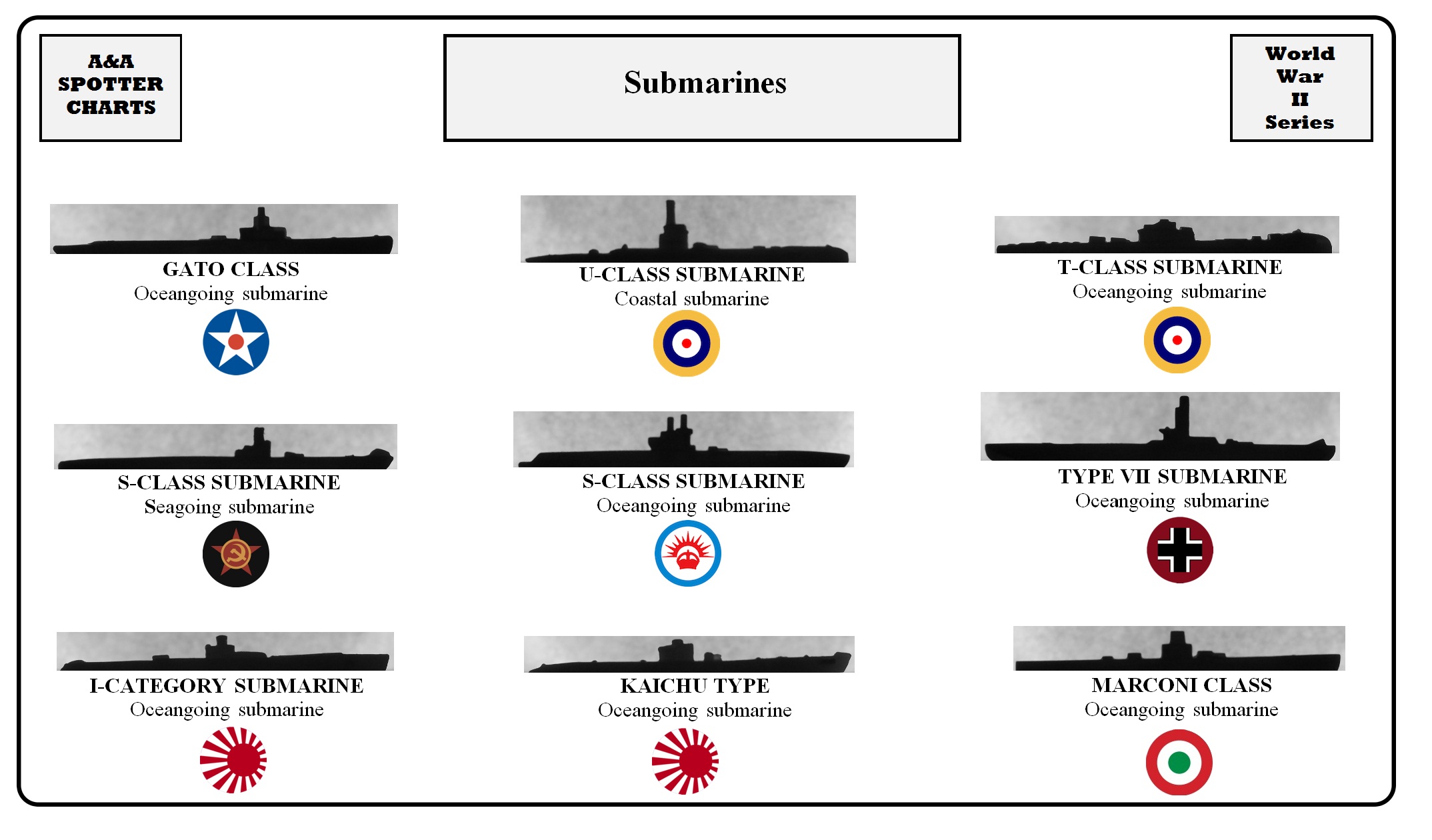
      The next two charts are the submarine and transport ship charts.

      WW2-Sea-Submarines.jpg
      WW2-Sea-Transport Ships.jpg

      posted in Customizations
      C
      CWO Marc
    • RE: How Can We Incentivize the US to Split its Effort Between Atlantic and Pacific?

      @Argothair:

      Here’s an idea inspired by some of your thoughts: You win the game if and only if your team controls 2+ out of 3 “target cities” in both theaters simultaneously.

      Allied Atlantic Target Cities are Paris, Rome, and Warsaw.
      Allied Pacific Target Cities are Manila, Shanghai, and Singapore.

      Axis Atlantic Target Cities are Cairo, Leningrad, and Stalingrad.
      Axis Pacific Target Cities are Honolulu, Sydney, and Calcutta.

      Here’s a (still only rough) concept for a variation on your idea.  It’s aimed at accomplishing both of the goals that have been mentioned: on the one hand, encouraging the US and the UK to fight a multi-front global war, while on the other hand encouraging the European Axis powers of Germany and Italy to concentrate on their half of the map board and encouraging Japan to concentrate on its half of the map board.  A lot of details are missing, so I can’t tell yet if it would actually work, but I’ll float the idea for whatever it’s worth.

      First the background. If you look at a historical map of Axis territorial holdings in mid-1942 (the high point of the Axis conquests), you’ll see that the Axis powers, the Anglo-American / Commonwealth powers, and the Soviet Union were basically in three different geographic situations.

      Germany and Italy in the European / Mediterranean region more or less held a single, large, contiguous block of territory running vertically from Norway to North Africa and horizontally from France to the western Soviet Union.  Japan, similarly, held a single, large, contiguous block of territory (most of it ocean), with Manchuria in the north-west, the Dutch East Indies in the south-west, the western Aleutians in the north-east and the Gilberts in the south-east.  Both the European Axis powers and Japan were therefore controlling a territory that had a single large perimeter, and they were fighting a multi-front war at various points along that perimeter; to oversimplify, they were each fighting on a circular front.

      The US, the UK and the Commonwealth Dominions of Canada, South Africa, Australia and New Zealand, unlike the territorially concentrated Axis powers, were quite literally scattered over the map.  Some of their territories were contiguous, but others (because of the presence of oceans and neutrals) were not contiguous; overall, their locations on the world map were characterized by dispersion rather than concentration.  One important advantage of this dispersion was that they could reach (and thus reinforce) one another, whereas the two Axis blocks were more or less isolated from each other.  While the Axis powers could visualize themselves as fighting to push outward to expand their respective blocks of territories, the Anglo-American / Commonwealth powers could visualize themselves as being outside those Axis blocks and fighting on multiple fronts to force those blocks inward.

      The USSR, like the Axis powers, was defending a single block of contiguous territory, but unlike both the Axis powers and the Anglo-American / Commonwealth powers it spent most of WWII fighting a war on a single linear front rather than a single circular front (like Germany/Italy and Japan respectively) or on two circular fronts (like the US and the UK).  The potential existed for the USSR to end up fighting a two-front war if Japan had invaded the eastern USSR, but that didn’t end up happening in real life.

      As previously mentioned in this thread, in A&A the US tends to concentrate all its forces in one theatre or another (which is dull) and Japan tends to join Germany in a drive on Moscow (which is unrealistic) because the existing victory conditions encourage it.  Argothair proposed solving the problem by requiring the Axis and the Allies to capture certain specific victory cities in both theatres in order to win.  I’m thinking that it might be useful to refine this model by introducing the following distinctions:

      The Allies (as a group) would have to control a certain number of VCs on the Europe map and a certain number of VCs on the Pacific map in order to win, but they would not be required to control any specific cities (which is a departure from Argothair’s model).  In that sense, every VC on the Global map would be a potential target for any Allied power; it wouldn’t matter which one of the six Allied powers controlled such-and-such a city, though of course there are built-in limitations to what France and China can do in that regard.

      The Axis, likewise, would have to control a certain number of VCs on the Europe map and a certain number of VCs on the Pacific map in order to win, and would not be required to control any specific cities.  In this respect, they’d be just like the Allies.  The difference would be that all the VCs on the Europe map would be designated as VCs for the European Axis powers alone (or alternately designated as primary VCs for the European Axis powers and secondary ones for Japan), and all the VCs on the Pacific map would be designated as VCs for Japan alone (or alternately designated as primary VCs for Japan and secondary ones for the European Axis powers).

      Applying this is practice wouldn’t simply be matter of saying that, for example, Japan is prohibited from capturing Moscow, because that would just be another way of saying (in this particular case) that Japan can’t break the NAP with the USSR.  Rather than saying that Japan is prohibited from capturing VCs on the Europe board and that Germany and Italy are prohibited from capturing VCs on the Pacific board, it might be better to make it more advantageous for Germany and Italy to capture VCs on the Europe board and more advantageous for Japan to capture VCs on the Pacific board.  One possibility would be for VCs to have differentiated values depending on who captures them, wich is what I meant by primary and secondary VCs.

      Just for illustrative purposes (these aren’t meant to be real numbers), let’s say that in order to win the Axis has to control 6 points’ worth of VCs on the Europe side plus control 6 points’ worth of VCs on the Pacific side.  A Europe VC controlled by Germany or Italy would be worth 2 points.  A Pacific VC controlled by Japan would be worth 2 points.  A Europe VC controlled by Japan would be worth 1 point.  A Pacific VC controlled by Germany or Italy would be worth 1 point.  Under those conditions, it would be (for example) of greater advantage for the Axis side for Japan to go after Pacifc VCs than after Moscow.

      There are probably other ways to achieve this kind of differentiation, but at the moment the above is the only one that came to mind, so I wanted to put it out for potential consideration.

      posted in House Rules
      C
      CWO Marc
    • RE: Chicago vs Graf Spee

      @wittmann:

      The Graf Spee might also be disadvantaged by having such a humanitarian man as commander too.  I do need to wiki the US Cruiser(as usual!). I presume it is a late war Cruiser.

      There was a 1931 USS Chicago and a 1945 one; I did my analysis based on the 1931 version, which was sunk in 1943, since it’s the one Graf Spee (sunk in 1939) would have fought.

      Langsdorff was indeed scrupulous about not causing any fatalities when he was operating against merchantmen during his cruise but – quite correctly for a naval officer – he had no reservations about putting up a strong fight when he encountered Harwood’s cruisers because engaging enemy warships wasn’t the same thing as raiding cargo vessels.  The (Australian!) actor who plays Langsdorff in the movie The Battle of the River Plate says early in the film that “I don’t like waging war on civilians”, which was a distinction that, to his credit, a by-the-book captain like him could still make at that point of the war.  Not all Kriegsmarine skippers were equally chivalrous, as the passengers of the Athenia found out as early in the war as September 3, 1939.

      posted in World War II History
      C
      CWO Marc
    • RE: WWII movies

      An additional source would be to go in the opposite direction from new movies: by looking for WWII films (dramas, documentaries, propaganda films, newsreels) which were actually produced during the war. A lot of this stuff is now in public domain; some of it can be found for free on sites like YouTube, or purchased on DVD at a low cost. There are companies like Mill Creek Entertainment which sell multi-disc (24, 50, 100 disc) packages which add up to dozens of hours of viewing time; a good one from Mill Creek is the 24-disc pack America: Stories of War, which covers several wars (including WWII and Korea). Many of these WWII films are shorts, so they’d fit nicely into the A&A time intervals in between an individual player’s game turns, and some of them are in colour. Three examples of the kind of movie I’m talking about are: The Fighting Lady (1944), The Memphis Belle: A Story of a Flying Fortress (1944), and With the Marines at Tarawa (1944); I especially like The Fighting Lady, which is about carrier warfare and which will appeal both to the naval and aviation enthusiasts in your group.

      posted in General Discussion
      C
      CWO Marc
    • RE: Introduce or Re-Introduce Yourself (Feb. 2019)

      @Sarge said in Introduce or Re-Introduce Yourself (Jan. 2019):

      I live in Northern Florida (Tallahassee ) and am Retired. I was first introduced and bought my first Axis and Allies in the 1989. Played for about 2 years then life took over my free time.

      To balance things out, retirement is a great moment where free time allows Axis and Allies to take over from life. :) Welcome back to the A&A game and welcome to the forum!

      posted in Welcome
      C
      CWO Marc
    • RE: A&A Unit Identification Charts

      The next chart is the one which covers both the mechanized infantry vehicles from Global 1940 and the general transport trucks from Battle of the Bulge.

      WW2-Land-Mechanized Infantry & Trucks.jpg

      posted in Customizations
      C
      CWO Marc
    • RE: How Can We Incentivize the US to Split its Effort Between Atlantic and Pacific?

      To pick up on Argothair’s reference to momentous turning points of the war being something that could perhaps be reflected in a revised system of victory conditions, here’s a concrete example of a territory (and of events associated with it) which turned out to have major political and strategic implications for both the Allies and the Axis in WWII, even though in Global 1940 this territory has no IPC value, contains no victory city, and has no OOB national objectives associated with it.  That territory is Sicily.

      For the Allies, the planned invasion of Sicily was (among other things) designed to benefit the overall Allied war effort by helping to keep the Soviet/Anglo-American alliance glued together.  Churchill and Roosevelt were under pressure from Stalin to open a second front against Germany in continental Europe, to help relieve the pressure on the Soviets, who felt – with some justification – that they were bearing the brunt of the land war with Germany.  The Anglo-American argument that their strategic bombing offensive against Germany was a kind of “second front” wasn’t satisfactory from Stalin’s point of view, but at the same time the British and the Americans weren’t yet ready in 1943 to launch a cross-Channel invasion against occupied France.  An invasion of Italy (via Sicily) from North Africa thus offered a kind of compromise between what Stalin wanted and what the Anglo-Americans were unable to do.  (It also helped that Churchill had the same fondness in both WWI and WWII for strategic outflanking schemes of debatable value.  He believed that Italy was “the soft underbelly of the Axis crocodile,” an assertion which ought to have sounded absurd to anyone who could read a topographical map of Italy.)

      The Anglo-American invasion of Sicily in early July 1943 advanced the cause of the three main Allied powers by helping to maintain their cohesion, but it was also the start of a chain of events which ultimately had the opposite effect on the two main European Axis powers.  Mussolini was removed from power within a couple of weeks of the invasion of Sicily.  When the Allies invaded mainland Italy at the beginning of September, the new Italian government negotiated an armistice with the Allied powers, and eventually switched sides from the Axis to the Allies.  The Italian armistice led both to an Italian civil war and to the German invasion of Italy, whereby the German Army (taking advantage of the fact that Italy’s topography is well suited for defense) reduced the Allied advance to a slow grind that would last until 1945.  The German invasion of Italy (and its takeover of the Italian zones of occupation in France and the Balkans) involved about 40 divisions if I’m not mistaken, which necessarily meant reducing the number of German forces serving elsewhere.

      The specifics of the above anecdote are, of course, too detailed for a simplified military-themed game like A&A, and I’m not suggesting that they (and similar ones for other territories) be modeled in detail into a new set of victory conditions.  The more general point to take away is that a particular territory (or a particular set of actions by a player) could potentially be considered to affect the course of the war in ways that aren’t reflected in a victory system which is based either on economics or on victory cities.  I’m not sure, though, if that’s what Argothair was driving at.

      posted in House Rules
      C
      CWO Marc
    • RE: Chicago vs Graf Spee

      @ABWorsham:

      I considered matching up Graf Spee against the Japanese cruiser Tone.

      Either Germany or Japan would have to switch sides for that to happen, though there are certainly precedents.  Britain turned on its former ally France after it surrendered, sinking or damaging several French navy ships at Mers-el-Kebir and Oran. Germany turned on its former ally Italy after it surrendered, sinking the battleship Roma with a radio-controlled glide bomb.  Things never got that bad between Germany and Japan, although Japan did get seriously torqued off when Germany signed the Molotov-Robbentop Pact with the USSR, against which Japan was fighting an undeclared war on the Mongolian/Manchurian border at that time.

      posted in World War II History
      C
      CWO Marc
    • RE: British and French aid the Confederate States

      @taamvan said in British and French aid the Confederate States:

      Interesting hypothetical. My research on “King Cotton” and the abolition of the slave trade indicates that England would have been very unlikely to intervene on behalf of the south. Southern media and propaganda lobbied for this, but I don’t sense the European powers were watching developments with an eye to intervene if the South did well–they had their own entanglements. They may have been rooting for the Union to lose or at least take some knocks (divide and conquer, retard a future rival), but the risks of a failed intervention were two-fold; eventual defeat of the South anyways PLUS alienating the presumptive victor.

      Agreed. The leadership of Britian and France wasn’t unanimous on the subject, but for the most part Britain and France didn’t much care to get into a war with the USA to support the CSA; they had no pressing reasons to do it, and good reasons not to do it. They had no objections to making money from the conflict (e.g. by building blockade runners for the CSA), so non-intervention from a military standpoint was commercially a good strategy.

      posted in General Discussion
      C
      CWO Marc
    • RE: A&A Unit Identification Charts

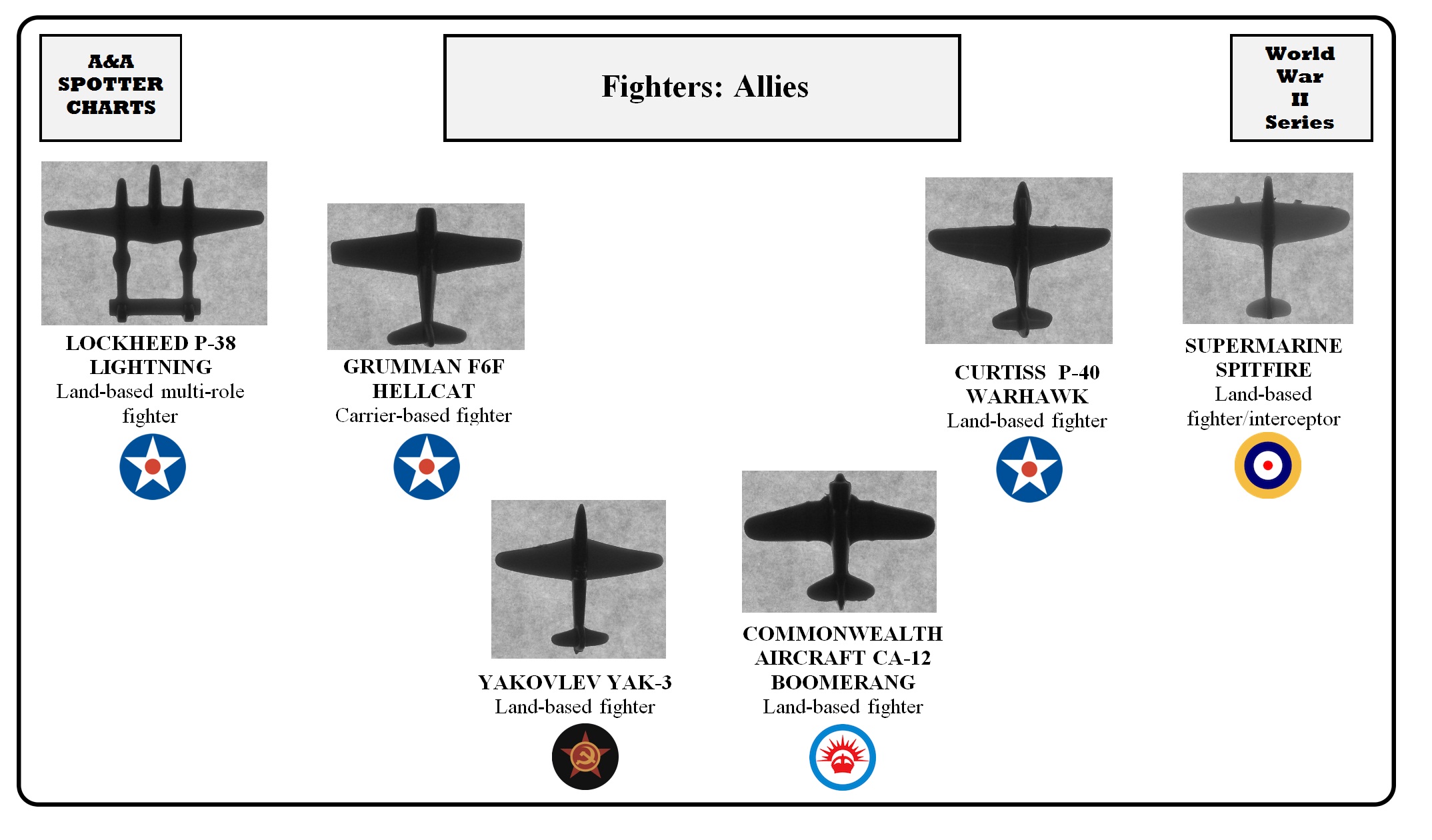
      The next two charts are the Allied and Axis fighter charts.

      WW2-Air-Fighters-Allies.jpg
      WW2-Air-Fighters-Axis.jpg

      posted in Customizations
      C
      CWO Marc
    • RE: Should we make better rules for invadable neutrals? (1940)

      @WILD:

      Could have it that only the axis can attack true neutrals, but if certain events or situations come up the allies are allowed to violate neutrality of some countries.

      Which they did in real life.  The British occupied Iceland (the Americans later joined them in doing so) and the Americans seized Greenland, in both cases to keep them out of enemy hands in case the Germans had any designs on them.  The Icelanders and the Danes were seriously torqued off by these actions, but were hardly in a position to do much about it (especially the Danes, who were under Nazi occupation).  The British and the Soviets jointly invaded Iran when they started getting nervous about where the Shah’s loyalties were.  The British also staged a mini-coup (using troops and tanks) against King Farouk of Egypt in 1942; Egypt was technically an independent country at the time, though in practice it was a British protectorate.

      posted in House Rules
      C
      CWO Marc
    • RE: Military History's Best Loser

      @Imperious:

      It was already established as a land war a looong time ago unless elephants were used as boats and swim to Italy.

      In shallow waters Hannibal’s elephants, owing to their trunks, would have been analogous to tanks fitted with snorkel tubes (for air intake and engine exhaust) to allow the tank to ford a river while submerged (as was planned for the Maus, which was too heavy for most bridges).  The Mediterranean is too deep to be forded that way, of course, but I guess Hannibal could have brought in his elephants on the Carthagenian equivalent of LSTs and then have allowed them to wade ashore on the final approach to the landing beaches like Duplex Drive Sherman amphibious tanks.  :-D

      posted in World War II History
      C
      CWO Marc
    • 100th Anniversary of Scapa Flow Scuttling

      One hundred years ago today, the German High Seas Fleet, which was interned at Scapa Flow, scuttled itself, sending 52 of the 74 ships to the bottom. Peace talks to formally end WWI (which technically was still in progress, since the armistice of November 11, 1918, was a cease-fire rather than a surrender) were dragging on, and the interned German sailors were worried that their ships were going to be seized outright, so it was ultimately decided to sink them in a final gesture of defiance to keep them out of enemy hands.

      https://www.bbc.com/news/uk-scotland-north-east-orkney-shetland-48717820?intlink_from_url=&link_location=live-reporting-story

      posted in General Discussion
      C
      CWO Marc
    • RE: A&A Unit Identification Charts

      The next two charts are the cruiser and destroyer charts.

      WW2-Sea-Cruisers.jpg
      WW2-Sea-Destroyers.jpg

      posted in Customizations
      C
      CWO Marc
    • RE: Population Counter?

      I haven’t searched for it on the forum (I don’t know if the search function has been reactivated; I think it was on hold for a while), but according to my files this subject came up in a thread titled “Total Domination (or close to)”. I don’t have a date for it, but here’s a copy of a post I made at the time in that thread:


      The OOB A&A rules and the total domination variant both actually have something in common: the games can theoretically last forever – or at least for an extremely large number of rounds – and as such they’re unrealistic because a total war between major powers can’t be sustained forever.

      Total war, on the scale seen in WWI and WWII, imposes enormous social and economic strains on the participant nations (in addition to the direct casualties and destruction which occur both on the battlefield and in civilian areas that are subjected to military attack). In many cases (the U.S. in both world wars being a significant exception), the resources and manpower of nations engaged in total war are expended more quickly than they can be replaced (particularly in the case of people, who even if they’re drafted as teenagers take 15 or more years to be replaced from newborns). The game rules don’t take these factors into account: the players can keep fighting as long as they can collect income, without worrying about running out of civilian workers or draft-age recruits, and without worrying about social breakdown or revolution at home (except in the case of the optional Russian Revolution rule in A&A 1914).

      Barbara Tuchman’s book The Zimmermann Telegram describes vividly how nations can eventually crumble under the strain of total war. Her opening chapter, set in January 1917, says, “Now the French were drained, the Russians dying, Rumania, a late entry on the Alied side, already ruined and overrun. The enemy was no better off. Germans were living on a diet of potatoes, conscripting fifteen-year-olds for the army, gumming up the cracks that were beginning to appear in the authority of Kaiserdom with even harsher measures. The [recent German peace offer] had been a mere pretense, designed to be rejected so that the General Staff could wring from the home front and faltering Austria yet more endurance and more sacrifice. […] England had fortitude left, but no money and, what was worse, no ideas. […] No prospect of any end was visible. […] It seemed there was nothing that would bring in the Americans before Europe exhausted itself beyond recovery.” Similarly, Gwynne Dyer’s book war makes the point that none of the regimes on the losing side (or rather sides) of WWI survived: the Russian, German, Austro-Hungarian and Ottoman empires were all destroyed, and the latter two were completely dismantled into a patchwork of successor states. The British and French empires survived on paper, but were greatly weakened and were ultimately finished off by WWII and its aftermath.

      If a group of players wanted to prevent A&A games from going on forever (and in fairness, players don’t necessarily want this), one solution might be to create some sort of house rule that tracks the social and economic strain of waging total war, and which has some sort of built-in breaking point for each power depending on the particulars of its situation. Realistically, though, such a house rule would favour the Allies because of the US’s geographic isolation (which makes it difficult to attack) and its status as a net producer of war goods (unlike the UK, which was a net consumer), and the USSR’s vast manpower reserves. One factor that would compensate matters to some degree would be for the game to assume improved economic efficiency by Germany than was the case historically. (Germany in WWII was extremely inefficient at making use of its domestic and captured economic infrastructure, for a variety of reasons.)

      posted in House Rules
      C
      CWO Marc
    • RE: What are you reading

      @Private:

      Found this a very interesting read. It attempts to dismantle the often accepted view that the Versailles peace treaty was so damaging that it lead directly to WW2. I did not find every argument advanced by Mr Tampke convincing, but there is a lot of worthwhile argument and analysis, covering the causes of WW1, the subsequent peace and so the causes of WW2. The general conclusion is that Versailles - being so very much less onerous than treaties imposed by Germany on its defeated enemies - did not deal with the underlying causes of European conflagration, allowing those to come to the fore again.

      The Times website won’t let me read more than the opening paragraph of the article, so it’s hard to evaluate the book’s arguments, but I’d say that while Versailles certainly contributed to the eventual outbreak of WWII it’s questionable to claim that it led “directly” to it, given that the two wars were twenty years apart.  The Franco-Prussian War similarly contributed to the eventual outbreak of WWI forty years later, but similarly did not lead to it directly.  The argument that “Versailles did not deal with the underlying causes of European conflagration, allowing those to come to the fore again” sounds at least partially right.  WWI caused serious cracks in the European power structure which had been in place for the past couple of centuries, and Versailles was arguably an attempt by the winners to patch up the cracks in their part of the edifice and restore the status quo.  The restoration proved superficial; WWI caused serious economic, demographic and political damage to all the participants, including the winners, and this damage left them in a fragile state throughout the 1920s and 1930s – which is one reason why Britian and France in particular were in such a weak position to face expansionism by the Axis powers.  It took WWII to finish the job started by WWI, i.e. the replacement of the European order by the new global order which emerged after the war – a global order characterized by the bipolar US/USSR superpowerdynamic and by the crumbling of the British and French colonial empires over the following couple of decades.

      posted in World War II History
      C
      CWO Marc
    • 1 / 1