Axis & Allies .org Forums
    • Home
    • Categories
    • Recent
    • Popular
    • Users
    • Register
    • Login
    1. Home
    2. CWO Marc
    3. Best
    C
    • Profile
    • Following 0
    • Followers 3
    • Topics 129
    • Posts 5,700
    • Best 194
    • Controversial 0
    • Groups 13

    Best posts made by CWO Marc

    • RE: Winter 2019/20 Battle of Britain - 12th January 2020

      @Wittmann said in Winter 2019/20 Battle of Britain - 12th January 2020:

      @Private-Panic I am not old. Just blind. Is a bitch yo drive up north, with the sun from the right, blinding my one good eye.

      This reminds me of an anecdote about Horatio Nelson, who on at least three occasions disobeyed orders from the fleet flagship during battle. At the Battle of Copenhagen in 1801, Admiral Sir Hyde Parker sent Nelson a signal to withdraw. Nelson, upon being informed of this by his signals officer, raised his telescope, held it up to his blind eye, pointed it at the flagship and stated that he did not see the signal. As usual, he got away with it. And once Nelson became Commader-in-Chief, the problem of disobeying orders from the Commander-in-Chief solved itself.

      posted in Events
      C
      CWO Marc
    • RE: A&A Unit Identification Charts

      The next two charts are the Allied and Axis aircraft carrier charts.

      WW2-Sea- Aircraft Carriers-Allies.jpg
      WW2-Sea- Aircraft Carriers-Axis.jpg

      posted in Customizations
      C
      CWO Marc
    • RE: WWII Mohawk Code-Talkers

      @SS-GEN said in WWII Mohawk Code-Talkers:

      @CWO-Marc

      Just love these ww2 stories and learning about all the good and bad hardships during this war !

      Me too. One of the things I like about the code-talkers concept is that, in my opinion, it’s an example of the flair which the Allies sometimes showed for coming up with clever, practical, and sometimes deceptively simple solutions to wartime problems. Some of those solutions involved large-scale efforts, but some of them were small-scale nuts-and-bolts devices and practices which required relatively few resources yet produced a big payoff. An example of the large-scale type is the solution the Americans devised to meeting the Battle of the Atlantic’s huge demand for shipping capacity, a demand which could not possibly be met by traditional shipbuilding practices and by existing shipyard capacity. The solution was to design a standard, simple cargo vessel (the Liberty Ship) which could be prefabricated in pieces at inland factories, then sent to the coast for final assembly; this greatly reduced the amount of worktime at the shipyards themselves, and meant that even small shipyards could handle the work. On the small scale, several examples come to mind. When the Allies started running into the new German high-tech (for the time period) acoustic torpedo, for example, they soon devised a low-tech countermeasure: simple mechanical noisemakers (as I recall, bunches of metal bars trailed in the water at the end of a steel cable, which would clang against each other under the influence of the flowing water) to draw the torpedoes away from the ships. When the Allies experienced trouble with Normandy’s dense hengerows, which tended to make tanks go belly-up, a U.S. Army sergeant come up with the answer: welding some steel “teeth” (initially improvised with cut-up railway track sections) to the front of a tank so that it could plow into a hedgerow and crash through it rather being tilted upward by it. These “can do” practical solutions, even when they were small-scale ways of dealing with a local problem, could potentially add up, and they also had the virtue of having an excellent cost/benefit ratio (in contrast, let’s say, with the impractical and wasteful Maus super-tank, which never even saw combat).

      posted in World War II History
      C
      CWO Marc
    • RE: Questions regarding a 1936 start date

      I think that one of the potentially most interesting applications of the pre-1939 time period isn’t to start the actual game prior to 1940 but rather to set up an alternate starting situation for the 1940 game, in order to introduce variety from game to game (or possibly as a different type of bid from the customary IPC-based ones). The idea would be to look at the chronology of the historical pre-1940 territorial changes and to say, “Let’s assume that instead of X happening, Y happened instead,” and to alter the look of the 1940 map accordingly so that the players are starting from a different geopolitical situation. This could be done either in small, modest ways, or on a more ambitious scale. An example of a “small and modest” change would be, let’s say, assuming that the USSR never annexed the Baltic States and Bessarabia to create a buffer zone between itself and Germany. Examples of more radical changes might include: what if Franco had lost the Spanish Civil War? What if China had never seized Manchuria in 1931 and Jehol and in 1933, and had never invaded China proper in 1937?

      posted in Axis & Allies Global 1940
      C
      CWO Marc
    • RE: France and Canada as one Power, two Economies.

      No offense taken.  I wasn’t actually objecting to the concept of Quebec being used as the seat of a government-in-exile for France, I was just saying that this shouldn’t result in Quebec turning into a territory controlled by France.  One concept shouldn’t require the other concept, since we’re talking about house rules that, by definition, deviate from what’s strictly permitted under the OOB rules.  After all, the earlier suggestion of putting France’s government-in-exile in London wasn’t based on any assumption that the British territory containing London would turn into a French-controlled territory (the opening of the game being set in 1940, not in 1066).

      posted in House Rules
      C
      CWO Marc
    • RE: A&A Unit Identification Charts

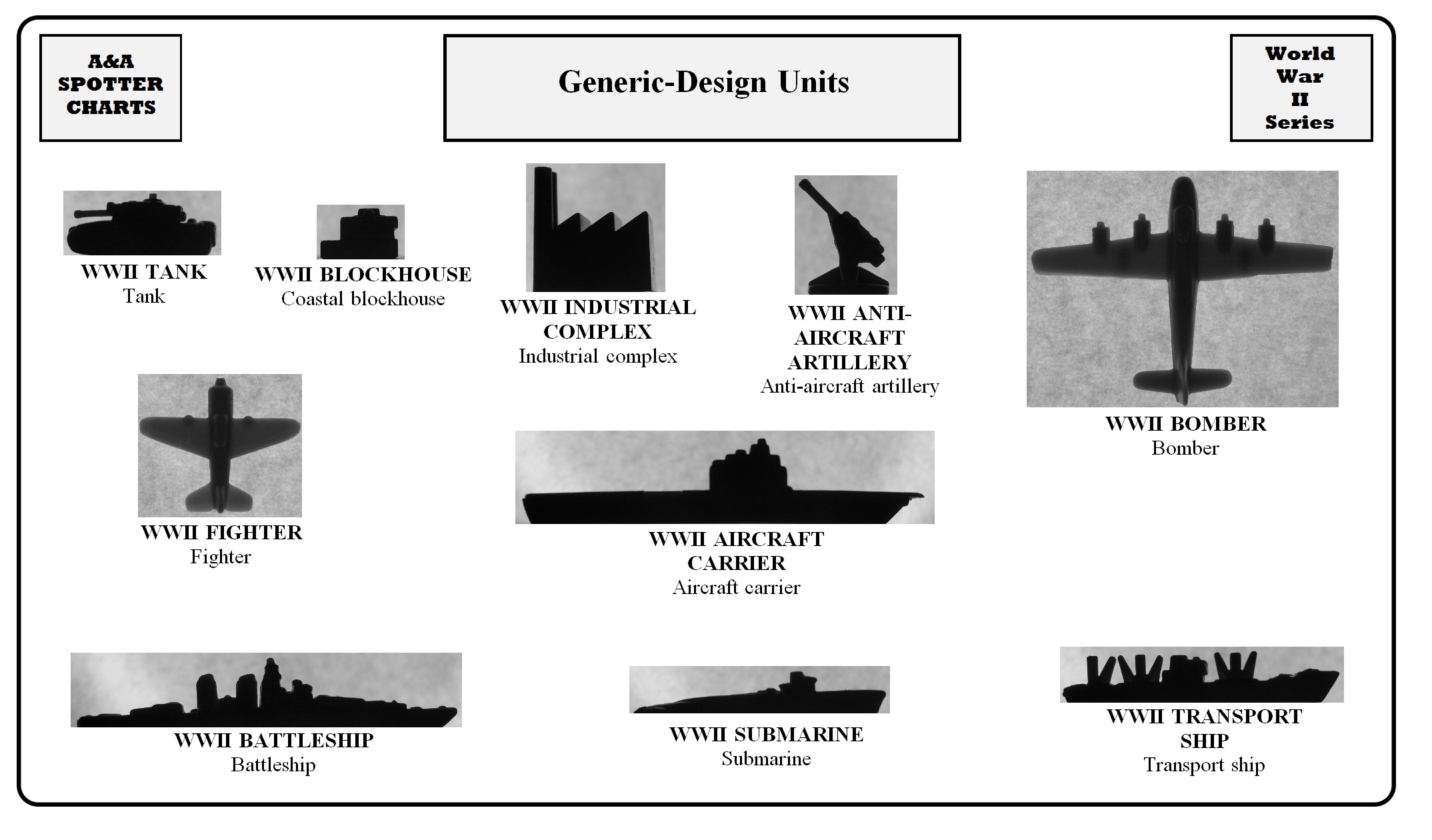
      And last of all are the WWI and WWII generic-design equipment charts.

      WW1-Generic.jpg
      WW2-Generic.jpg

      posted in Customizations
      C
      CWO Marc
    • RE: Is This Alleged D-Day Footage Authentic?

      @aequitas-et-veritas said in Is This Alleged D-Day Footage Authentic?:

      @CWO-Marc the impression i have is, that it might be the last Training before the actual D-day.
      Because the date says 05 of June.

      If the footage (which I haven’t looked at) says that this is a training maneuver conducted on June 5 in preparation for the D-Day invasion, then the information isn’t accurate for a couple of reasons. First, the troops didn’t conduct intensive training exercises right up to the last day; the days prior to the invasion (I think it was a period of about one week) were devoted to moving the troops from the camps where they had been living to the assembly areas for the invasion, loading them aboard their transports, and giving the “sealed” troops (no disembarkation allowed) their final briefings, including (in some cases) restricted information about the identity of the actual targets they would be assaulting. (A typical reaction from the troops was: “Ah, now I see what they were training us for. Those cliffs (or whatever) in Normandy look exactly like the ones in England on which we practiced.”) Second, it’s impossible for major training exercises (like an amphibious landing) to have been scheduled for June 5th because June 5th was the date on which the actual invasion was supposed to take place; it was delayed until June 6th at the last minute – some of the ships had already left for Normandy, and had to be recalled – because of unexpected bad weather.

      posted in World War II History
      C
      CWO Marc
    • RE: A&A Unit Identification Charts

      Here’s an example of what an unprocessed shot looks like.  The original raw image was 1.46 MB in size, but for purposes of posting it here I reformatted it to reduce the file size.

      I should have mentioned in my previous post that the aircraft sculpts had to be shot from above with the lit paper below them, not from the side with the lit paper behind them.

      Some of the sculpts, by the way, were slightly translucent in my lighting set-up.  This was particularly so for the beige UK units, and especially in the case of the thin-winged Spitfire.

      Unprocessed Shot Sample.jpg

      posted in Customizations
      C
      CWO Marc
    • Blast From The Past

      Unexploded WWII bomb suddenly detonates in German field

      There are still thousands of unexploded bombs in Germany from the Second World War and new pictures show what happens when one goes off.

      https://www.ctvnews.ca/video?playlistId=1.4483432

      posted in World War II History
      C
      CWO Marc
    • RE: Flags and Army Movers

      I like the concept of putting national leader office title cards on the component boxes; I don’t think I’ve ever seen that particular idea used anywhere else. “Army movers” are also known as “croupier sticks” in the casino industry and in A&A circles as “war rakes” (a much cooler term than croupier stick). Yours seems to be made of bamboo skewers (I have some at home), and one potential upgrade you might consider giving them is to use short sections of wooden popsickle sticks (sawn into thirds or quarters) to put a horizontal scoop at the end of each skewer base.

      posted in Customizations
      C
      CWO Marc
    • RE: On this day during W.W. 2

      And as a further point of terminology, the Schwerpunkt concept is an important component of the style of warfare which was used to conquor Poland in 1939 and the Low Countries and France in 1940, but it’s a component rather than a synonym. It refers to the concept of concentrating superior combat power at a decisive point of the front (such as the Ardennes in 1940), a concept which is valid both in mechanized and non-mechanized contexts. The style of warfare to which the term “Blitzkrieg” refers, however, is the use of massed formations of tanks, closely supported by mechanized / motorized infantry, self-propelled artillery and ground-attack aircraft, to punch through the enemy’s front lines, bypass strongpoints, and quickly penetrate deep into enemy territory to seize key objectives and to surround and isolate large groups of enemy forces. This general concept was actually considered by the Allies towards the end of WWI, as a way to “win the war in 1919” if they hadn’t already done so by then (which, in the end, they did). To be clear, however, what the Allies had in mind at the time wasn’t on the same scale as what occurred in 1939 and 1940, partly because they didn’t have the technology to do it (tanks at the time were mostly too slow, and the only reasonably fast one, the Renault FT, was too light), and partly because it wasn’t necessary (because their objective was to break the deadlock of trench warfare, not to overrun hundreds of miles of territory). Mechanized warfare, with close air support, was perceived to be the solution to what had been two of the fundamental problems of trench warfare: the vulnerability of infantrymen on the offensive to the weapons fire of an entrenched enemy, and the inability of artillery to keep up with advancing troops (especially across shell-cratered and/or muddly terrain).

      posted in World War II History
      C
      CWO Marc
    • RE: Identifying destroyers

      It’s all a matter of preference, of course, but here are a couple of related reasons why painting the stern is a good option. Most (though not all) A&A destroyer sculpts have transom sterns, meaning that they’re flat, which means that looking at the shape of the stern is already a good way to distinguish destroyers from cruiser sculpts (whose sterns tend to be pointy) – so by painting the stern, you’d be attracting attention to their most distinctive characteristic. Also note that if you paint just the flat vertical part of the stern, the paint won’t be visible if you’re viewing the sculpt from the front or the side. The benefit is that this doesn’t mess up the appearance of your sculpt too much; the drawback is that you won’t necessarily be able to tell at a glance if a sculpt is a destroyer, which may not be what you’re trying to achieve.

      posted in Customizations
      C
      CWO Marc
    • RE: Churchill-Bradley Hypothetical Incident

      Thanks barnee and Midnight Reaper for the info on the firing stances used by Ike and Churchill – I love these kinds of technical details. Churchill had indeed served in the Boer War and in places like Cuba and India as a young man; during WWI, after the Gallipoli debacle, he left government and spent a few months of 1916 an an infantry officer on the Western Front, which was quite a contrast from sitting on the padded benches of the House of Commons a year earlier. I’ve just checked on the specifics, and his posting (as a Lieutenant-Colonel) was from January to May 1916 in a Belgian village called Ploegsteert. It’s close to the border of Flanders, the region where his future opposite number in WWII, Corporal Adolf Hitler, would have been serving at the time: Hitler’s unit, the List Regiment, spent much of the war in Flanders, and in July 1916 it took part in the Battle of Fromelles, which is only 20 kilometers from Ploegsteert.

      posted in World War II History
      C
      CWO Marc
    • RE: Global Gaming Table Threads and Pictures

      @fasthard
      This is a beautifully designed table, and the wood-paneled room in which it’s located looks great too. And it’s a nice touch to have added those two monitors which, as far as I can tell, keep track of which territory is controlled by which power and the current status of the national objectives. Is that how those two charts get used during game play?

      posted in Customizations
      C
      CWO Marc
    • RE: Wrecks of WWII Carriers Kaga and Akagi Located

      The discovery is well-timed: Roland Emmerich’s new Midway movie is set to be released on November 8, 2019. The trailer can be accessed here: https://www.imdb.com/title/tt6924650/?ref_=fn_al_tt_1

      posted in World War II History
      C
      CWO Marc
    • RE: Wrecks of WWII Carriers Kaga and Akagi Located

      @barnee said in Wrecks of WWII Carriers Kaga and Akagi Located:

      When i read the article I had forgotten that the carriers and a light cruiser on the last day of the battle were the only Japanese ships sunk. Seems odd, even with only planes vs ships

      Actually, the outcome reflects good tactical judgement by Admirals Spruance and Fletcher, who were the commanders on the spot. (Fletcher was technically in overall command, since he was senior, but in practice the two American groups – the Hornet/Enterprise group commanded by Raymond Spruance and the Yorktown group commanded by Jack Fletcher – operated fairly independently. Once Yorktown was sunk, and Fletcher had transferred his flag to a cruiser, Spruance was the only carrier commander left in the game.) The Americans were vastly outnumbered at Midway, and not just in carriers; Yamamoto committed about half the Imperial fleet to the operation, if you count all the groups of forces he deployed. The Americans, following Mahan’s principle of going all-out for the enemy’s capital ships (defined in Mahan’s time as his battleships, but by 1942 being redefined as his carriers), concentrated all their attention (and their limited bomber resources) on Kaga, Akagi, Hiryu and Soryu and sent them to the bottom. Also important, but less well-known, is the fact that Spruance, once evening came, steamed eastward (meaning away from the Japanese forces) in order to avoid risking his precious two remaining carriers in potential night-time surface combat (at which the IJN excelled) against the still impressively large Japanese armada. He and Fletcher had eliminated Yamamoto’s key pieces, the carriers, for the loss of just one US carrier (the patched-together Yorktown, which had taken a beating at the Coral Sea shortly beforehand), and that in itself was enough to make Midway a US victory of enormous strategic importance. Even the Japanese recognized this; they briefly considered taking another crack at capturing Midway by sending in their battleships (including Yamamoto’s flagship, the 18-inch gunned Yamato) to bombard the island prior to staging an amphibious landing, but soon gave up on the idea and turned west to head for home.

      posted in World War II History
      C
      CWO Marc
    • RE: On this day during W.W. 2

      @taamvan said in On this day during W.W. 2:

      While it wasn’t the main factor early on in the war, the US had broken the Japanese codes and had functional radar, very long range planes and incredibly detailed information and plans (yamamoto ambush) and other unknown technologies–I personally think that this led the Japanese to paranoia as US ships and planes kept showing up at the most inopportune times.

      And interestingly, the Japanese also suffered on at least one occasion – at Midway – of what could be called anti-paranoia, which was to assume that the Americans would obligingly follow the timeline which Japan had scripted for them. Their Midway operation did not include any contingency plans to deal with the possibility that one or more American carriers might inconveniently show up ahead of schedule…so when that actually happened, Nagumo had to improvise on the spot (and do so in the absence of adequate information, a problem that haunts every military commander) and the operation started falling apart. It didn’t help that the Japanese were trying to accomplish two contradictory things at once: conducting an amphibious landing, an operation which needs to be carefully coordinated and which needs to take into account such immutable factors as the tides, and destroying a mobile enemy carrier force, an operation which involves many unknowns and which requires a high degree of flexibility. Their concept was built around a “First A, then B” scenario, but they ended up facing an A+B scenario.

      I’ve sometimes wondered how Midway would have turned out if Yamamoto had dispensed with the diversionary Aleutian operation and instead had assigned the light carriers Junyo and Ryujo to augment Nagumo’s main carrier group. This would have given him added reconnaissance capabilities, a reserve attack force, and a bigger combat air patrol to protect his fleet from enemy fighters.

      posted in World War II History
      C
      CWO Marc
    • RE: Is this common knowledge?

      I guess one way to tie all of this together would be to see a revival showing of Saving Private Ryan at a Cineplex on the west coast, since that would amount to watching a Tom Hanks WWII European theatre movie in a Pacific theatre.

      posted in General Discussion
      C
      CWO Marc
    • RE: Combining Your A&A Editions.

      I’ve been combining my sculpts for years.  As each new game comes out I take notes on the contents, particularly on the appearance and colour of the sculpts, then I put the sculpts into Flambeau Zerust plastic storage trays (tackle boxes with movable dividers). The trays are slotted into low, wide, stackable wooden storage shelves (the kind you buy flat and assemble with a screwdriver).  The trays are arranged by country.  The US, Britain, Russia, Germany and Japan currently have four trays each, due to the large number of sculpts each country has.  Each of those five sets of four trays starts with a large compartment devoted to the main infantry pieces for the country in question, followed by smaller compartments for variant-colour infantry (such as the dark green US marines from the original Pacific game) which I use represent elite or special units.  After the infantry, there are tray sections for the various equipment types (land units first, then air units, then sea units), subdivided by specific types (tanks, field artillery, anti-aircraft artilley, etc.) in the main colour (or shade) for that particular nation.  Then comes a section for infantry units whose shade is problematic – different from the main shade, but difficult to distinguish from it under most lighting conditions.  (Most of the pieces with this problem are the American troops, which have been produced in about ten different shades of green, but fortunately it’s not a problem to quarantine the problematic ones because I have such a large number of correct-shade ones.)  The final tray sections are devoted to equipment pieces which either have ambiguous-shade problems, or which are radically different in shade or colour (like the cherry-red Japanese equipment units from the original Pacific game).

      Italy, ANZAC, China and France are less complicated (because their pieces have never been produced in multiple colours or shades) and require fewer trays (because they’ve been in fewer games, and thus I own fewer of them).  The order of the pieces in the trays is the same as for the Big Five: infantry first, then land and air and sea equipment.  Italy’s pieces occupy two trays, in part because they include the German-design and Japanese-design pieces with which Italy was first provided, plus the Italian-specific designs from Europe 1940 2nd edition.  Due to the many ANZAC pieces I own, ANZAC would in principle have two trays too – but what I’ve done instead is designate the Pacific 1940 2nd edition’s butternut-grey units as ANZAC ones (in their own single tray) and the Pacific 1940 1st edition’s butternut-grey units as Canadian ones (in their own single tray).  China is in one tray, with the Chinese infantry supplied by Anniversary and by Pacific 1940.  China has no official equiment, so I use one-half of the lime-green British equipment from Revised to fill that gap.  (More on the other half in a moment.)  France is in one tray, which represents both the Third Republic and the Vichy regime.

      The project on which I’m currently working is to integrate the new pieces from A&A 1914 into my collection.  I’ve taken the blue 1914 French pieces and put them into half a tray, where they represent the Free French forces.  (I haven’t decided yet what to put in the other half of the tray.)  I’ve taken the pale green 1914 British pieces and put them into half a tray, where they represent South Africa.  The other half of that tray holds the second half of the lime-green British equipment from Revised, plus the lime-green British infantry units from the same game, to represent India (which technically is just a British imperial colony rather a Commonwealth Dominion, but which is an autonomous regional economy in the Global 1940 rules).  That leaves six 1914 sculpts sets whose use I still have to determine (which will be my project for next weekend), plus the generic equipment sculpts from the Milton Bradley edition.

      I also have a single tray in which I put the generic-shape (and generic-colour) anti-aircraft artillery units and industrial complexes from the earlier A&A games, plus special extras from various other games I own: atomic bombs, nuclear mushroom clouds, city markers and so forth.

      posted in Customizations
      C
      CWO Marc
    • RE: How to tell Classic first from second

      The cruiser and generic AAA units in the first printing of Guadalcanal similarly got colour-switched. It made no difference for the AAA sculpts, since they were a generic common design, but in the case of the other unit the game had a Japanese-orange American-design Portland-class cruiser and an American-green Japanese-design Takao-class cruiser.

      It’s too bad that the colour-switched green German and grey American infantry units are rare production errors, and thus aren’t widely available: they would be perfect for use in A&A Battle of the Bulge as house-ruled special units representing Otto Skorzeny’s disguised infiltration units.

      posted in Axis & Allies Classic
      C
      CWO Marc
    • 1
    • 2
    • 3
    • 4
    • 5
    • 9
    • 10
    • 3 / 10