Axis & Allies .org Forums
    • Home
    • Categories
    • Recent
    • Popular
    • Users
    • Register
    • Login
    1. Home
    2. captainwalker
    3. Best
    • Profile
    • Following 0
    • Followers 0
    • Topics 129
    • Posts 18,616
    • Best 405
    • Controversial 0
    • Groups 8

    Best posts made by captainwalker

    • RE: On this day during W.W. 2

      June 8, 1940. Norway

      Evacuation of Narvik. French and Polish troops, pursuing General Dietl’s forces towards Sweden, pull out overnight and return to Narvik leaving dummies to fool the Germans. Group II troopships embark the final 4600 Allied troops (British, French and Polish) and depart Narvik, escorted by aircraft carrier HMS Ark Royal, cruisers HMS Southampton and HMS Coventry and 11 destroyers. The convoy is spotted by German reconnaissance planes and bombed continuously until out of range but without damage. Germans quickly assess the withdrawal and retake Narvik.

      Operation Juno. German cruiser Admiral Hipper sinks British tanker Oil Pioneer and escorting armed trawler HMS Juniper (20 lives lost, Hipper picks up 29 survivors). Later, Hipper sinks empty British troopship Orama (19 lives lost, 280 rescued by German destroyers) but spares hospital ship Atlantis. Atlantis obeys the rules of war and does not attempt to radio any signals; Hipper does not sink her.

      Operation Juno meets Evacuation of Narvik. At 0300 hours, aircraft carrier HMS Glorious sails for Scapa Flow with destroyers HMS Ardent & HMS Acasta (these vessels are not needed to escort troop transports). Captain Guy D’Oyly Hughes does not post top look-outs or fly patrol aircraft and runs into German battleships Scharnhorst and Gneisenau, 170 miles off the Norwegian coast. At 1630 hours, Scharnhorst and Gneisenau open fire from 24km, one of the longest hits ever recorded. Glorious is hit with several 11 inch shells, preventing aircraft taking off. Ardent & Acasta lay smoke and close on the German battleships firing 120 mm guns and torpedoes but both are hit. Acasta hits Scharnhorst with 1 torpedo (50 dead). Ardent sinks at 1720 hours (151 lives lost, 2 survivors). Glorious sinks at 1910 hours (1162 sailors and 59 RAF personnel killed, 42 survivors). Acasta sinks at 1920 hours (161 dead, 2 survivors). Admiral Wilhelm Marschall, aboard his flagship Gneisenau orders his flag lowered to half mast to honour the crews of the British destroyers. Photo is Scharnhorst firing on HMS Glorious.
      scharnhorst.jpg

      Source: worldwar2daybyday

      posted in World War II History
      captainwalkerC
      captainwalker
    • RE: On this day during W.W. 2

      On this day in 1944, German Tiger tank commander Wittmann stops the entire British 7th Armoured Division advance to Caen, “single-handedly”, at Villers-Bocage. Wittmann destroyed in less than fifteen minutes 13 tanks, 2 anti-tank guns and 14 transport vehicles.wittman caen.jpg

      posted in World War II History
      captainwalkerC
      captainwalker
    • RE: On this day during W.W. 2

      13th June 1944: London;

      The V1 Flying Bomb, ( Hitler’s Vergeltungswaffe 1, Vengeance Weapon 1) known by The Allies as Buzz Bombs or Doodlebugs was an early cruise missile & the only production aircraft to use pulsejet for power.

      The Wehrmacht started launching the V1’s in mid 1944. A total of 9,521 were fired at London & the South East Coast, the first hitting London, next to a railway bridge, on Grove Road, Mile End, on 13th June 1944, killing 8 civilians. The last V1 hit the UK in October 1944, when the sites were overrun by the advancing Allies, after which they targeted Belgium, until 29th March 1945.

      Several methods were incorporated to Destroy the V1’s, Anti-aircraft guns & Barrage Balloons being two of them. The Third was the Interceptor, (Fighter Aircraft). Early attempts to Intercept the V1’s often failed, but improved techniques soon emerged. One of these was the use of airflow over the Interceptors Wing to raise one wing of the V1, by sliding the wingtip to within 6 inches (15cm) of the lower surface of the V1’s wing, (as shown in photographs below)

      When properly executed, this manoeuvre would tip the V1’s wing up, thereby overriding the gyro & sending the V1 into an out of control dive. At least 16 V1’s were destroyed this way, the first by Major R E Turner, of 356th Fighter Squadron on the 18th June 1944;

      The total number of casualties inflicted by the V1’s was 22,892.
      v1.jpg

      posted in World War II History
      captainwalkerC
      captainwalker
    • RE: On this day during W.W. 2

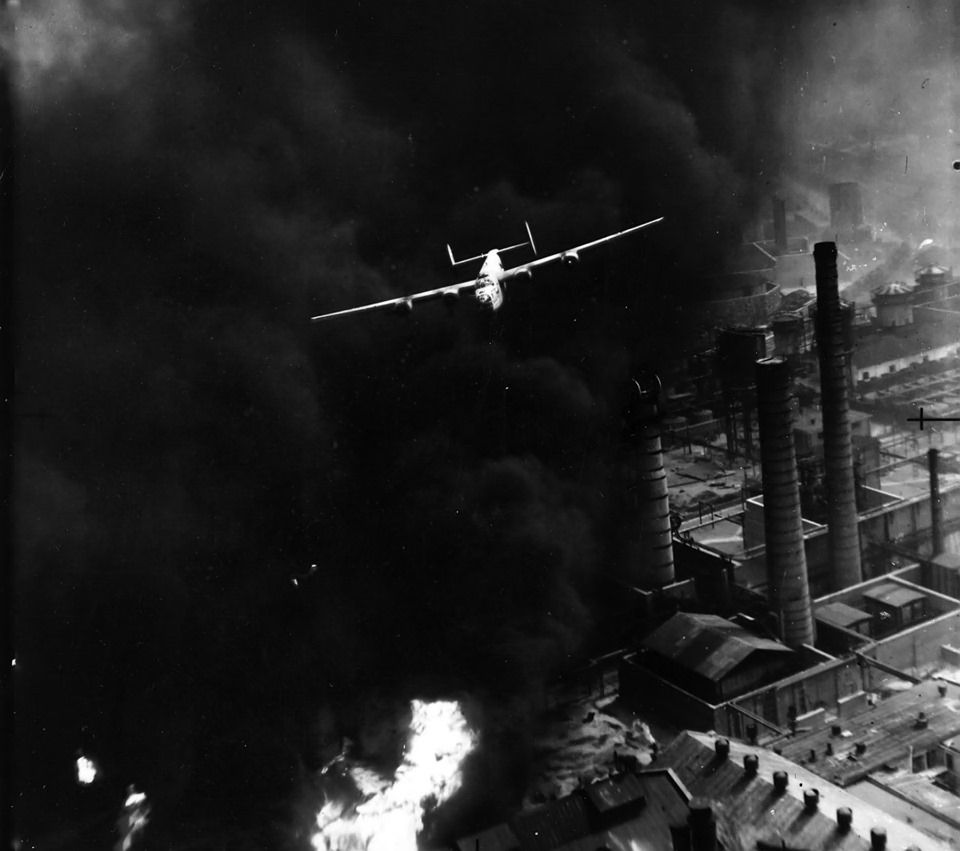
      One of the most famous images of World War II shows The Sandman, piloted by Robert Sternfels, as it emerges from a pall of smoke during the Operation Tidal Waveb24 1.jpg

      posted in World War II History
      captainwalkerC
      captainwalker
    • RE: On this day during W.W. 2

      75 Years Ago, Today: Saturday, August 5, 1944.

      Photograph: The British recaptured what was left of Villers-Bocage on August 5, 1944. This view of a knocked-out Sherman tank and ruined buildings reveals the extent of the damage that two months of heavy bombing and fierce combat had wrought.

      The General Staff of the German Armed Forces is informed by their generals in Normandy that Commonwealth forces are attacking south of Caen. Moreover, to the east of Avranches, in the Cotentin, the Americans continue their advance towards Mortain, south of Vire, defended by the 7th German army commanded by General Hausser. In Brittany, part of the 3rd Army of General Patton (two of the three corps of the 3rd Army) is now attacking towards the east, in the direction of Laval, Sainte-Suzanne and Mayenne.

      The German troops between Thury-Harcourt and Mortain now fear an Anglo-Canadian encircling from the North and American from the South. The German headquarters decides to counter-attack massively and plans an operation that will begin in the coming days.

      The British, aware of the bad German position between Mortain and Thury-Harcourt, decide to continue the BLUECOAT offensive for a time before concentrating their advance south of Caen to close the circle.

      In Warsaw, Poland, the hopeless battle continues. The Polish forces liberate a concentration camp. But without the support promised by the Soviets, and then withheld, a German victory and terrible vengeance is only a matter of time.

      villers bocage 2.jpg

      posted in World War II History
      captainwalkerC
      captainwalker
    • RE: On this day during W.W. 2

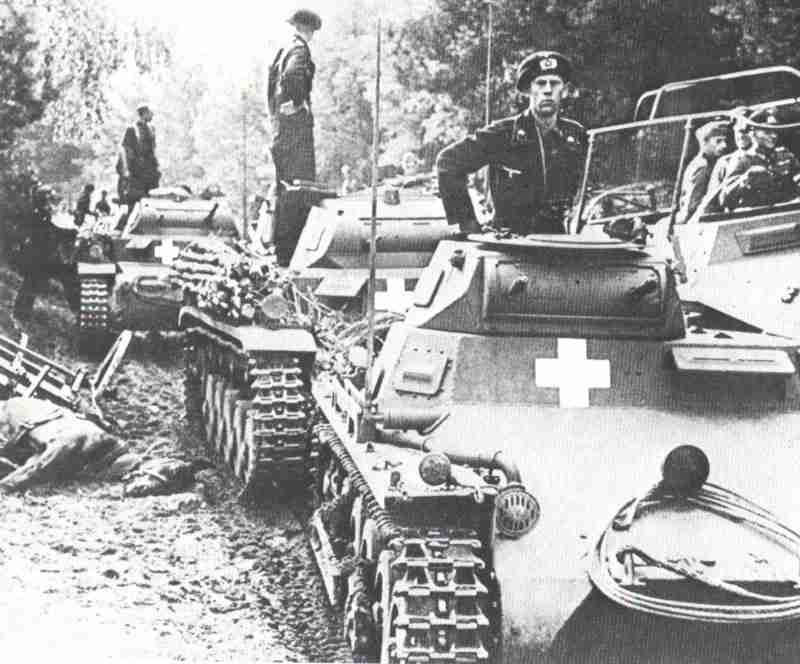
      September 2, 1939. Poland

      Using new tactics developed by Heinz Guderian, German forces advance 50 miles into Poland in 36 hours, threatening Krakow, Lodz and other cities.

      The term BLITZKRIEG has not been coined yet. Large fast-moving group of tanks, tracked artillery and troop carriers (supported by dive bombers) penetrate the front lines and fan out deep in the enemy’s rear. They attack supply dumps and HQ companies unprepared for combat, while enemy front line units are isolated, surrounded and destroyed. The undermanned Polish army is not fully mobilized and equipped with ancient weapons and horse-drawn artillery. It is outmatched and quickly overwhelmed despite brave resistance.

      Following earlier assurances of Poland’s security, France and Britain are committed to war with Germany but diplomatic and strategic questions delay an immediate response on this day. However, the evacuation of children from London begins.

      Photo: Guderian (top right of photo in command vehicle) guides his Panzerwaffe in Poland.

      guderian.jpg

      posted in World War II History
      captainwalkerC
      captainwalker
    • RE: On this day during W.W. 2

      9 October 1943

      A Douglas-built B-17F-50-DL Flying Fortress, 42-3352, “Virgin’s Delight,” of the 410th Bomb Squadron, 94th Bombardment Group (Heavy), 8th Air Force, is over the Focke-Wulf Fw 190 fighter factory, Marienburg, East Prussia.

      The aircraft commander was Lieutenant R.E. Le Pore and was based at Bury St Edmunds, Suffolk, England.

      VIII Bomber Command Mission Number 113 was an attack by nearly 100 American heavy bombers on the Focke-Wulf Flugzeugbau AG aircraft factory at Marienburg, East Prussia (Malbork, Poland), where the Luftwaffe‘s Fw 190 fighter was being built. Early in the war, German fighter production had been dispersed and it was thought that Marienburg was beyond the range of Allied bombers.

      100 B-17 Flying Fortress bombers were assigned to the target and 96 of these reached the plant. Between 1253 hours and 1302 hours, the B-17s arrived over the target in five waves at 11,000 to 13,000 feet (3,353 to 3,963 meters). They dropped 217.9 tons (197.7 metric tons) of bombs with a very high degree of accuracy.

      During the mission, two B-17s were lost with 13 more damaged. Three airmen were wounded and 21 listed as Missing in Action. The bomber crews claimed 9 Luftwaffe aircraft destroyed and 2 probably destroyed in air-to-air combat. Target assessment estimated that 15 Focke-Wulf Fw 190 fighters were destroyed on the ground.

      Casualties among the factory work force were high. Of 669 workers, 114 were killed and 76 injured.

      This B-17 was shot down by fighters and crashed into the North Sea off the coast of Germany on the November 29, 1943 on a mission to Bremen, Germany. 8 KIA, 2 POW.

      (Photo source - U.S. Air Force)

      (Colorised by Mario Unger)

      fortress.jpg

      posted in World War II History
      captainwalkerC
      captainwalker
    • RE: On this day during W.W. 2

      Two U.S. Army infantrymen of the 84th Infantry Division decorate a Christmas tree in the cellar of a home in Geilenkirchen, Heinsberg, North Rhine-Westphalia, Germany. December 1944.

      The division entered combat, 18 November 1944, with an attack on Geilenkirchen, Germany, as part of the larger offensive in the Roer Valley, north of Aachen. They were supported by the British Sherwood Rangers Yeomanry. Taking Geilenkirchen, as part of Operation Clipper on 19 November, the division pushed forward to take Beeck (Geilenkirchen) and Lindern in the face of heavy enemy resistance, 29 November.
      After a short rest, the division returned to the fight, taking Wurm and Würm (Geilenkirchen), Mullendorf, 18 December, before moving to Belgium to help stem the German winter offensive (Battle of the Bulge).

      (Color Ghost of WW2)army christmas.jpg

      posted in World War II History
      captainwalkerC
      captainwalker
    • RE: On this day during W.W. 2

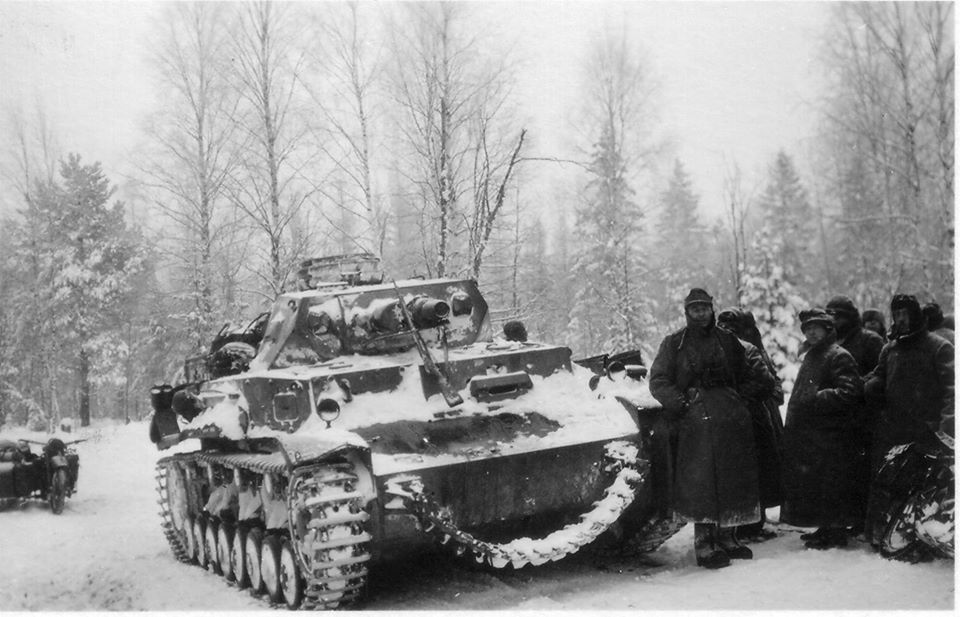
      January 7, 1942. Eastern Front

      The Soviet General Offensive begins as scheduled on 7 January 1942. North of Lake Ilmen, Soviet 4th and 52nd Armies and 2nd Shock Army (now under the command of Lieutenant General Andrei A. Vlasov) of Volkhov Front attack southwest of Leningrad. On the southern part of Lake Ilmen, ski troops and motor convoys of Soviet 11th Army cross the frozen lake while German outposts watch from the opposite shore. The Red Army attacks are not strong, but the defending German 16th Army does not have a continuous line but instead a chain of isolated strongpoints. The German generals quickly decide that the 11th Army thrust is the most dangerous because it threatens Staraya Russa, the main German supply depot for the entire region. Nothing appears too dangerous to them at the moment, but there are wide gaps in the German lines with no troops behind them for dozens of miles. Things could get difficult for the Germans, but it all depends on where the Red Army units head and how far they decide to go. The Battle of Moscow is generally defined to end on 7 January 1942 due to the Soviet offensive.

      Source: worldwartwodaily
      russian winter.jpg

      posted in World War II History
      captainwalkerC
      captainwalker
    • RE: On this day during W.W. 2

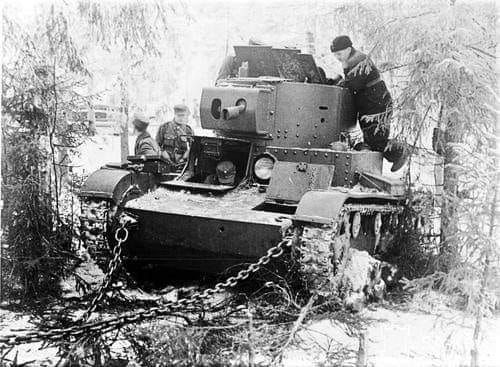
      January 8th 1940 - Finland
      Details of the Finnish victory over two Russian Divisions at Suomussalmi were released. The 44th Division was completely destroyed, trapped while going to the support of the defeated 163rd Division. The Finns captured 102 field guns, 43 tanks, over 300 vehicle and 1,170 horses.
      On the night of 8th January in Helsinki the Church bells were ringing, flags were flying and strangers embraced on the streets in celebration.
      Many Soviet tanks were burnt-out by Molotov cocktails thrown by Finns hiding in pits by the forest tracks, other Soviet troops froze to death with nothing to protect them from the cold except crude shelters of spruce branches.
      When the Finns attacked some of the Soviet troops were too weak to stand, too cold to fight.
      Picture shows Finnish soldiers preparing to tow a Soviet flamethrower tank OT-130. The OT-130 tank was based on the T-26 tank chassis, with the 45 mm gun replaced with a flamethrower.russian flamethrower.jpg

      posted in World War II History
      captainwalkerC
      captainwalker
    • RE: On this day during W.W. 2

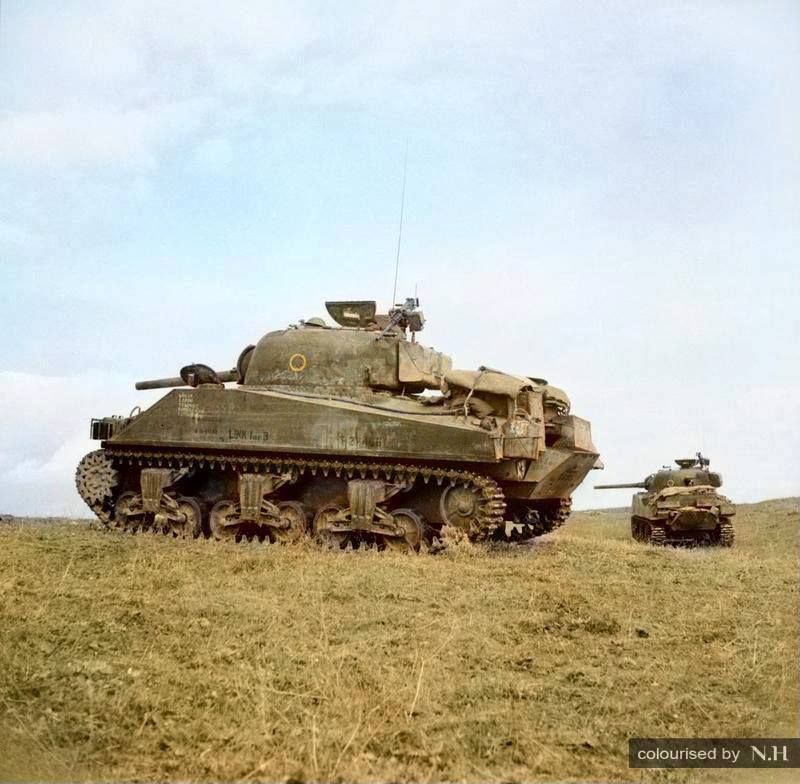
      January 9, 1942. Eastern Front

      200 miles northwest of Moscow, Soviet Northwest Front is fully engaged. 3rd and 4th Shock Armies (hastily-assembled, poorly-trained troops with little equipment, ammunition or food) cross the icy marshes of Lake Seliger in waist-deep snow. 4th Shock, attacking southwest towards Andreapol, is decimated by German machineguns at Peno but sheer weight of numbers overcomes the Germans. 3rd Shock Army fails to make progress attacking west towards Kholm. Further north, Soviet 11th Army approaches the town of Staraya Russa, defended by the experienced but exhausted German 18th Motorised Division, resting after the battles at Tikhvin.
      Source: worldwar2daybyday
      russian winter1.jpg

      posted in World War II History
      captainwalkerC
      captainwalker
    • RE: On this day during W.W. 2

      U-123 (Kptlt. Reinhard Hardegen, shown here in January/February 1942, was the first U-boat operating off the east coast of the United States as part of Operation Drumbeat. On 25 January 1942, it sinks British freighter Culebra.u123.jpg

      posted in World War II History
      captainwalkerC
      captainwalker
    • RE: On this day during W.W. 2

      'Operation Shingle’
      Anzio, Italy, 25 January 1944.
      Sherman tanks of the 46th (Liverpool Welsh) Royal Tank Regiment provide fire support for men of the 1st Battalion, Loyal Regiment (North Lancashire).
      Operation Shingle’ was finally launched on 22 January 1944, four days after a new US Fifth Army attack on the Garigliano and Rapido rivers near Cassino. British 1st Infantry Division under Major General Ronald Penney, supported by 46th Royal Tank Regiment and commandos of 2nd Special Service Brigade, landed north of Anzio. The US 3rd Infantry Division under Major General Lucian Truscott, supported by a tank battalion, three battalions of Rangers and an Airborne battalion, landed south of the port. Tactical surprise had been achieved and the landings were virtually unopposed. A handful of Luftwaffe aircraft got through the Allied fighter umbrella to strafe the ships, but the Allies lost only 13 men killed and 97 wounded. Anzio itself had been abandoned by the Germans and its civilian population moved out. Many German units had been deployed further south to counter US Fifth Army’s attack on the Garigliano. By the end of the day 36,000 troops and 3,200 vehicles had been delivered ashore. A US reconnaissance jeep patrol found the way open to Rome, and a bolder commander might well have taken advantage. But Major General John Lucas threw away the initiative, choosing instead to dig in and await the Germans.
      (Ian Carter - IWM)
      (Photo source -© IWM NA 11412)
      Sgt. Menzies - No. 2 Army Film & Photographic Unitshermans italy.jpg

      posted in World War II History
      captainwalkerC
      captainwalker
    • RE: On this day during W.W. 2

      On this day in 1945, SSG Audie Murphy repelled a German attack all by himself, killing/wounding 50 German soldiers with a machine gun, firing from a burning M10 tank destroyer.
      For his actions that day, he was awarded the Medal of Honor.
      Picture is from the movie ‘To Hell and Back’ (1955). The soldier is Murphy himself, re-enacting the battle.audie.jpg

      posted in World War II History
      captainwalkerC
      captainwalker
    • RE: On this day during W.W. 2

      January 30, 1944 Italy
      At Anzio the Allied offensive begins. There are heavy losses and no gains against the German defenses. To the south, along the German-held Gustav Line, the US 5th Army continues attacking. The British 5th Division (part of 10th Corps) breaks through the line and captures Monte Natale. Around Monte Cassino, the US 34th Division (part of 2nd Corps) holds its bridgehead on the west bank of the Rapido River.anzio italy.jpg

      posted in World War II History
      captainwalkerC
      captainwalker
    • RE: On this day during W.W. 2

      January 31, 1942. Eastern Front

      The weather on the Eastern Front on 31 January 1942 is horrible, with snowstorms that close roads throughout the sector. However, some German and Soviet formations have remained on the move through the worst of it, or at least some key elements have. The Soviets are trying to encircle German formations tied to strongpoints along their old front lines both by the weather and Hitler’s firm orders to stand fast. The German-held towns are easy to encircle, but at least they provide some shelter from the blizzards. Elsewhere, the Wehrmacht is simply trying to block the worst of the Red Army advances while allowing them to occupy empty space. These conflicting strategies come into play today when the irresistible force of the Red Army is met by the immovable object of the German Army.

      In the German Army Group South (von Kleist) sector, the Soviet 57th and 9th Armies and some cavalry corps have moved behind the front line of the German 17th Army (General Hoth). Hoth is holding the line in the centre of the Army Group South sector, with Sixth Army to his north and First Panzer Army to his south and down to the Sea of Azov. The Soviet breakthrough has taken place in the northern part of Hoth’s line, and the Red Army is trying to use two cavalry corps (I and V) to head south to the coast. This would effectively encircle two German Armies and blow a huge hole in the front.

      However, Hoth’s men have found a copy of the Soviet plan on a dead Red Army officer. Thus, they know that the Soviet cavalry is heading for the coast. There’s only one problem, and that is the complete absence of any Wehrmacht troops to block them. Kleist thus has ordered the “Von Mackensen” Group, a mixed force under the command of General von Mackensen (commander of III Corps) that is composed of the 14th Panzer Division, 100th Light Division, and Panzer Detachment 60, to intercept the fast Soviet cavalry. The fate of Army Group South rests on von Mackensen getting into position to block the Soviet advance before the Red Army cavalry opens a road for the two following Soviet armies. For three days, the Mackensen Group struggles through the bitter landscape.

      Today, the issue is decided. Using any means available in blinding snowstorms, von Mackensen’s Group arrives just in time to block the road south before the Soviet cavalry can get through. Fortunately for the Germans, the Soviet tanks have fallen behind in the horrible conditions, leaving more vulnerable Red Army cavalry units unsupported in the lead. The most mobile elements of the von Mackensen Group, Panzer Detachment 60 and 14th Panzer Division attack the leading Soviet elements about forty miles south of Barvenkovo. The Red Army tanks have lagged behind on the poor roads, so the German tank forces defeat the Soviet troops on their horses and send them reeling. This leads to an extended battle in zero-degree weather, with both sides gradually feeding in reinforcements but the Germans always holding the advantage because they only have to hold the ground, not take new ground in the Arctic like conditions.

      Source: worldwartwodaily russian offensive.jpg

      posted in World War II History
      captainwalkerC
      captainwalker
    • RE: On this day during W.W. 2

      1 February, 1943
      T-34s on the main square of Stalingrad, a six-barrel Nebelwerfer mortar standing by.
      While the last fighting goes on in the industrial district, the city center is cleared of German troops. Victory is near.moscow1.jpg

      posted in World War II History
      captainwalkerC
      captainwalker
    • RE: On this day during W.W. 2

      February 2, 1943 Battle of Stalingrad ends!
      At four in the morning, General Strecker was informed that one of his own officers had gone to the Soviets to negotiate surrender terms. Seeing no point in continuing, he sent a radio message saying that his command had done its duty and fought to the last man. He then surrendered.
      The northern pocket of the German 6th Army, trapped at Stalingrad, surrenders. In total, the Red Army has taken about 90,000 prisoners. Later, the Soviets announce that 147,000 Axis, and 47,000 Soviet corpses have been removed from Stalingrad. Furthermore, an estimated 40,000 were evacuated during the air supply operations conducted by the Germans, during the siege. The Luftwaffe lost about 500 transports. Only 5000 Germans taken prisoner survive to return to Germany after the war; the last to return arrives in 1955. The Soviet success is generally attributed to General Chuikov’s leadership and tactical innovation.stalingrad surrender.png

      posted in World War II History
      captainwalkerC
      captainwalker
    • RE: On this day during W.W. 2

      February 3, 1942. Eastern Front

      The Germans achieve a major success on 3 February 1942 when they clear the vital supply road to Fourth Army that runs from Yukhnov to Gzhatsk. German XII Corps and the 20th Panzer Division blast their way through Red Army roadblocks and “bridge the gap,” thereby allowing resupply to the beleaguered army. There are Soviet forces on either side of the road - Soviet Thirty-third Army to the west and Forty-third Army to the east - and the corridor (which includes the nearby railway line) is only a few miles wide in places. However, for the first time in over a week, General Heinrici’s Fourth Army can get the supplies that it needs to survive. Now, the Soviets to the west of the corridor begin to worry that they may be the ones who are trapped. However, German strength along the Rollbahn (as the Germans call the road) is very weak, and supply convoys must have armed escorts to fight their way through at times.

      In Finland, General Mannerheim sends a letter in response to a German request that Finnish forces resume an advance toward the Murmansk railway line. It says that Finnish troops would be unavailable to advance toward Belomorsk, the chosen point of attack, during the winter. The letter leaves few doubts in German minds that Mannerheim has become pessimistic about the course of the war and is unlikely to mount any offensive operations until the Red Army is basically defeated.

      Luftwaffe ace Rolf Kaldrack (24+ victories, 3 in Spain) is killed in his Messerschmitt Bf 110 E-1 “S9+IC” (Werksnummer 4057 (factory number)) south of Toropets when his plane collides with a Mig-1 that he or his gunner (Unteroffizier Enke, also killed) had just shot down. He posthumously is awarded the 70th Oak Leaves to the Knight’s Cross of the Iron Cross.

      Source: worldwartwodaily russian winter 3.jpg

      posted in World War II History
      captainwalkerC
      captainwalker
    • RE: On this day during W.W. 2

      February 4, 1942. Eastern Front

      The Wehrmacht continues its painful attempt to restore its front, or at least communications to its most isolated units, on 4 February 1942. The Rollbahn between Yukhnov and Gzhatsk has been cleared, restoring access to the Fourth Army, but many other large units remain blocked from receiving supplies. In the most important movement today, Ninth Army’s 46th Panzer Corps advances through blizzards from Sychevka toward Rzhev in order to establish another line of communications to the Fourth Army. If it succeeds in this 30-mile advance, it will create a line in the northwest that will trap large Soviet forces west of the Rollbahn in its own pocket. The Germans optimistically hope to confine and eliminate Soviet 39th Army in this area southeast of Rzhev, but the German hold is weak everywhere and a focused Red Army effort in virtually any direction would at the very least enable the Soviet troops to break out. However, the Stavka is not interested in breakouts at this time and the Red Army local commanders hold a large swathe of territory in which they receive air supply and also supplies through the porous front. It is a peculiar situation in which both sides consider themselves, with some justification, to be on the offensive, only operating in different directions.

      Source: worldwartwodaily flak 88.jpg

      posted in World War II History
      captainwalkerC
      captainwalker
    • 1 / 1