Axis & Allies .org Forums
    • Home
    • Categories
    • Recent
    • Popular
    • Users
    • Register
    • Login
    1. Home
    2. captainwalker
    3. Best
    • Profile
    • Following 0
    • Followers 0
    • Topics 129
    • Posts 18,615
    • Best 405
    • Controversial 0
    • Groups 8

    Best posts made by captainwalker

    • RE: On this day during W.W. 2

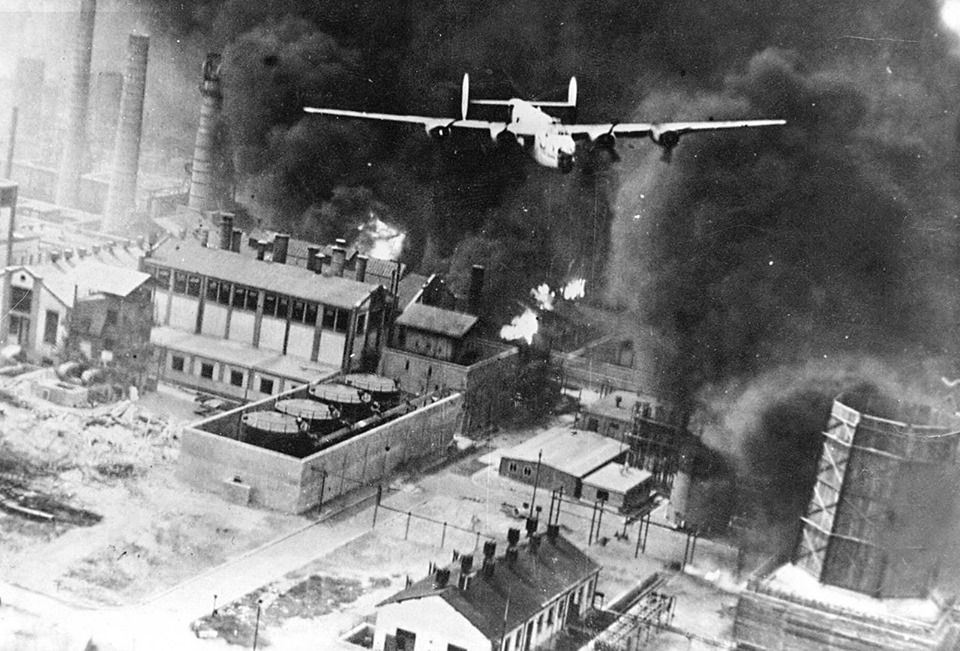
      August 1, 1943. Operation Tidal Wave

      178 B-24 Liberator very long range heavy bombers of the 8th and 9th Air Forces (United States Army Air Forces) based in Libya, with 1,751 crewmen, made an extreme low-level attack on the Axis oil refineries at Ploesti, Romania.

      The mission was a disaster: 53 B-24s were lost, 310 crewmen killed in action, 108 captured, and 78 interred in neutral countries. The damaged refineries were repaired within weeks and their output was higher than before the attack.

      Five Medals of Honor were awarded, three posthumously, the most for any single air action in history.
      b24.jpg

      posted in World War II History
      captainwalkerC
      captainwalker
    • RE: On this day during W.W. 2

      @barnee said in On this day during W.W. 2:

      @captainwalker
      Thanks captain Do you know what ship the picture was taken from ?

      From the light cruiser Hermione…

      posted in World War II History
      captainwalkerC
      captainwalker
    • RE: On this day during W.W. 2

      Mid-day on the 4 December 1943

      A Japanese Nakajima B6N ‘Tenzan’ torpedeo bomber is hit by a 5 inch shell while attacking the USS ‘Yorktown’ aircraft carrier off Kwajalein Atoll, Marshall Islands, North Pacific.
      Deck side account, “At 300 yards, the Jap plane took a shell in its left wing and flames spurted out. The pilot then veered to try to crash into the Yorktown, skimming the flight deck so close that the flames singed the beard of one of the Yorktown gunners. The plane finally crashed into the sea 100 yards close aboard and exploded in a ball of smoke and flame.”

      (Photo taken from the aft end of Yorktown’s flight deck, by Chief Petty Officer Photographer’s Mate , Alfred N. Cooperman)

      (Colourised by Royston Leonard)kamikaze.jpg

      posted in World War II History
      captainwalkerC
      captainwalker
    • RE: On this day during W.W. 2

      Wishing everyone here a Merry Christmas!merry christmas army.jpg

      posted in World War II History
      captainwalkerC
      captainwalker
    • RE: On this day during W.W. 2

      January 3, 1941. Eastern Front

      German command problems continue on 3 January 1942 as the Red Army counteroffensive broadens. Already, two army group commanders and numerous generals such as Heinz Guderian have been sacked. The generals now are fighting over retaining control over units which the OKH and Hitler want to be transferred between commands. General Georg-Hans Reinhardt, commander of 3rd Panzer Army, refuses an order from General Adolf Strauß at Ninth Army, who has been given control over 3rd Panzer Army. The situation in Army Group Centre always has had these ad hoc commands, where one army is given command of another, but Reinhardt is upset about the refusal of Strauß to give him command over V Panzer Corps, which had been transferred to his sector. Army Group Centre commander Field Marshal Guenther von Kluge finally has to threaten Reinhardt with a court-martial if he does not obey Ninth Army’s orders. This is a prime example of the diva-ish behaviour that regularly breaks out within the upper ranks of the Wehrmacht.

      Soviet troops are advancing on Rzhev, which had been far behind the front lines a few weeks ago. The Luftwaffe manages to operate despite -40 °F temperatures and flies in a battalion of reinforcements. The Germans have requisitioned winter clothing from the local inhabitants and learned ways to keep their machine guns and other automatic weapons working. This gives them a fighting chance to hold Rzhev, which is an important railhead and the entrance to the “land bridge” to Moscow.

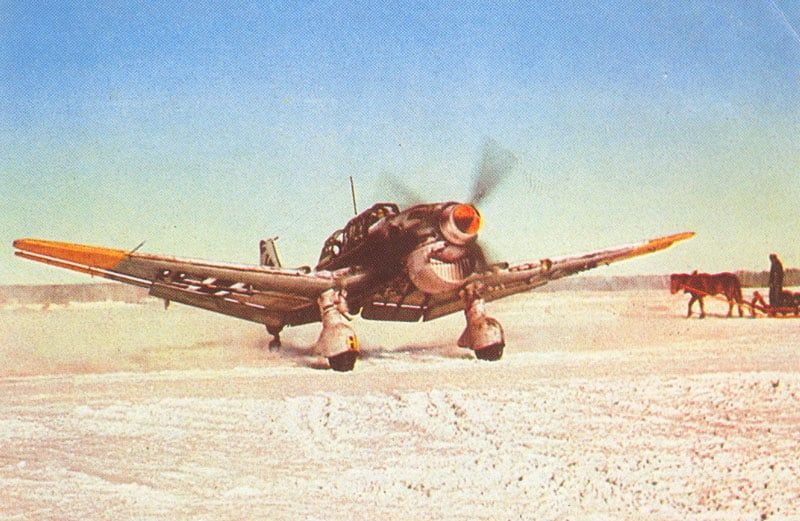
      Further south, Junkers Ju 87 Stukas of StG 77 attack Soviet shipping off the Kerch Peninsula. They bomb and badly damage Soviet cruiser Krasnyi Kavkaz. It is under repair until October 1942. On land, the Germans begin building up forces for a counterattack along a line about 10 miles west of Feodosia while the Soviet 51st, which has occupied the entire Kerch Peninsula, begins moving slowly west to reinforce the 44th Army. General Erich von Manstein, commander of 11th Army, sends 30 Corps under the command of Generalmajor Maximilian Fretter-Pico and also two other divisions from the Sevastopol perimeter to buttress the new line in the east. The Germans plan a counterattack as quickly as possible but it will take a couple of weeks to launch.

      Source: worldwartwodaily
      stuka russia.jpg

      posted in World War II History
      captainwalkerC
      captainwalker
    • RE: On this day during W.W. 2

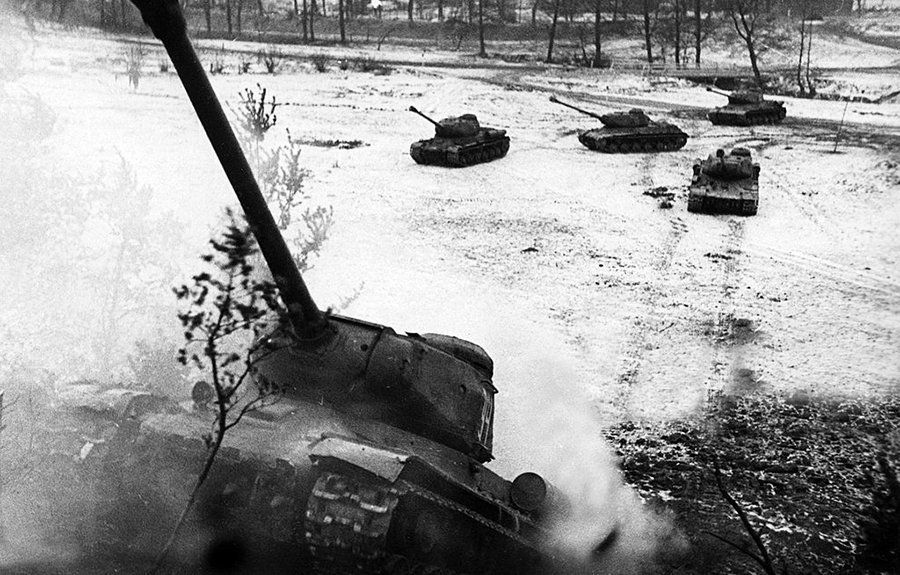
      January 12, 1945. On the Eastern Front, Stalin launches the Vistula-Oder Offensive earlier than originally planned. Soviet forces attack with over 2,000,000 men, 4,500 tanks, 2,500 assault guns and 5,000 aircraft.russian vistula.jpg

      posted in World War II History
      captainwalkerC
      captainwalker
    • RE: On this day during W.W. 2

      January 28, 1942. Eastern Front
      The unexpected success by a small German force to relieve the trapped garrison at Sukhinichi leads Adolf Hitler to begin dreaming of bigger successes. He asks the Second Panzer Army to convert the relief operation, which barely reached the town, to continue to the northeast toward a Fourth Army garrison at Yukhnov. This, at least theoretically, would trap a large Red Army force to the west. The plan bears remarkable similarities to Hitler’s desire to have Army Group North continue its advance past Tikhvin in November 1941. Second Panzer Army commander General Rudolf Schmidt has to explain to the Fuehrer that further advances are impossible until reinforcements arrive.
      The Soviet Stavka (military command) creates the Crimean Front under Lieutenant General Dmitry Timofeyevich Kozlov. It includes the 44th, 47th, and 51st Armies. The Separate Coastal Army and Black Sea Fleet also come under Kozlov’s control. General Kozlov is inexperienced and has been hastily promoted from a regimental command, and his staff also is inexperienced. The Stavka sends Lev Mekhlis to Kozlov’s headquarters to help plan strategy, and the two agree to launch an offensive in mid-February to reconquer the entire Crimea. The Soviets in general and Kozlov, in particular, remain under the impression that the Red Army has military superiority in the Crimea when the opposite is true. In addition, the Kerch Peninsula has poor roads and the Luftwaffe has complete aerial superiority, making road movements in daylight extremely hazardous for the Soviets.
      Photo: A Soviet KV-2 captured by the Germans and put into use on the Kalininsky front. 28 January 1942. The Germans would sometimes use captured tanks as “Beutepanzers” (“booty tanks”).
      Source: worldwartwodailykv2.jpg

      posted in World War II History
      captainwalkerC
      captainwalker
    • RE: On this day during W.W. 2

      January 30, 1942. Eastern Front

      There are heavy snowstorms in northern Russia on 30 January 1942 which bring most operations on the Moscow sector to a halt. General von Mackensen’s III Panzer Corps moves north in anything it can find to use as transport, while XI Corps moves east, both trying to cut off Soviet advances near Barvenkovo. There is little fighting today, and overall the poor weather aids the Wehrmacht’s attempt to stabilise the front while the Soviets are having trouble capitalising on earlier successes. Soviet forces also are getting strung out as they cover much longer distances than the Germans do. The Red Army cavalry is moving much faster than the tanks and infantry, leaving them vulnerable for a riposte - if the Germans can get into position to deliver one.

      Source: worldwartwodaily eighty 8.jpg

      posted in World War II History
      captainwalkerC
      captainwalker
    • RE: On this day during W.W. 2

      February 2, 1942. Eastern Front

      The winter has bent but not quite broken the Wehrmacht, and by 2 February 1942 it is fighting back to protect its most vital arteries. The Rollbahn, a major (for Russia) road from Yukhnov to Gzhatsk, is the lifeline to Fourth Army in the Moscow sector, and the Soviets have held it for a week. The Germans now are fighting furiously from either end of the road to open it up, with General Heinrici sending his Fourth Army troops south and General Ruoff advancing with his Fourth Panzer Army vehicles north toward him. They make good progress today, though they do not quite close the gap and reopen the road yet. There are supplies waiting behind Ruoff’s forces to be sluiced through the moment the road is cleared. This is one of the most important operations of the winter because until the road is cleared, the Fourth Army must rely on air support. The Luftwaffe already is hard-pressed supplying surrounded garrisons at Kholm, Demyansk, and elsewhere, so clearing the road is a top priority.

      As the Germans regain their footing on the Eastern Front, their ambitions begin to expand again. General Dietl, commanding the Army of Lapland, is trying to convince the Finns to participate in an attack to cut the Soviet railway line to Murmansk at Belomorsk. Marshal Mannerheim, commanding all Finnish forces, is noncommittal but indicates that he would be ready to participate in such an operation once the Germans capture Leningrad. Of course, the Germans have no hope of capturing Leningrad anytime soon due to their difficulties on the main front and pretty much everyone knows that. German General Waldemar Erfurth, who leads the German liaison team at Mannerheim’s headquarters, reports back to OKW that Mannerheim has a pessimistic view of the war and is unwilling to stage any attacks that he has any chance of losing. Mannerheim prepares a letter to General Keitel today which basically expresses these views. The Germans have no alternatives in the northern sector of the front and are at Mannerheim’s mercy.

      Source: worldwartwodaily russian winter 2.jpg

      posted in World War II History
      captainwalkerC
      captainwalker
    • RE: On this day during W.W. 2

      The Tol Plantation Massacre - 4th February 1942
      Rabaul was the capital of Australian-mandated New Guinea and was protected by a tiny garrison consisting mainly of the 2/22nd Australian Bn - “Lark Force”.
      The town was quickly routed by a massive Japanese fleet of carriers, destroyers, submarines and fighter and bomber aircraft.
      When the order “every man for himself” was given, soldiers and civilians fanned out over New Britain looking for escape routes through the most rugged terrain imaginable.
      Some endured an epic trek through dense jungle, battling malaria, dysentery, tropical ulcers, leeches, exhaustion, malnutrition and crocodile-infested rivers, to eventually reach points where they were able to escape on small boats.
      But this was not the majority, including those who reached Tol Plantation hoping to be rescued.
      To their horror, five barge-loads of Japanese troops were on the beach to meet them.
      There was no option for the starving, exhausted, virtually unarmed Australians but to surrender. At first it seemed they would be treated as normal PoW’s. Then an order to execute the PoW’s was given.
      Red Cross brassards were ripped off medics. Men were trussed together in small groups with fishing line or ropes and taken into the jungle and slaughtered.
      They stood or sat listening to their mates’ death cries, awaiting their own fate by blade or bullet.
      The few survivors told of grinning Japanese soldiers emerging from the bush wiping blood from their bayonets and beckoning their next targets.
      Some victims were asked if they wanted to be shot or bayoneted, a majority chose to be shot only to be bayoneted. Two wounded men found alive in Waitavalo Plantation homestead had been smeared in pig grease to be burned alive in the house.
      Requests for final cigarettes were refused. Some men prayed, some begged for their lives, others said cheerio to their mates.
      They were covered in palm leaves and left to die. Incredibly, several men feigned death and survived to tell the story.
      Pte Billy Cook, 2/12 Australian Field Ambulance survived 11 bayonet wounds. He wrote:
      “The first stab knocked us down. The Japs stood over us stabbing madly. I received six wounds in the back, two just missing the spine, two more breaking ribs…
      “As the Japanese were moving off, the man next to me groaned. One of the Japanese soldiers came running back and stabbed him once more. By this time I could hold my breath no longer. When I drew a deep breath the soldier heard me and inflicted four more bayonet wounds.
      “The last thrust went through my ear into my mouth, severing an artery on the way. Seeing the blood gushing out of my mouth, he assumed that I was at last dead, he covered the three of us with coconut fronds and vine leaves and left.”
      Cook somehow crawled off into the jungle, as did five other survivors, and eventually was evacuated from New Britain to Port Moresby with 156 soldiers, sailors and civilians aboard the overcrowded government yacht, the Laurabada.
      Approximately 160 members of “Lark Force” were massacred.
      An estimated 1,053 of the troops and Rabaul residents who remained in the town or who were captured would eventually perish as prisoners when their prison ship, the Montevideo Maru, taking them to Hainan then occupied by Japan, was sunk by mistake by a US submarine " USS Sturgeon", off the Philippines on the 1st July 1942.
      After the war some remains were retrieved, and buried at Rabaul’s beautiful Bita Paka war cemetery, but the bones of others are still in the jungle soil of a place whose name most Australians and British have never heard of.tol plantation.jpg

      posted in World War II History
      captainwalkerC
      captainwalker
    • RE: On this day during W.W. 2

      On this day in 1944, Field Marshal Manstein begins his relief attempt to break the Korsun–Cherkasy Pocket.
      Six German divisions were surrounded. Though many trapped men escaped, they had to leave nearly all of their equipment behind, with heavy losses.tiger in winter.jpg

      posted in World War II History
      captainwalkerC
      captainwalker
    • RE: On this day during W.W. 2

      February 9, 1942. Eastern Front
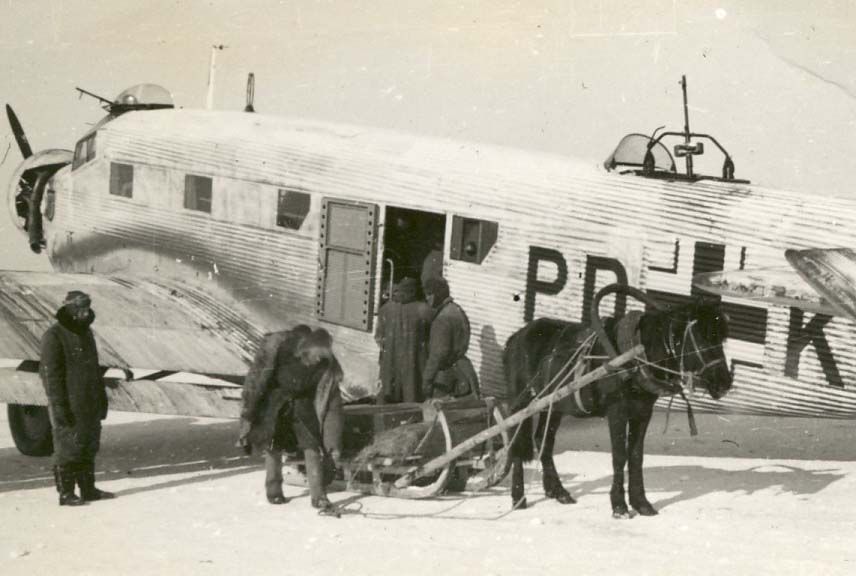
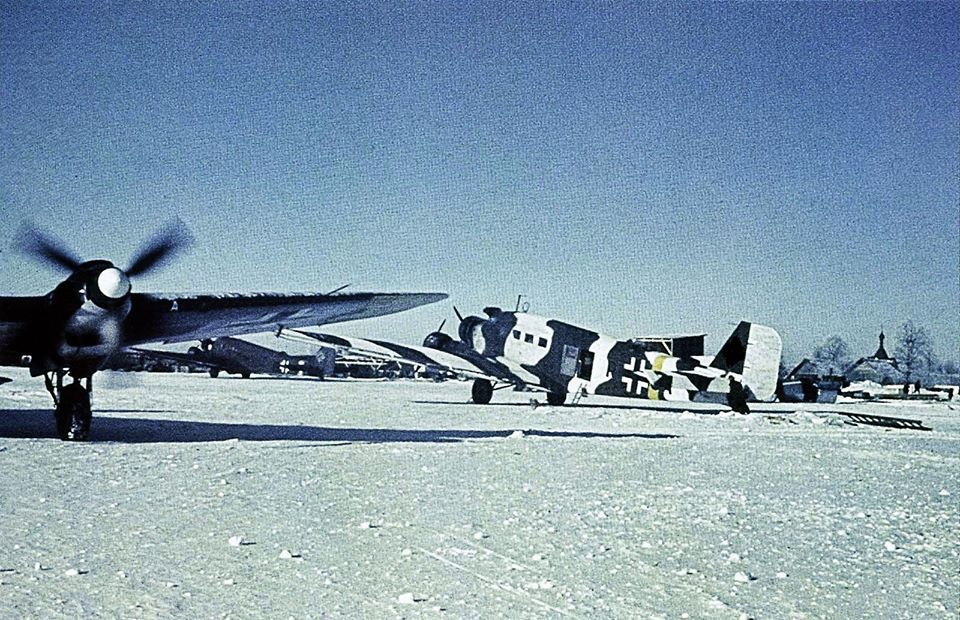
      The Luftwaffe airlift to the encircled German garrison at Demyansk and Kholm is underway. The German troops in the larger pocket at Demyansk, II Corps, have reported that they require 300 tons of supplies every day to survive. This is a lot of supplies to ferry, considering that every Junkers Ju-52 could only carry about one ton of supplies. The transports are slow and very vulnerable to the Red Air Force fighter attack, so they have to fly in “convoys” of 20 to 40 planes with fighter cover. The airfields within the Demyansk pocket are under sustained bombing attacks, which makes landings difficult at best and sometimes impossible. In the latter situation, the cargo containers are dropped through the bomb bay doors with parachutes and sometimes drift into enemy territory. Early indications are that the airlift will never reach its goal of 300 tons of supplies, but may barely carry enough to keep the soldiers fighting until they can be relieved.
      Source: worldwartwodailyjunkers transport.jpg

      posted in World War II History
      captainwalkerC
      captainwalker
    • RE: On this day during W.W. 2

      February 12, 1942. The Channel Dash

      Battle of the Atlantic: Having left Brest late on Wednesday, the ships of Operation Cerberus, better known as the Channel Dash, reach Barfleur, France, by dawn on 12 February 1942. This means that Scharnhorst, Gneisenau, and Prinz Eugen are due south of the Isle of Wight, some 300 miles (500 km) up the English Channel. The British remain blissfully unaware that the German operation is in progress, due to chance, clever German planning, and foul winter weather. Finally, an RAF patrol plane flies directly over the flotilla, but its pilot is under strict orders to not break radio silence. So, he waits until he returns to base to report his observation. By this point, the German ships are passing by Beachy Head in Sussex.

      As the ships pass Dover, the British Army’s long-range artillery attempts to engage them. However, the cloudy weather forces the gunners to guess the ships’ location, and the shells all fall short. Royal Navy torpedo boats then approach, but the MTBs are kept at bay by the half-dozen destroyers accompanying the three capital ships. They launch their torpedoes, but the two-mile range is too great and they score no hits. Then, the Royal Navy sends half a dozen Swordfish planes to launch torpedoes, escorted by 10 Spitfires. Adolf Galland’s Luftwaffe fighter cover (Unternehmen Donnerkeil) shoots all of the slow Swordfish down. Overall, the RAF loses 20 bombers and 16 fighters while the Luftwaffe loses 18 fighters.

      Sporadic British attacks continue throughout the day, without effect. The RAF sends 242 bomber sorties in all, but only 39 of them can even drop their bombs due to the fighter defences and poor visibility. They score no hits. When the Royal Navy sends destroyers based at Harwich to intercept the flotilla, they are attacked by RAF planes who have not been informed of their presence. When the five remaining destroyers approach, the German ships open fire and damage HMS Worcester. They score no hits. However, the German ships do not escape unscathed, as Scharnhorst hits a mine at 19:55 and Gneisenau hits one off Terschelling a bit later, but they continue sailing. Scharnhorst hits a second mine on the port side at 21:34, and this one causes the engines to stop. At 22:23, though, the Scharnhorst’s crew gets the starboard engine operating again. Under the cover of darkness, the ships continue on their way, Prinz Eugen and Gneisenau about three hours ahead of Scharnhorst.

      Photo: Gneisenau and Scharnhorst during the Channel Dash of 12 February 1942. channel dash.jpg

      posted in World War II History
      captainwalkerC
      captainwalker
    • RE: On this day during W.W. 2

      February 23, 1945 Iwo Jima.
      The moment after the famous photograph was taken.iwo jima after.jpg

      posted in World War II History
      captainwalkerC
      captainwalker
    • RE: On this day during W.W. 2

      February 27, 1942. Eastern Front
      In the Crimea, Soviet Lieutenant General Dmitry Timofeyevich Kozlov launches an offensive along a section of the front at the Parpach Narrows at 06:30. The Red Army has 93,804 troops, 1,195 guns and mortars, 125 anti-tank guns, 194 tanks, and 200 aircraft. The offensive begins with a 230-gun artillery barrage, but the shelling is poorly aimed and does little to disrupt the German defences. The Germans have their 46th and 132nd Infantry Divisions on the 42 Corps front along with the Romanian 18th Infantry Division. The Germans also have Gruppe Hitzfeld in reserve.
      The Germans rely on a hedgehog defence of fortified strongpoints at the villages of Tulumchak, Korpech’, and Koi-Asan. They have built strong fortifications all along the front, and they are aided by warmer weather which creates muddy conditions benefiting the defence. The Soviets must advance across a flat, 80-square kilometre plain which exposes them to brutal counter-fire. Soviet tanks, particularly the heavy KV-1s which are slow and make good targets, sink in the mud. Still, the Red Army soldiers take Tulumchak, which is held by the Romanian 18th Infantry Regiment. However, the Germans hold their other two strongpoints at Korpech’ and Koi-Asan after brutal fighting. The Luftwaffe makes 40 Stuka sorties which help to knock out 93 Soviet tanks in total, including 28 KV-1s. The Soviets do make minor gains but suffer heavy losses.
      Source: worldwartwodailystukas 1.jpg

      posted in World War II History
      captainwalkerC
      captainwalker
    • RE: On this day during W.W. 2

      March 7, 1942. Eastern Front
      The Luftwaffe on the Eastern Front is overstretched, and this is beginning to affect overall operations. Eighteenth Army informs the OKH that it is ready to begin Operation Raubtier (“Beast of prey”), whose aim is to re-establish the former line along the Volkhov River and thereby trap Soviet 2nd Shock Army to the west. The gap in the German lines is only about six miles wide, though the Soviet incursion bulges out to the west. Closing this gap is well within the Wehrmacht’s abilities. However, the operation depends upon strong Luftwaffe support, and it is fully engaged in supplying the trapped German garrisons at Kholm and Demyansk. Knowing that the two encircled outposts cannot survive without each day’s deliveries, Hitler postpones Operation Raubtier. The Eighteenth Army then tries to build up its forces sufficiently so that it can mount the operation with only minor Luftwaffe support, that but will take several days.
      Source: worldwartwodailydemanysk transport.jpg

      posted in World War II History
      captainwalkerC
      captainwalker
    • RE: On this day during W.W. 2

      March 10, 1942. Eastern Front
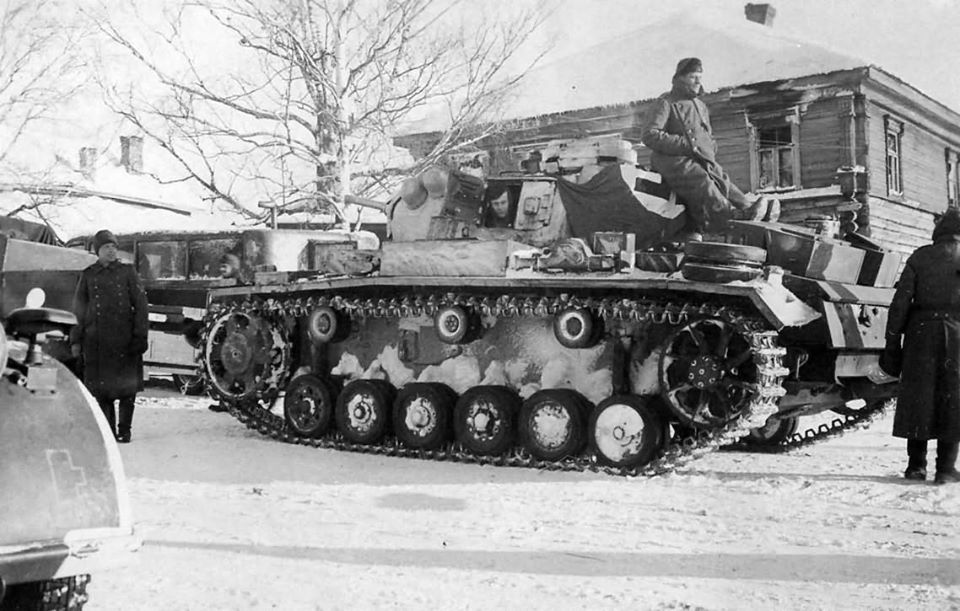
      German Fifth Panzer Division captures part of Soviet I Guards Cavalry Corps in a pocket south of Vyazma. After this, a blizzard hits the area which stops all movement for almost a week. The unusually heavy snowfall (even for the area) hampers the Uckermann relief attempt toward the Kholm pocket and creates dangerous icing conditions on the Luftwaffe’s planes that are keeping the pocket from collapsing.
      Source: worldwartwodailypanzer 3 russia.jpg

      posted in World War II History
      captainwalkerC
      captainwalker
    • RE: On this day during W.W. 2

      Fiat-Ansaldo M13/40 tanks of the VII Battaglione, 32 Reggimento Carri, Ariete Armoured Division on or about 24 March 1941, just before the Axis advance on El-Agheila. Italian troops, particularly infantry, formed a huge component of General Rommel’s successful Afrika Korps operations.italian tanks.jpg

      posted in World War II History
      captainwalkerC
      captainwalker
    • RE: On this day during W.W. 2

      March 28, 1941. Battle of Cape Matapan

      In late March 1941, as British ships of the Mediterranean Fleet covered troop movements to Greece, Mavis Batey, a cryptographer at Bletchley Park, made a breakthrough, reading the Italian naval Enigma for the first time. The first message, the cryptic “Today’s the day minus three,” was followed three days later by a second message reporting the sailing of an Italian battle fleet comprising one battleship, six heavy and two light cruisers, plus destroyers to attack the merchant convoys supplying British forces. As always with Enigma, the intelligence breakthrough was concealed from the Italians by ensuring there was a plausible reason for the Allies to have detected and intercepted their fleet. In this case, it was a carefully directed reconnaissance plane.

      At the same time, there was a failure of intelligence on the Axis side. The Italians had been wrongly informed by the Germans that the Mediterranean Fleet had only one operational battleship and no aircraft carriers. In fact the Royal Navy had battleships, while the damaged British aircraft carrier (HMS Illustrious) had been replaced by HMS Formidable.

      On 27 March, Vice-Admiral Pridham-Wippell, with the cruisers HMS Ajax, HMS Gloucester, HMS Orion and HMAS Perth and a number of destroyers, sailed from Greek waters for a position south of Crete. Admiral Cunningham with HMS Formidable, HMS Warspite, HMS Barham and HMS Valiant left Alexandria on the same day to meet the cruisers.

      On 28 March, 150 miles west of Crete, an IMAM Ro.43 floatplane launched by Vittorio Veneto spotted the British cruiser squadron at 06:35. Italian cruisers Trieste, Trento and Bolzano close in and open fire at 08:12 from 13 miles without success, then battleship Veneto joins in at 10:55 from 14 miles but cause little damage to 4 Allied cruisers as the Italians experienced trouble with their rangefinding equipment. Torpedo bombers from HMS Formidable attack Veneto at noon and again at 15:09, hitting a propeller and causing flooding which stops her for 90 minutes. Admiral Cunningham immediately orders the Mediterranean fleet to close on the damaged Italian battleship. Torpedo bombers from HMS Formidable and from Crete (815 Squadron) attack at 19.36, crippling Italian cruiser Pola. Cruisers Zara and Fiume remain to help Pola while Vittorio Veneto and the other ships run for cover at Taranto. After dark, battleships HMS Barham, HMS Valiant and HMS Warspite close to 2 miles unnoticed by the Italian ships (which have no radar). They open fire at 23:30, sinking 2 Italian cruisers Fiume and Zara and 2 destroyers Alfieri and Carducci while destroyer Oriani escapes with heavy damage.
      Photo: The battleship Vittorio Veneto firing upon the Allied cruisers during the action off Gavdositalian bb.jpg

      posted in World War II History
      captainwalkerC
      captainwalker
    • RE: On this day during W.W. 2

      March 30, 1941. North Africa
      General Rommel is ready to get moving. Since he does not have orders from OKH to attack, he gives his directives verbally. He tells the 5th Light Division to attack Mersa Brega in the morning. The 5th Light has had patrols out and reports that it captured an armoured car. The British 2nd Armoured Division defends Mersa Brega. Rommel is encouraged by recent skirmishes, including the capture of El Agheila, and also wants to advance to the Jebel Achdar (Green Mountain) south of Benghazi because it is a rare source of potable water in the desert.

      The RAF raids Tripoli in the early morning hours, causing only slight damage. The Luftwaffe also is in action, claiming to have destroyed an armoured car, self-propelled gun, and tanker.
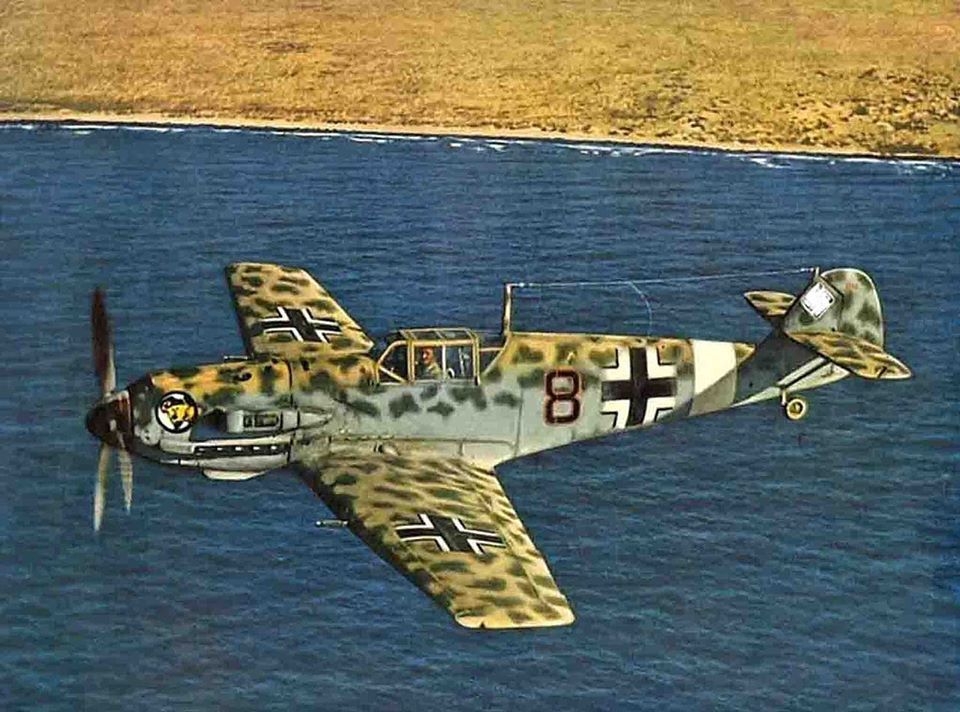
      Photo: Bf 109E-4Trop JG27 off North African coast, 1941
      Source: worldwartwodailyme109 water.jpg

      posted in World War II History
      captainwalkerC
      captainwalker
    • 1 / 1