edit* moved the working draft to the relevant game section. Thanks for letting me camp in the article section while I knocked it out. :-D
http://www.axisandallies.org/forums/index.php?topic=35703.0
Earlier…
Hi all! YG has asked me if I might be able to provide a kind of “General Introduction and Strategy Guide for Axis and Allies 1942 Sec Edition” as an outgrowth of the things I was writing in the “Russian openings” thread linked above.
If its cool with everyone here, I’d like to reserve this thread in the article submission section as a placeholder, so I can organize some of my ideas and outline a basic approach to the subject. Thought it might be easier to draft and expand things here first, then abridge/edit with feedback, before creating a final document. I imagine it will take me a few weeks to pull it all together, but I’m pretty enthusiastic when it comes to A&A, so hopefully it won’t take me forever.
:-D
Right now though, I just wanted to brainstorm a little, and highlight some of the subjects I think it might be worth addressing. This isn’t an article yet, just a way to get there eventually.
I’ve been teaching people how to play A&A for a while now, and I have some definite ideas about various ways to introduce new players to the game, starting from the very basic and moving into the deeper strategic territory. Although there is now a “starter board” called 1941 (currently in print) that is meant to do this job for us, I think 1942 Sec Edition is sufficiently simple enough that I could teach pretty much anyone how to play A&A using this board, without requiring prior experience with Axis and Allies. I don’t think you need to have played 1941 before you jump to this one, or that you need a familiarity with the earlier A&A games to enjoy and excel at 1942 Sec Edition.
It may be helpful for the purposes of comparison or analogy, if you’ve played a game like Risk or Chess or Monopoly before, if you are fascinated by the History of World War II, or like Maps, that’s fantastic too, but none of that is strictly necessary. All you really need is a bit of enthusiasm for the spirit of gameplay, and a little patience. If you’ve ever enjoyed playing with miniature figurines or Plastic Army Men as a child (setting them out and imagining battles!) then I can definitely teach you how to play this game.
First I just want pause and say, I think you should go out and buy yourself a copy! Its a great way to motivate yourself to learn how to play. :wink:
1942 Second Edition is still available at most shops and in many toy stores that sell boardgames. Its not too expensive, and if nothing else, you get a bunch little plastic army men out of the deal! Plus a playing field included (the World) for them to move around on!
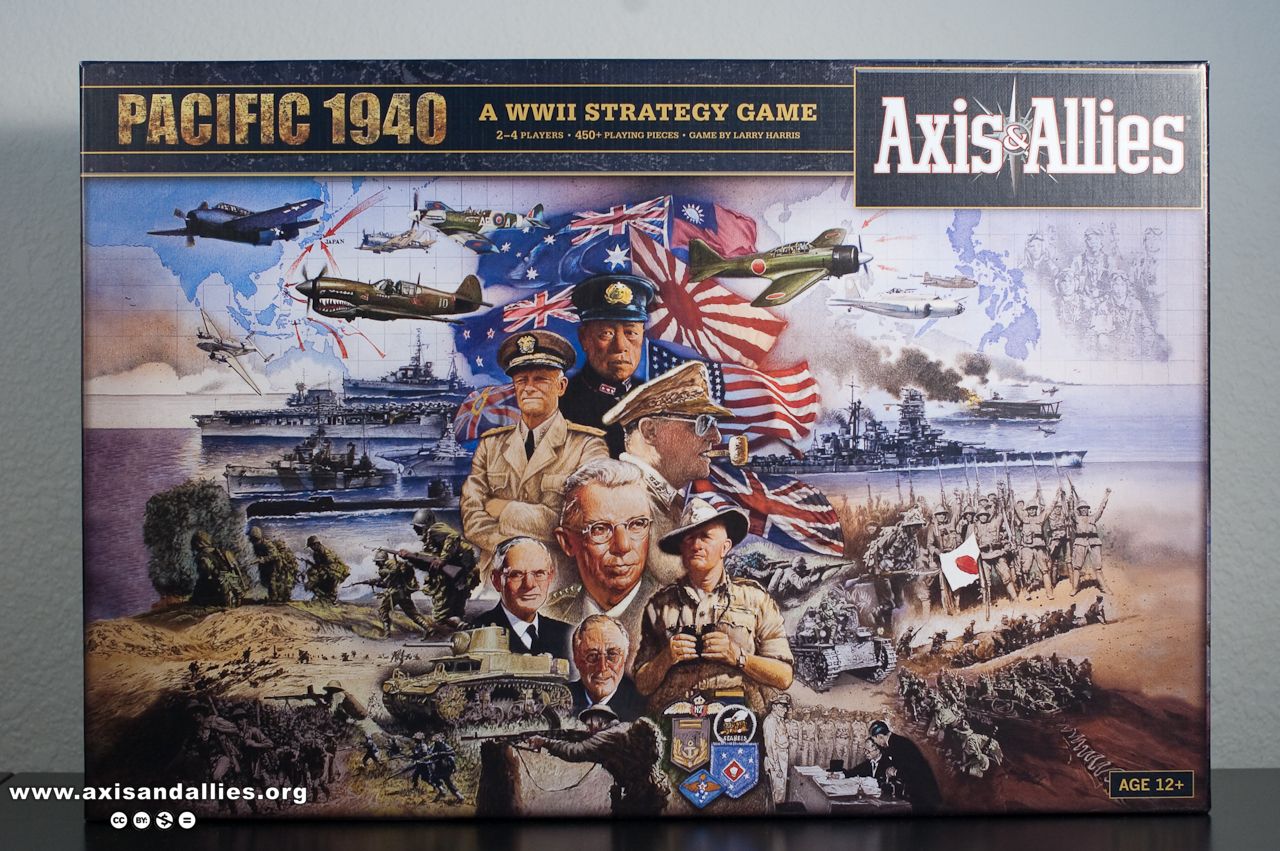
Sure, there is a recommended age for this game, but as long they’re old enough not to choke on the pieces or wantonly destroy the cardboard map, you can play A&A with most kids. Its nice to have a bunch of toys on hand, in a tidy box somewhere in your house. You know, just in case kids descend on you haha. But even for adults, this game has solid potential as an education tool, one that promotes greater aptitudes in the social skills, as well as in geography, history, and mathematics. Game play is good for us, and good for the species, I truly believe this. But if you need more help justifying the expenditure, how about support for the arts and the killer illustration on the cover of the game box?! Or poker-like predilections, with those mini stack-able A&A chips, now in Green too?! (like green M&Ms, you just want them! and I probably also just dated myself exactly haha, but those greens are great.) Or how about all the miniature flag roundels, and the thrill of punching them out?! There are all sorts of reasons to pick up this game.
Some of you who frequent these forums, or hang out on the Larry boards might know that I’m a pretty big proponent of digital gameplay. (For those who are new to these haunts or new to A&A, Larry is the dude who first created and came up with this game. He did us a solid. Thanks Larry!) But back to the subject of “Machine” aided gamplay, there are all sorts of digital tools and applications for Axis and Allies that are pretty cool. Everything from dice rolling, to battle calculators, to map emulators, to simulations of the game itself. I think these are all fantastic. I fully endorse them, and think they can be very helpful for learning and enhancing your comprehension of the game, but still, there is just no real substitute for the physical game on your table. Rattling the box open, laying out the pieces, feeling the dice in your hand, the thrill of facing down your opponent in an actual face to face match! That’s what it really comes down to. It’s not always possible to get someone to sit down with you and achieve the full gameplay experience, and in those instances there are great digital ways to play this game; by email or by forum, or live online using software, but face to face is still the ideal that I strive for. Everything else just builds up to it in my mind, like training, so you can be at the ready when the opportunity does present itself. It’s totally worth it to pick up a copy of 1942.2 for yourself, and this guide that follows will assume that you have, or hope to do so sometime soon.
:-D
That’ll do it for a mission statement, or a rocket launch, that mission control will hope to keep in view. What follows is I guess, a rough outline or notes. I’ll be editing as I go.
First things first, What’s in a Name?
Axis and Allies 1942 “Second” Edition:
1942.2, or the game you just bought, is one of the latest in a whole series of Axis and Allies games that came before it. Taking our time machine back to the 1980’s, this thing has been available in one form or another for geeks like you and me to enjoy for a while now. Each iteration aims to improve over the last and carry the concept forward, but the game itself is intended as a stand alone thing. There is no “First Edition” you need to pick up prior to playing this one. Everything you need (or at least, almost everything) can be found in the box, and all you need to know (or at least, almost all you need to know) can be found in the game manual. The “almosts” are why we’re here, to help you out and point you in the right direction. So with that in mind, lets talk about a couple things you might want to have on hand, in addition to the boxed materials…
Show me the Money!
This game uses a kind of currency, or game points, which are called IPCs. They are imagined as “certificates” that are meant to represent an Industrial Production Capacity (IPC). In the past, little paper bills were included as part of the Axis and Allies boxed materials, similar to monopoly cash or funny money, which you could hold in your hand and count. These bills were awarded for accomplishing your in-game goals, used to purchase units, or track your progress, and for other purposes as well. In the more recent Axis and Allies games, this paper money was replaced with an “IPC” tracker, but I really believe that it is helpful to have a physical representation of IPCs available when playing this game. You can find gaming “funny money” online or in specialty shops, or you can use colored pocker chips, or even simpler you can just use actual coins. Where I live Pennies and Nickels can be fun for this purpose, representing 1 ipc and 5 ipcs.
Not that I’d ever endorse gambling. (Although I totally would) ;) But just having something at the ready, for your players to count up and exchange, and horde as their IPCs, can be very helpful for maintaining general order while promoting a more avaricious desire to play the game (you know, until the sun comes up! haha). Honestly, it helps. The tracker can be useful too, but coins, or chips, or bills in hand, is just best, especially with newer players.
Write it down, check it twice:
Like all things conceived in one place, built in another, and coming into your home after passing through who-knows-how-many hands, there’s a chance things might glitch out somewhere along the way. Unfortunately these glitches sometimes occur with A&A games too. In 1942.2 a few things in the game manual and some of the set up charts included with the boxed materials weren’t 100% in line with the vision of its creator. I don’t know why these things happen, but they do, so in addition to the Box, you’ll also want to check out the game FAQ and Errata for 1942.2, and maybe print out a page to keep on hand. Often on these boards you’ll hear people use the acronym “OOB” what this means is the straight up game out of the box, by the book, or the “official” game. This is the game described in the manual + updated addendum from the FAQ/Errata.
The arbiters of officialdom, are basically the creator Larry, and our friend Krieghund who keeps us posted on Larry’s views whenever a serious question comes up. You can always ask a question here on the boards and someone will chime in to help. And if its a real stumper, then Krieghund, our war-hound on point, will bound over the barbed wire and guide us in the right direction so we can avert mini rules disasters.
That’s it! That’s all you need to get started. The game and the rules! Now that we have them, lets take it back to the basics…
Plastic Armies, and Plastic Army Training:
I’ve seen a lot of different ways that people teach this game, and reading the rulebook aloud cover to cover is probably the worst of these. It might be admirable for yourself, and necessary to do at some point, but it’s just not the best way to get people pumped up to play the game with you. If you take this approach to teaching, A&A can rapidly become overwhelming and tedious, and can challenge the attention span of the new person in your gang. Frequently they’ll look to you to just “explain how to play, so we can start playing.” And that’s the trick. If you have a second person in the room who knows how to play, you can do the “watch and learn” method. This is better than straight up reading the rulebook, but it can also be confusing for the new player. They will see a lot of things happening, without understanding why, and you will constantly be pausing and digressing and explaining what’s happening in a somewhat haphazard and circuitous manner. It works, but it takes a while, and it requires that you have at least 2 people in the room who know what they’re doing. Sometimes you won’t, sometimes its just going to be you and the new guy, and when you find yourself in this situation I have very basic method I like to use…
When I first learned how to play Axis and Allies, from my older buddies Griff and Oddie, they taught me to play it this way, and its the approach I’ve taken with new players ever since. Start with the Units, the Battle Board and the Dice!
The very first thing you’re going to do when you open the box, and the very first thing your new players will do when they dig in, is to pick up the plastic pieces and start checking them out. Fantastic! First hook achieved :-D
Once you have the little units in hand, and you’re ogling all the mini sculpts; looking over the infantry and tanks, fighters and battleships etc. I say dive right into the battle with the dice. Before you bother setting up, or explaining the map, or IPCs or production, or how units move, or even unit value as it relates to these things, just grab the units and start staging mock contests on the battle board!
Rolling dice is the one surefire way to get people quickly engaged with the game, and the combat system is truly what makes A&A. It allows you to “play” plastic army men, but “with rules.” You don’t even need a map or a broader game architecture for this to work, all you need is the battle itself, and a simple way to connect the units with the rolls. That’s the start, explaining Attack vs Defense, how “Hits” are determined, how casualties are allotted when those hits are made, and how this stuff all repeats until one side wins or the attacker withdraws.
I start with Ground. Infantry first, then add in the other ground units, explaining the principles of “heavy hitters” and “fodder” along the way. Then do the same thing with all the Naval combat units. Then the same thing with Air Units. Then combine these to showcase the different abilities or units in differing combinations. I like to talk about subs, destroyers, and aircraft last, as that one can be a bit tricky.
Now add in the AAAgun and show how it interacts with aircraft. Finally introduce the transport unit, showing how they can work in amphibious assaults with bombardments, or at sea vs air. Once you’ve gone through the entire unit roster this way, and have described the abilities and relative attack/defense combat values for each, pause the battles and turn to the economic/production aspect of the game
The easiest way to make this transition is with the Bomber unit. Its a good unit to showcase the concept of Unit Value/Cost. After you’ve showed your friends some ways that bombers can be used in battle, you can gradually segue to a discussion about how this unit can “also be used” to Strategically Bomb factories. SBR is way to show how units enter play. All units must be spawned at factories, so the SBR thing naturally gives rise to a more in depth discussion of what IPCs are, how they are awarded, and what they can be used for e.g. buying more units!
Here I find it helpful to draw more attention to the map itself, which until this point just serves as a backdrop and place to mess around with units, but which will now take on a more meaningful gameplay significance. It will make more sense now, since your players will start to “get” the concept that the territories on the Map=IPCs=Money=Units.
And Units that must be spawned from production facilities at specific places on this map.
At this point you’re still not “playing the game”, what you’re doing is priming your players and getting them invested in the process of “setting up the game.” As someone who’s played before, you might be temped to do your players a favor a set everything up beforehand to save time, but I think this has a definite downside if someone in the group is new to A&A or even just new to the map. Pre-Settting is something you can do next time, once everyone has a practice game under their belt. But for the first time out I think its really important, to actually go through the process of letting each player place their starting units, and read through their set-up charts, and all the rest. Not all together but one at time. In other words, don’t just hand everyone a set up card and say “go to town.” Instead, begin with the Russian set up, and get everyone involved. This will necessarily take a bit longer, but it doesn’t take as long as you might expect, and it has the advantage that everyone is on the same page, get’s to see all the units and all the territories involved, familiarizing themselves with names and locations and the distribution of forces, double checking to make sure that the set up for each nation is correct.
Take 5 roundels (one for each nation) out of the box, and arrange them from left to right in the sequence of the Turn Order.
Russia, Germany, UK, Japan, USA and keep these 5 off to the side somewhere where everyone can see them. Then go through the set up in that same order. You can have one player read off the locations and units from the set up card, and the other guy place them in the territories, both checking to make sure you got all the right stuff in the right place. You’ll notice that when you slowly build up like this, not only does the map take shape in a more organic and resonant way for your new player, but it also increases the feeling of mutual participation and anticipation. The situation on the gameboard will start to “read” for them, in a way that it won’t, if you just start slapping pieces down all over the place. This way there is a progression and a point of focus: First Red, then Black, then Tan, then Orange, then Green.
And by the time you get to Green (USA), all of your players will have surveyed the full map and starting forces. Green light go! Eat another green M&M! Do it this way, and I’m telling you, your new players will be so ready to rock it, you won’t be able to hold them back. Building to the crescendo, which is actually just the start, the First Round!
You can do this in an hour, 2 hours tops (if you include all the messing around on the battle board I mentioned earlier) but it will be worth it, because now your players will be fully invested in the game. They just built it out together, and it took a while, so they’ll be eager to get back to the battle board and the fun of rolling the dice!
Lets call everything I’ve discussed up till now, just a bunch of suggestions or advice for introducing new players to the most basic appeal of A&A. You might not get in a full game this first session, but you don’t really need a full game. Just making it through the set up and the first few rounds can often be enough to hook your new player and make them want to come back to finish what you’ve started. Or to do it again, “even better next time!” That’s what you want to shoot for, get a hook in, make it fun the first time, so you can get them coming back. Most people won’t have the patience to play a game like this, until they see how it just sucks you in, and once you’re sucked in, it’s like a happy black hole, you don’t wan’t to escape from, and couldn’t even if you did.
:-D
With visions of tiny tanks dancing through their heads, they’ll be going home and concocting strategies for “next time” maybe they search a few things online, try to up their game. But the whole point is to make it engaging, and in this respect I think pacing is important, part of what you’re doing when you play A&A is to create a “bigger” story about what’s happening on the board and with the dice. The narrative component of the gameplay, and this can take a little time, but there’s no need to rush it. Historical banter and high drama, more snacks! You know the drill
Right then, just wanted to draft something I could use here as a jumping off point, in order to keep the echo chamber echoing. For a more substantive outline of an actual article what I’d like to do is this…
Units: full examination of each unit in the 1942.2 roster. Discussing their abilities, attack/defense/movement and TUV significance, along with their magnified abilities. Battle board focus: Land, Sea and Air.
Map/Production Spread: overview of the games basic economy and how this relates to the map.
Player Nations: General overview of each Nation, following the turn order sequence. I’ve touched on this in the Russian openings thread, but I think it makes sense to have a look at each nation individually. Then analyze the situation “by sides” for both Axis and Allies.
First Round: Looking at potential opening moves, and opening builds for these 5 nations, with a discussion of “Theater focused” strategies/builds.
Endgame: Thinking about the overall production spread, income parity, double dipping etc. Then a discussion about capital control, capital trading, center control, and VCs. Here I think it makes sense to think of things like how to use turn the order, and builds/logistics/attacks over multiple rounds to set up viable endgames for each side. Lot of ground to cover there, but hopefully once the rest is fleshed out it will be easier to approach in a more coherent way.
Ok, that feels alright for a start, and a goal. I’ll return to this soon, as the ideas come. Catch you guys in a few.
-Elk