Axis & Allies .org Forums
    • Home
    • Categories
    • Recent
    • Popular
    • Users
    • Register
    • Login
    1. Home
    2. Argothair
    3. Best
    A
    • Profile
    • Following 1
    • Followers 4
    • Topics 88
    • Posts 3,173
    • Best 217
    • Controversial 0
    • Groups 9

    Best posts made by Argothair

    • RE: axis_roll vs. Argothair (AA50 Balanced Mod playtest)

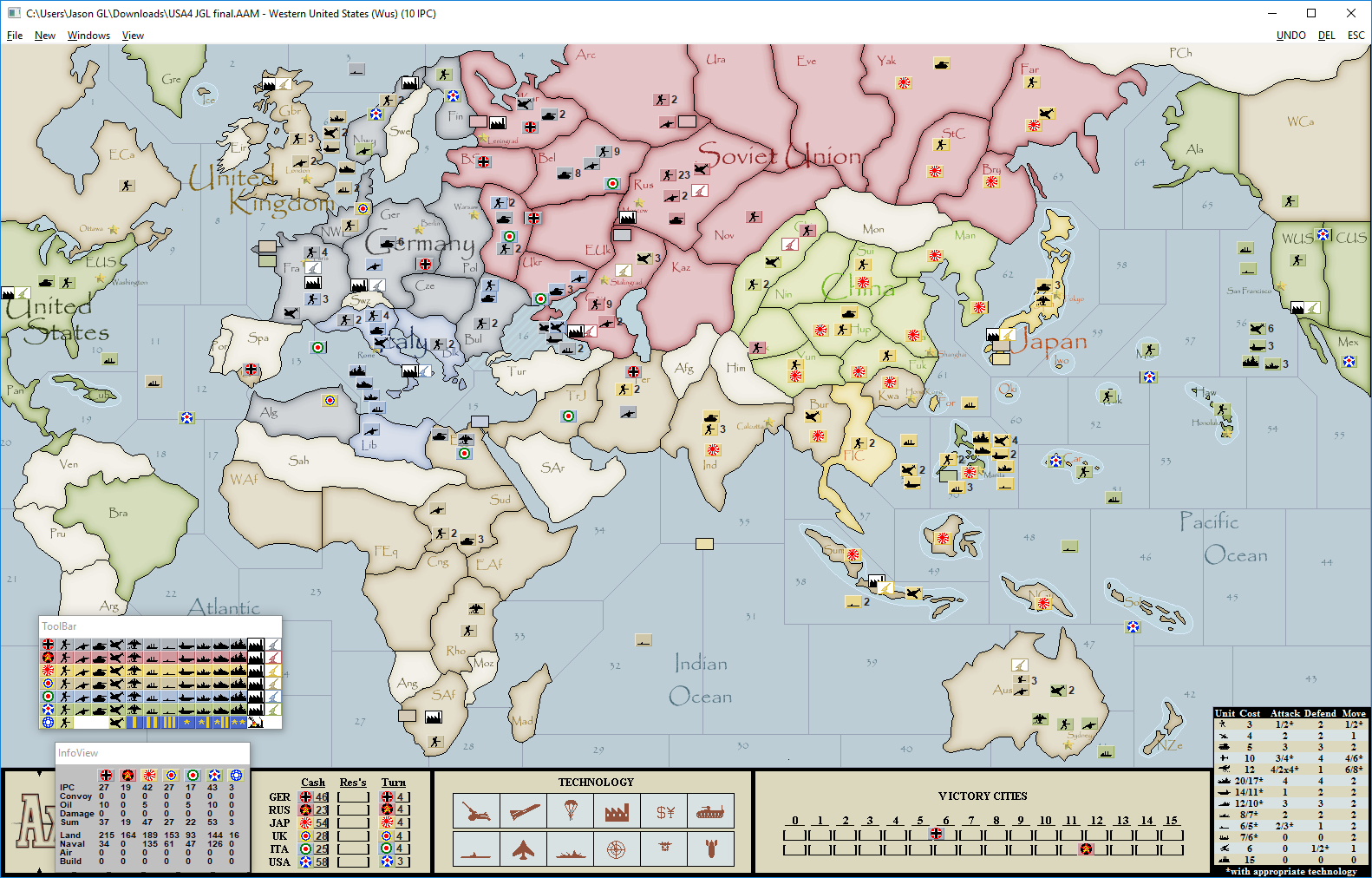
      Here’s the board after round 4:

      76549e02-654e-4727-86dc-31cc78f7cb40-image.png

      As you can see, the Allies have made some progress in Scandinavia and have kept the sea lanes to Australia open, but otherwise have had a lot of trouble getting any momentum going. The Axis are still out-earning the Allies by about 10 IPCs per turn, and Russia is unlikely to hold Stalingrad, which means that Russian income will further collapse.

      Based on the playtest so far, I’ve suggested letting the Russians have their lend-lease NO income starting on turn 2 instead of turn 3, and I’ve suggested letting China collect income (including its NO, if applicable) based on what China owns at the end of its turn, which would slightly increase Chinese income – so far China would have collected another 1 inf and 1 art this game if we had been playing the rule that way. @axis_roll notes that an Allied opening that included an Atlantic fleet buy on US1 before switching to Pacific buys on US2 and later might be more effective with these NOs, and I’m willing to give that a try, but my opinion at the moment is that the Russians are seriously under-powered with lend-lease delayed until turn 3.

      posted in Play Boardgames
      A
      Argothair
    • RE: Deck building area control WWII game?

      I’ve made a deckbuilding game with a friend that’s set during the American Civil War where you play cards from your deck to move different types of army units around the map, but it’s pretty specific to the Civil War – I don’t think it would port well to WW2.

      You might try Quartermaster General; it’s a bit lighter than A&A, but it’s a game about making very efficient use of each card in a relatively small deck to win World War 2 by moving armies around a map.

      posted in Customizations
      A
      Argothair
    • RE: Argo's Middleweight Map for 1939 & 1942

      @vodot Thanks! Let me know if you ever want to try a game; I think the balance still needs more playtesting from humans. :-)

      posted in Other Axis & Allies Variants
      A
      Argothair
    • RE: We need an allied playbook.

      USA:

      The USA starts off very slow, partly because it’s not at war and isn’t allowed to declare war for three turns without a specific provocation, and partly because it’s so far away from the initial front lines – a perfect US logistics chain is still usually two full moves, and more often it’ll take you three moves to get where you’re going. So a ship that you build on turn 1 isn’t likely to be part of any attacks until turn 4. This means you need to plan ahead and you need to make sure that when your forces finally do arrive, they do something that turns the tide of the game. It’s not enough to pick off a couple of medium-value territories; you need a high-value target that can win the game for the Allies.

      The four most plausible targets are, in no particular order:

      1. Queensland / Indonesia / Philippines
      2. Sea Zone 6 / Korea / Manchuria
      3. Southern Italy / Northern Italy
      4. Norway / Denmark / Western Germany / Berlin

      The idea behind the Queensland opening is that you build a large US Pacific fleet, and rapidly advance it from SZ 10 (San Francisco) to SZ 26 (Hawaii) to SZ 54 (Queensland, i.e., northeast Australia). Sitting in SZ 54 allows you to take advantage of Australia’s naval base and air base, so your fleet is protected by Australia’s starting 3 fighters, and it has some extra range. Conversely, Australia can take advantage of the US fleet’s umbrella to send otherwise unprotected transports up to Queensland. From SZ 54, both American and Australian transports can reach the Philippines, Java, Borneo, Celebes, Sumatra, New Guinea, Malaya, Siam, and Shan State – an astonishing 22 IPCs of territory, plus another 15 IPCs in national objectives. It’s also almost impossible to get transports from Japan to India (or from Japan to Sydney) without passing through the region controlled by the US fleet in SZ 54, so sitting in SZ 54 protects both of these two victory cities (and their respective economies), give them a chance to build up strike forces instead of turtling at home. You don’t actually need to force a major confrontation with the Japanese fleet in this opening – the fact that you’re sitting on their flank, stealing their most valuable territories, in a sea zone where it’s very, very difficult to defeat you means that you’re on track to win in the Pacific.

      The idea behind the SZ 6 opening is that by threatening the Japanese capital, you force Japan to recall its fleet and most of its air force very early in the game, limiting Japan’s ability to expand and giving India, China, and ANZAC a chance to retake some of their front-line territories. The American fleet moves from San Francisco to Hawaii, and from Hawaii the US is only one turn away from Japan via Midway and SZ 16. If Japan doesn’t put a blocking destroyer in SZ 16 or 25 each turn, then the US can rapidly move into SZ 6. Japan is uniquely vulnerable to convoys; almost every valuable territory that Japan does or could occupy is sitting adjacent to a convoyable sea zone, so if the US Pacific fleet parks in SZ 6, it will wreck Japan’s income. There’s also the possibility of taking Korea and building a minor factory there, allowing the US to rapidly reinforce its fleet and build up regional naval superiority. Without access to SZ 6, Japan has difficulty building enough boats to face off against the full US Navy – elsewhere, Japan has only minor factories, and usually at least some of the production slots in those minor factories are needed to build infantry to hold off the Chinese, Indian, and Siberian hordes.

      The idea behind the Italian opening is that Italy is the weakest Axis power, and can easily be neutralized and occupied to provide a permanent forward base for the Allies. A popular tactic that has gotten some discussion in earlier posts is to have the USA take Rome while the UK takes Northern Italy later in the same turn, preventing the Germans from immediately reclaiming Rome and giving the USA a chance to build infantry and land planes. Another benefit to attacking Italy is that Italy’s major factory is awkwardly located in Northern Italy, so if you can trade Northern Italy even once, that downgrades the factory and makes it very difficult for Italy to build enough units to keep up with American transports. The typical move order is Washington DC (SZ 101) to the west coast of Gibraltar (SZ 91) to the west coast of Italy (SZ 95). If you’re facing a strong Luftwaffe or stiff Italian naval opposition you may need to slow that down a bit by moving from west Gibraltar (SZ 91) to east Gibraltar (SZ 92) and then from there to the eastern coast of Italy (SZ 97). Once you’ve got an initial toehold, you can consider expanding to Southern France, Greece, and/or Yugoslavia, adding new minor factories as needed. The hope is that eventually the Germans won’t be able to place enough land units to contain your threat while also holding steady against the Russians.

      The idea behind the Norwegian opening is that once Germany loses control of the North Sea / Baltic Sea area, it has too many different land territories to try to simultaneously defend. Germany has to heavily defend Denmark, because otherwise the Allies can drop marines into Western Germany or Eastern Germany – the US can take Denmark, and then the UK can sail into the Baltic Sea later that same turn. On the other hand, Germany also has to heavily defend Western Germany, because that’s accessible to the Allies even without taking Denmark first. If Germany is serious about invading Russia, that will leave little or nothing left to defend Norway, Holland, and Normandy, and so the Allies can seize those territories and build or keep minor factories there. An HQ in Norway is particularly valuable because once the Baltic Fleet is gone, Germany has no practical way of retaking Norway, and the loss of Norway costs Germany one of its few early national objectives. Even if Moscow falls, the US may be able to continue to fight and successfully expand out of a Norwegian base. Also, London’s naval base and airbase can help a US fleet parked in the Channel project a lot of power while also remaining well-defended by British fighters.

      China:

      China’s options in the opening are usually pretty limited by a series of brutal Japanese attacks. China needs to fight for the Burma Road national objective while also maintaining at least a token ability to harass Japanese forces in northern China, but Chinese forces will rapidly be worn out through attrition, and once China loses control of Yunnan (or is pushed entirely out of northern China), it can no longer afford to build enough units to replace the infantry that it will lose every turn. Therefore, if China is fighting by itself, it will die in all but the strangest of games. To grow, China needs support from at least one of the British (in Yunnan), from the Russians (in Kansu or Manchuria), or from the Americans (in Manchuria or Kiangsu). Keep in mind that if the USA liberates a Chinese territory, even an ‘occupied’ territory like Manchuria, then China can immediately build more infantry there and immediately collect its income. In turn, if China can maintain control of a territory on or near the coast, that can provide a forward base that the USA can reinforce with planes, providing an ‘unsinkable carrier’ for the US Pacific fleet that will further restrict Japanese options for safe naval movement.

      When deciding what to do with China’s only fighter plane, keep in mind that the Japanese can ‘airblitz’ your territories, attacking them with a large stack of planes that are totally unsupported by infantry. If Japan can wipe out 10 of your infantry at the cost of 2 Japanese planes, that’s a pretty good trade for Japan. Similarly, Japan may be willing to trade one or two planes to knock out your irreplaceable Chinese fighter. This usually means that your fighter should be stacked up with your largest stack of infantry, and this sometimes means that your fighter needs to land on the far western border of China, or even in Burma – where-ever it will be out of reach of Japanese planes.

      posted in Axis & Allies Global 1940
      A
      Argothair
    • RE: axis_roll vs. Argothair (AA50 Balanced Mod playtest)

      The Americans collected 62 IPCs last turn, but with Germany consistently in the mid-40s, Japan in the mid-50s, and Italy in the mid-20s, that’s just not enough to make up for an anemic UK in the mid-20s and a struggling Russia that has been in the mid-20s and is likely to dive into the teens. America is nibbling away at the edges of Axis possessions, but not fast enough to make up for the loss of Russian income – the ability to send transports through the Turkish straits is powerful!

      @axis_roll suggested that the UK take a slightly different tack on turn 3, building a large Atlantic navy in the North Sea that could threaten Paris and Berlin and force them to keep infantry at home on the Western Front, instead of going south to Algeria and forcing Italy to divert troops from Ukraine / Egypt. Personally, I think it’s six of one and half a dozen of the other – either way, I don’t see how to hold Stalingrad long-term with the Russian income this low. axis_roll and I may swap sides at some point so he can show me!

      posted in Play Boardgames
      A
      Argothair
    • RE: [AA50/Anniversary] Modular Map Overlays - Splitting Australia, the Balkans, and Sea Zones; adding Cairo, Malaya, Singapore, Rio, Cape Town, Recruitment Centers and tons more!

      @vodot Yeah, zeroing out Siberia is another one of those hard design choices that you have to make at this level of complexity. On the one hand, it’s cold and snowy and thinly populated and you want the map to reflect that in a way that’s clear to new wargamers. It’s no good having Yakutsk generate more income then, e.g., Yugoslavia.

      On the other hand, the Soviets did relocate most of their industry to the Urals as the war went on, and much of that industry was fueled by mines and workshops in Siberia. They didn’t put all their millions of prisoners in the gulag just to be cruel; they were also mostly doing work vital to the war effort, I believe.

      If you squint you can say that Moscow + Urals + Kazakhstan together cover the cities like Kuibyshev and Perm and Chelyabinsk where all that Ural manufacturing was taking place, but it seems to me that at least some of that industry was really in the Siberian part of the AA50 map. Perhaps more to the point, if the Axis conquer Moscow and Stalingrad then there is really nothing important left in the Soviet income, which is very ahistorical. In real life something like 40% of Soviet economy was in Moscow/Stalingrad and points west, but on the AA50 map it’s closer to 80%. Zeroing out Siberia would make that even worse.

      posted in Customizations
      A
      Argothair
    • RE: WW2 Path to Victory - Strategies

      Here’s a Path to Victory map that’s been edited to show the maximum historical extent of Axis expansion – if the Axis ever controlled a territory at some point during the war, I gave it to them, and if the Allies ever failed to control a territory, I took it away from them. Thus, Iraq is Axis because there was a very brief pro-Axis coup; French Central Africa is neutral because it took a little while for the Free French to liberate it. Some territories are judgment calls – you could argue that the Germans took the territory represented by Vologda, near Leningrad, or that the Japanese never took the territory represented by Kweichow, but these are 1-IPC swings that would not greatly affect my conclusion.

      The interesting thing about editing this map is that Axis and Allied income are essentially tied. The Axis are collecting 134 IPCs per turn before national objectives, and the Allies are collecting 135 IPCs per turn before NOs. Assuming everyone is at war, the Atlantic Wall is duly garrisoned, there are enough German subs in the water to annoy the British, but not enough to interrupt Russian Lend-Lease, then I count 26 IPCs in Axis national objectives, and 27 IPCs in Allied national objectives. In other words, at the maximum extent of Axis expansion, the Allies were up by a grand total of $2. If the Axis take, e.g., Southern Caucasus or Midway, then the Axis are instead up by about $5. If the Allies liberate British Somaliland or the Solomon Islands, then the Allies are up by about $5.

      This is dramatic, but not especially historical – in real life, when the Axis were at their maximum expansion, the Allies were still out-producing them at least 2:1. It’s an interesting game design question whether it is more elegant to give the Axis a fighting chance by making the territories near their capitals worth more money (as Path to Victory seems to do), or by giving the Axis so many starting units that they are able to expand far beyond their historical borders (as, e.g., Anniversary Edition seems to do).

      41ad5cdc-611b-4501-b13b-79da97dc1c79-image.png i

      posted in Other Axis & Allies Variants
      A
      Argothair
    • RE: We need an allied playbook.

      UK:

      The key to the UK opening is making the best use of your limited number of transports. Any transports in the Atlantic that survive the German opening attack are still far enough northwest that they’re stuck in the northwest – at most, they can make it to Gibraltar or Morocco. You don’t normally need to take Normandy or Gibraltar on turn 1, so what you do with your Atlantic transports is usually not very important – the smart thing to do is to either stack them up with what’s left of the British Home Fleet (if that’s enough to keep them safe) or send them fleeing west to Canada to be part of a rebuilt British Home Fleet (if you’ve taken heavy losses and need a couple of turns to rebuild).

      Outside of the Atlantic, you should have exactly two transports: one near Egypt, and one near India. You have several plausible targets for these transports: Southern France, Greece, Tobruk, Ethiopia, Persia, and Sumatra.

      First, the niche cases. Southern France only makes sense if you’re playing Balanced Mod (to stop France from selling out ala Vichy) or if for some reason it’s clear that Germany has committed 100% to an Afrika Korps strategy and you need to shut down the German Med factory.

      Likewise, Greece only makes sense if Germany is severely over-extended – if both Germany and Japan declare war on turn 1, or if the Axis have declared war (or are clearly about to declare war) on the true neutrals. Greece makes a great monkey wrench if the Axis are relying on split-second timing to get their troops where they need to go, but you’ll lose your transport and you’re not actually going to kill many enemy troops or earn much income with your tiny Greek army of six units (four neutrals plus your one loaded transport), so don’t go to Greece without a good reason.

      The strongest play, in my opinion, if you can get away with it, is to send your transports to Persia and Sumatra. This activates the Persian infantry so that they’ll be ready to attack Iraq on UK2, activates the Persian territory so that you’ll be ready to build a factory there (and send the Russian mech on its merry way), and jacks up the UK Pacific income to a safer level. Yes, Japan can crush you in Sumatra – but they only have so many transports, so they can’t take Hong Kong and Malaya and Borneo and Sumatra and the Philippines all on one early wave of attacks. Holding Sumatra means you’ll still have some respectable income even after one round of Japanese attacks. I say “if you can get away with it” because sending a transport to Sumatra is much less justifiable when Japan has already declared war on you – you’ll lose the transport faster and you won’t collect the extra income for enough turns to pay for it.

      If you can’t or won’t go to Sumatra, another option is to send both transports to Ethiopia, along with the mech and tac bomber from Egypt. People often send one transport to Ethiopia, but I think that’s a mistake – Ethiopia is not a critical territory, and with only one transport, you’re not getting great odds – so why use a scarce resource (your transport) to set up an optional battle at only moderately good odds? The point of going to Ethiopia is to wipe the Italians off the face of East Africa, so that your existing units in the region can easily mop them up next turn, and your transports and aircraft can start moving elsewhere. If you’re going to have to transport units to Ethiopia again on UK2, there’s not much point in going there at all on UK1. In the long run, those Italian units have nowhere to go; they’re surrounded by British and French on all sides and they have no navy and no factories.

      Finally, there’s Tobruk. Only one transport can reach Tobruk, but you can get a fair amount of air power there, and you’ve got your land stack in Alexandria to fight with as well. A lot of people like Tobruk. I’m not one of them; I figure that Italian units are much better placed in the worthless deserts of Africa than as can-openers in the fertile Ukraine or as a pain in my rear soaking up the oil of the Middle East. If Italy wants to send reinforcements to Tobruk, that suits me just fine – if UK instead uses its air power to knock out most of the Italian navy at Taranto, then the Italians are never going to take Egypt anyway, let alone penetrate to Iraq. That’s also part of why I like to go to Persia early – if you build a factory there on turn 2, then it’s a flexible source of reinforcements that can go west to Egypt, east to India, or north to the Caucasus as needed.

      For those of you just tuning in, the Taranto raid is an attack on SZ 97 (the east coast of Italy) on the UK’s first turn. Different people recommend different configurations of units, but I like to bring in the entire British Mediterranean fleet minus one destroyer, plus every British plane that can reach. Note that planes in London can usually reach; some of them can land on the carrier, and the planes that started on the carrier can land on Malta, where they’ll be reasonably safe because they’re protected by an infantry and an AAA gun. I then also attack SZ 96 (Malta) with the Mediterranean destroyer and the cruiser from the west coast of Gibraltar. If that cruiser died to a German sub attack, I replace it with a single fighter. When the dust clears, Italy should be left with only one fleet and only one transport (in SZ 95, the west coast of Italy), and they just can’t do much damage with it, nor can they afford to build more – with only 10 starting IPCs, the best Italy can manage is either a transport or a destroyer, neither of which is likely to allow them to survive a follow up attack by all of the planes you landed in the Mediterranean. If the Germans invest very heavily in the Med by sending the entire Luftwaffe to crush the British navy there, the Italians might manage to eke out a marginal victory and keep a boat in the water…but then Russia will have a much easier time holding its southern flank, and your factory in Persia can send forces west to hold Egypt.

      No British opening guide is complete without a few words on whether to scramble your planes to defend the British Home Fleet against a German air attack on turn 1 – and my answer is, yes, scramble if Germany tries to attack both of the major UK fleets (SZ 111 and SZ 110). Statistically, you expect to lose money on that battle, and you might get wiped out quite badly, but you can afford to replace your planes, and Germany can’t. A big win for Germany over the skies outside London means that Italy gets off to a slightly more powerful start while still ultimately being contained; a big loss for Germany over the skies outside London means that Germany is toast. You can also scramble if Germany does something weird that makes the German planes vulnerable, like attacking four different smaller fleets, or sending only five planes to attack one large fleet while using the other planes on land. The only time I wouldn’t scramble is when Germany concentrates its planes against one large British fleet – if you’re going to be outnumbered 10 to 6, then it’s not worth throwing your planes away.

      In terms of what to build, I’m a fanatical advocate for 2 infantry, 1 fighter in London – it’s enough defense for London that if Germany tries to do a Sea Lion, he’ll wish he hadn’t. Germany might wind up taking London, but not at a price he can afford. Any more defense of London is overkill; any less is too risky. I think you also need to build at least 3 land units in India, so that you don’t wind up giving India away to Japan too cheaply. Other than that, pretty much any purchase can be made to work out – you can spend the remaining money on a destroyer to fight for the Atlantic, on a transport near South Africa to get more efficiency and flexibility in the western Indian Ocean, on mechs and tanks for India to help it stack Yunnan, on artillery for India to help it trade Burma deep into the middlegame, on an additional plane, or even on a first-turn minor factory in Egypt if you’re doing a full Taranto attack. You can even get away with saving the extra money – you’re not likely to run out of build slots, and you may have a better idea of where to spend the money one turn later.

      Finally, I’m not reprinting it here because this is meant as a ‘beginner’ guide to Global 1940 openings, but check out @crockett36’s radical new ideas about Operation Richochet in the UK Middle Earth thread – he suggests that the key to victory as the UK might be not to attack anywhere at all, but instead to conserve and position your forces for a glorious comeback on turn 3 or 4.

      posted in Axis & Allies Global 1940
      A
      Argothair
    • RE: axis_roll vs. Argothair (AA50 Balanced Mod playtest)

      All right, axis_roll and I have called the first playtest at the end of round 5 – the Allies are still significantly down on income, and the problem’s only likely to get worse – Russia is collapsing faster than the Allies can hope to make up the difference in Scandinavia or the Middle East, and the South Pacific is basically stalemated.

      Per axis_roll’s request, we’re keeping changes to a minimum between playtests – so he’s got the Allies now and I’ve got the Axis with almost the same rules: the only change to the NOs is that Russian NOs are now activated starting with the end of round 2, rather than the end of round 3.

      552e3365-2f16-4e3a-acbb-42f1be905b8e-image.png

      posted in Play Boardgames
      A
      Argothair
    • RE: [AA50/Anniversary] Modular Map Overlays - Splitting Australia, the Balkans, and Sea Zones; adding Cairo, Malaya, Singapore, Rio, Cape Town, Recruitment Centers and tons more!

      @vodot Gorgeous! I love the way the Aleutians bridge the two sea zones and have a land connection to Alaska. Really gives the Japanese a reason to play in the north Pacific – not only can you now realistically capture a total of 3 IPCs, but the Aleutian landing zone poses a danger that fighters built in Tokyo can land on carriers, while fighters taking off from carriers can land in the Aleutians – in other words, if America loses the Aleutians, they might also lose control of the San Diego sea zone. Chef’s kiss

      posted in Customizations
      A
      Argothair
    • RE: Argo's Middleweight Map for 1939 & 1942

      Continued playtesting suggests the map is biased in favor of the Allies. To correct this, I’m thinking of making Berlin worth $10 instead of $8, adding 2 German infantry to Berlin, 1 German jeep to the Ruhr, 1 French fort to the Maginot Line, 1 Italian infantry to Rome, a Japanese carrier with 1 biplane to the Yellow Sea, and 2 Japanese commandos to the Japanese home islands. The idea is to give the Axis a bit more staying power in rounds 2-4 without unbalancing the turn 1 battles, which I am generally still happy with.

      If anyone has objections or concerns, speak now or forever hold your peace! I will post an updated map file to the server in a couple of weeks.

      posted in Other Axis & Allies Variants
      A
      Argothair
    • RE: Pearl Harbour Attack

      @Afrikakorps It might be a helpful exercise for you to try to specify exactly which units you think will be attacking India on J3 and where those units were on J2 and J1. I think Japan starts with 19 planes. If you’re sending 4 of them to attack Hawaii, and you’re lucky enough to take only 1 air casualty in all of your opening moves, and you’re leaving 3 planes near Tokyo to protect your northern fleet, that leaves you at most 11 planes for attacking India. Similarly, if you’re sending 4 transports east to take Hawaii, that leaves you at most 6 transports (= 12 land units) for attacking India. So you’re looking at an attack, at best, with 23 Japanese attackers – but surely you will take some land casualties at some point along your journey in attacking the Philippines, Kwangtung, and Shan State, so in reality you will have somewhat fewer units.

      You could also try to write out which British units you think will be defending in India on J3. Conservatively, it seems like those units would include at least the starting 6 inf, 1 art, 3 AAA, 2 ftr, 1 tac that start on India, plus the 5 inf that India can build on UK1, plus another 3 inf (minimum) that India can build on UK2. That means the UK is defending with at least 14 inf, 1 art, 3 AAA, 2 ftr, 1 tac. In reality, they will probably have a couple more units than that, because if they see your attack coming then they can reinforce from Burma, ANZAC, Russia, the Med, etc., but even with total surprise, you have to expect to be fighting against 21 British defenders.

      You also have to take and hold India – if the Allies can re-take India on UK3 or R4 using forces from the Mediterranean or Persia, then your gambit fails.

      If you’re going to base your entire strategy around a very specific, unusual, scripted attack, it helps to know what the odds of that attack are! I would bet that if you write out the scenario and run in through a battle calculator, and you’re honest with yourself about which units are going to be available to attack India on J3, then the battle calculator will show less than a 10% chance for Japan to hold India with more than 3 land units, even if you sacrifice every plane you own in the region.

      In general I think you are investing way too much effort into gleefully imagining how you will trick and manipulate your opponents, and not nearly enough effort into crunching the numbers to find a strategy that has a high probability of succeeding even when your opponents are aware of your plans. You’re not wrong that some weaker US players will panic after a strong Pearl Harbor attack and build a new US Pacific fleet that will be too slow to save Hawaii, and you’re not wrong that some weaker UK players will stubbornly try to defend Malaya while ignoring Japan’s staging ground in Shan State – but if the US player happens to realize that he can build fighters to reinforce Hawaii and win the game, or if the UK player happens to realize that an attack on the Shan State will save India and win the game, or if the Russian player happens to realize that an R2 attack on Korea will destroy the only possible source of the infantry you need to take India, then your whole strategy falls apart. The strategy you’re proposing is a little like the Fool’s Mate in chess – sure, if it works, then you quickly win the game, but once people know about it, it’s very easy for them to defend against it and crush you in the process.

      posted in Axis & Allies Global 1940
      A
      Argothair
    • Weddingsinger v. Argothair, playtesting Mechanized_Russia & Gibraltar_Stack, game 1

      @weddingsinger I’m ready to start our playtest when you are! What’d we agree on, low luck, no tech, balanced mod? You start with Axis? Send me your G1 whenever you’re ready. :)

      posted in Play Boardgames
      A
      Argothair
    • RE: [AA50/Anniversary] Modular Map Overlays - Splitting Australia, the Balkans, and Sea Zones; adding Cairo, Malaya, Singapore, Rio, Cape Town, Recruitment Centers and tons more!

      @vodot One thing to keep in mind while considering which French territories to add is what kind of role you envision for France in your game.

      Is the narrative focused on Free France and its small but cumulatively important efforts to build up from a colonial remnant and turn into a force that can potentially liberate part or all of metropolitan France? If so then you need some kind of reasonably secure rear area (e.g. French Equatorial Africa) that’s not too far aways from some relatively soft Axis targets (Vichy Algeria, Italian East Africa, etc.).

      Or, is the point of France to create a neutral or pro-Axis “buffer zone” that deemphasiszes the western Med in the middlegame by nudging most of the territories and sea zones in the region toward neutrality? If so then you might want to carve out a neutral territory in southern France, but you probably don’t care much about French possessions in Africa.

      You can have both in the same game if you insist, but I’m skeptical that France is interesting enough to justify both sets of changes in a mediumweight map. Better to save some ammo for other ideas, imo.

      posted in Customizations
      A
      Argothair
    • RE: Argo's Middleweight Map for 1939 & 1942

      New version is available for download from the server! In addition to the changes discussed above (ship costs, Guam, Samoa, boost to '39 Axis starting units, etc.), I have also playtested the '42 scenario a few more times and have added additional Allied starting units in the '42 scenario, as well as a few strategy notes for that map. I believe both maps are now reasonably balanced, although as always, more human playtesting will have the final vote.

      posted in Other Axis & Allies Variants
      A
      Argothair
    • RE: We need an allied playbook.

      @Guam-Solo I’m not the world’s most experienced Global player, but I’ve never had a Spanish beachhead used against me as the Axis, and I’ve never used it as the Allies. The difference between invading Spain and invading France is that invading Spain doesn’t require an immediate Axis response – if you’re in Paris, then you just gained a victory city and you’re one move away from permanently destroying my major factory in Western Germany. If you’re in Madrid, then you just gained 2 IPCs per turn. The consequences for the Axis just really aren’t in the same league. In a sense, actually invading Madrid is just a threat to do D-Day. Whether you pre-position your troops in Canada, London, or Spain, you’re still just pre-positioning. The only reason why I would want to do the Spanish beachhead is if I can’t get control of any sea zones near Europe, and I have to keep sending in waves of suicidal transports to cope with a Dark Skies strategy.

      posted in Axis & Allies Global 1940
      A
      Argothair
    • RE: Weddingsinger (Axis) vs Argothair (Allies) G40 BM, low luck

      TripleA Turn Summary: Russians round 1

      TripleA Turn Summary for game: World War II Global 1940 Balanced Mod3, version: 3.4

      Game History

      Round: 1
      
          Purchase Units - Russians
              Russians buy 9 mech_infantrys; Remaining resources: 1 PUs; 
      
          Combat Move - Russians
              1 artillery moved from Novgorod to Karelia
              3 infantry moved from Vyborg to Karelia
              6 infantry moved from Novgorod to Karelia
              1 infantry moved from Baltic States to Novgorod
              1 infantry moved from Baltic States to Novgorod
              1 infantry moved from Archangel to Novgorod
              1 infantry moved from Belarus to Novgorod
              1 infantry moved from Baltic States to Novgorod
              1 infantry moved from Eastern Poland to Baltic States
              1 infantry moved from Bessarabia to Western Ukraine
              3 infantry moved from Ukraine to Western Ukraine
              2 infantry moved from Caucasus to Rostov
              1 armour and 1 mech_infantry moved from Volgograd to Bryansk
              1 armour moved from Russia to Belarus
              1 mech_infantry moved from Russia to Belarus
              1 tactical_bomber moved from Russia to Novgorod
              1 fighter moved from Russia to Novgorod
              1 cruiser moved from 115 Sea Zone to 114 Sea Zone
              1 submarine moved from 127 Sea Zone to 125 Sea Zone
              1 artillery and 1 infantry moved from Russia to Bryansk
              6 infantry moved from Buryatia to Yakut S.S.R.
      
          Non Combat Move - Russians
              1 aaGun moved from Sakha to Amur
              1 infantry moved from Amur to Buryatia
              1 infantry moved from Amur to Buryatia
              1 aaGun and 6 infantry moved from Sakha to Buryatia
              1 aaGun moved from Russia to Bryansk
      
          Place Units - Russians
              3 mech_infantrys placed in Novgorod
              3 mech_infantrys placed in Ukraine
              3 mech_infantrys placed in Russia
      
          Turn Complete - Russians
              Russians collect 37 PUs; end with 38 PUs
      

      Combat Hit Differential Summary :

      Savegame

      posted in Play Boardgames
      A
      Argothair
    • RE: [AA50/Anniversary] Modular Map Overlays - Splitting Australia, the Balkans, and Sea Zones; adding Cairo, Malaya, Singapore, Rio, Cape Town, Recruitment Centers and tons more!

      @vodot My pleasure! Thanks for asking.

      Unit mix is very similar to the standard ww2v3 game; I didn’t want people to feel the units were unfamiliar. The only changes are that naval units are now cheaper, there is an option to build a minor factory called a ‘barracks’, and there are a few 2-hit bunkers starting on the map at setup. You can’t build any new bunkers.

      985e0ca8-317e-4341-92d8-41f65bf33f84-image.png

      Here is the map; it’s less exciting than Vodot’s gorgeous artwork, but it should be functional enough for online games. You can see that I’ve added Free France as a playable power (in light blue), and that there are new territories in the Med and the south Pacific. If anyone cares to make a skin or if there’s anything I can do to help with that, I’d love to hear about it.

      9e9473e9-5efb-4fc8-a5a8-a8f27aba5a52-image.png

      European setup:

      385a7eb7-c759-45da-a6b4-1d0498273213-image.png

      Pacific setup:

      a63560ae-de07-43b5-93ce-8aaf11d919cd-image.png

      And, finally, the reworked national objectives. These are easier to keep track of than you might think, both because the game automatically scores them for you, and because the oil derricks and Flying Tiger drop-off zones are marked with symbols on the map.

      33e0adb8-1f56-42b2-8089-b4629bb9da43-image.png

      posted in Customizations
      A
      Argothair
    • RE: G40 Balance Mod - Feedback Thread

      Does anyone have a list of what’s new in BM4 vs. BM3? I missed that somehow.

      posted in Other Axis & Allies Variants
      A
      Argothair
    • RE: We need an allied playbook.

      I was originally excited about this thread, and it was interesting to hear other people’s ideas about how to create a playbook that could give beginner-to-intermediate players a comprehensive overview of what specific moves they should make to do well with the Allied side during the first few moves of a Global 1940 game.

      At this point, though, it looks like the thread has mostly degenerated into a general stream-of-consciousness discussion about “how to win at Global 1940.” I’m not seeing a focus on the opening, I’m not seeing an attempt to be comprehensive, and I’m not seeing recommendations for specific moves.

      Do people want to try to get the thread back on track, toward creating a playbook? If so, I’d love to continue the discussion. If not, I’m going to unfollow the thread and let you all enjoy the rest of the conversation.

      posted in Axis & Allies Global 1940
      A
      Argothair
    • 1
    • 2
    • 3
    • 4
    • 5
    • 6
    • 7
    • 8
    • 9
    • 10
    • 11
    • 6 / 11