@arthur-bomber-harris I know you’re good at this game, but you’ve got to at least partly back up your claims when you’re throwing that much shade – otherwise it’s just rude. It’s not obvious why J3 DoW is a bad strategy; either tell us why you think it’s shit, or link to someone who did.
A
Best posts made by Argothair
-
RE: Axis are underpowered.posted in Axis & Allies Global 1940
-
RE: We need an allied playbook.posted in Axis & Allies Global 1940
@cornwallis Some interesting ideas in there. I appreciate in particular bombing the sub off Quebec and then landing in Iceland; I hadn’t thought of that, and it’s good to return the bomber as far east as you can as quickly as you can.
I think against your proposed opening I would do a Sea Lion most games, regardless of whether the US looked prepared. Once the British fighters land in west Africa, they can’t make it back to defend London, because there is no airbase there. Likewise the fighter from Gibraltar appears committed to the Tobruk strafe and then presumably lands in Egypt, where it can’t reach London. The new bomber in London is not going to contribute much to defense, so the proposed defensive buy for London is really only 3 units, which in my opinion is not enough after you’ve permanently sent all the fighters away to Africa. Also we’re assuming the Canadian transport was sunk, so no reinforcements arrive from Canada.
Egypt is relatively well-defended for now, but if Britain loses the capital or even if just Britain has to spend its UK2 income on max defense for London, then Italy will have a chance to catch up.
Can you say more about the purpose of strafing Tobruk? What are you trying to accomplish there, exactly?
-
RE: Balanced Mod [Anniversary 41]posted in House Rules
If anyone doesn’t want to read the entire game update thread, or if you want to skip my gaming buddy’s blatant pro-Allied propaganda, here’s the summary:
We played the first game out for five rounds, with axis_roll putting heavy Axis reinforcements into the Med via an early factory in France. As Britain, I built a factory in South Africa that didn’t quite pull its weight, and a US Pacific fleet that held the Japanese at bay but was not able to actually push them off of the core of their economy. axis_roll did a good job of shutting down Britain and Russia’s NOs, and Russia was so poor that even though German initially went south, Russia didn’t have the units to hold off the eventual German thrust, so we called the game when Russia’s position started to collapse. Germany also benefited from re-directing surplus African troops to Stalingrad via the open Dardanelles. The USA was earning slightly more than usual from the new NOs, but not nearly enough to compensate for Russia falling apart.
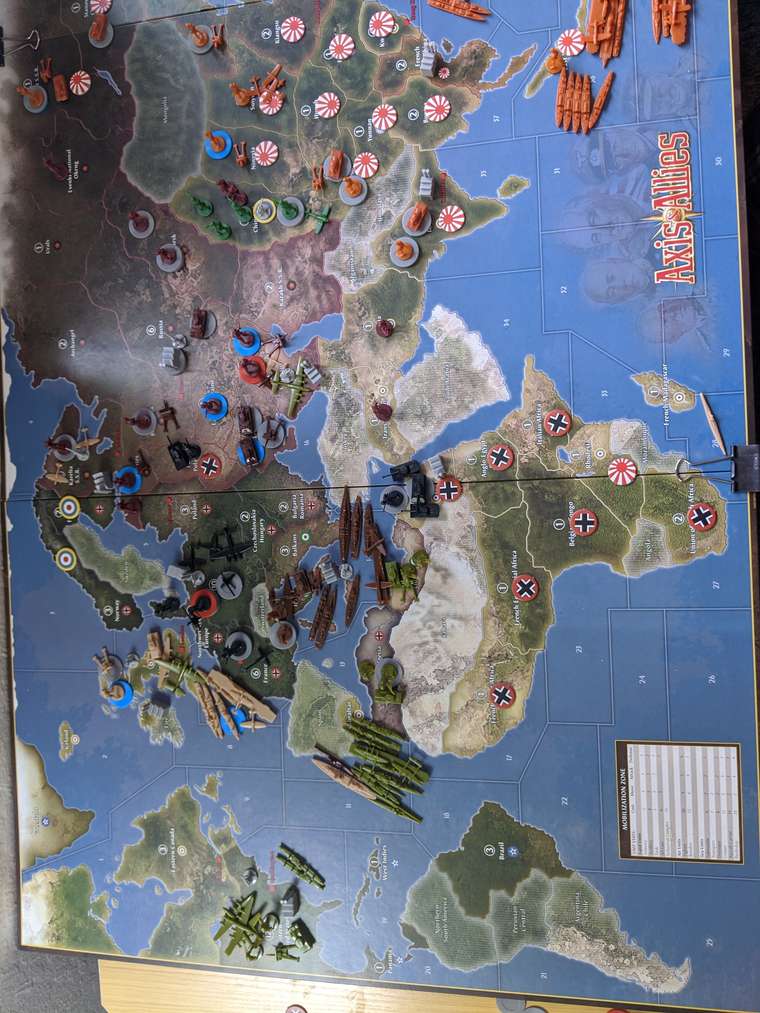
For the second game, to give Russia a bit more cash, we adjusted the Russian NOs to kick in on turn 2, and we switched sides. We are in the middle of round 6, and in my opinion, the game is still very much alive and kicking – fighting is hot in the Pacific, around India, and in eastern Europe. The Allies hold Scandinavia and are rapidly hoovering up Africa, but the Germans have western Europe locked down with big infantry garrisons – so the question is whether Moscow, Cairo, or the US Pacific fleet crack before the Germans and Italians run out of income after inevitably losing Africa.
We’re still struggling a bit to find ways to properly incentivize Pacific play – just giving the Allies money for holding territory in the Pacific doesn’t help much if holding the Pacific is impossible, so we’re not really seeing factories in India or China or Siberia or anything wild like that. There are too many d*** 1-IPC territories in the Allied Pacific sphere of influence, and too many starting Japanese transports and fighters to crush any initial pockets of resistance. It may be that just editing the NOs, by itself, isn’t enough to enable a truly competitive Kill-Japan-First strategy. Still, this game has seen a fairly convincing two-front war – the Pacific theater may be secondary, but it’s been a real front with meaningful losses and gains on both sides.
-
RE: We need an allied playbook.posted in Axis & Allies Global 1940
@mainah Another good question; I have two answers.
First, you don’t have to follow the opening plan quite so rigidly as to create a “formula.” If you like battleships, substitute battleships for some or all of your American carriers. If you like tanks, substitute tanks for some of your American artillery. If you like bombers, then load your initial American transports with 100% infantry, and plan to support them with bombers that you buy on later turns.
You also have some choices about theater and exact stacking location, even among the orthodox openings – you can go 80% Atlantic - 20% Pacific, or 70% Atlantic - 30% Pacific, or 60% Atlantic - 40% Pacific. You can stack your Atlantic fleet west of Gibraltar, or east of Gibraltar, or in the English Channel, or in the North Sea. You can concentrate the British economy in factories in Persia/Iraq, or build land units in South Africa and support them with fighters flown in from London -> West Africa -> East Africa, or just build a British Atlantic fleet to liberate France, or mostly send fighters to guard Moscow. All of these are valid options, and together they give you enough of an ability to vary your gameplay that your opponent won’t have a perfectly ‘canned’ response available and will have to calculate fresh how to defend each game.
The second answer is that you wait to do something bold and dramatic until the dice or your opponent do something weird. The best response to a standard Axis opening is a standard Allied opening; that’s why they’re standard, is that nobody has any reliably better ideas. But sooner or later, either your opponent will try some kind of gambit (and you can punish them for it, often by doing something weird yourself), or the dice will come up unusually strong or weak in a particular area of the map, which gives you an opportunity to exploit that with a weird strategy. Even weak dice can give you the excuse to abandon a region, which can free up cash to try a gambit somewhere else.
So the game does get complex and unique and replayable, but it mostly does that around turn 5 or 6, after players have had a chance to build their usual starting units and send those units into battle and see the results.
-
RE: Simplified Bombers, Flak Guns, and Submarinesposted in House Rules
Sure, you could put interceptors and escorts at 3 if you like, as long as only fighters are intercepting/escorting. I don’t think it makes much practical difference. And you could stop subs from hitting fighters; that’ s a simple enough change that speaks to most people’s intuitions.
I think having hidden information (hidden subs) is not really the right fit for the rest of the A&A franchise; I like hidden info a lot but I’d rather just play a game with two-sided blocks, like Europe Engulfed or whatever it’s called, that is designed from the ground up to handle hidden info.
-
RE: UK Strategy -"Middle Earth"posted in Axis & Allies Global 1940
@Cornwallis That’s very creative, and I appreciate you sharing it, but I agree with oysteilo that sending American transports to West Africa is too inefficient to be a reasonable strategy.
After unloading in West Africa, the tanks and mechs can certainly drive to Egypt as you suggest, but the infantry are basically wasted – by the time they can walk to Egypt that theater should already have been resolved one way or another. If you are going to carry on shipping the infantry from West Africa to Morocco then you are wasting a move because they could have just landed in Morocco in the first place, and I cannot see any good reason to ship the infantry from West Africa to South Africa – if South Africa is threatened so badly that it needs to be rescued by the Americans, then the Allies have already lost. A ‘buildup’ of infantry in West Africa does not accomplish anything that you could not do just as easily with a ‘buildup’ in the eastern US, because the troops in West Africa still can’t reach anywhere but Gibraltar and Morocco.
-
RE: 1942 3rd edition map thoughtsposted in House Rules
Love the idea of combining yakutsk, evenki, and novosibirsk into one high value inland territory, with Soviet far east as the low value, coastal dead zone between Russia and japan.
-
RE: UK Strategy -"Middle Earth"posted in Axis & Allies Global 1940
@oysteilo Well, sure, but then you have to dip into the thin British income to build a naval base in the Congo, or else your transports can’t quite make it back to Eastern US to pick up more ground units in one move.
-
RE: UK Strategy -"Middle Earth"posted in Axis & Allies Global 1940
@barnee I’m not recommending a naval base in Mexico; I’m just pointing out that Cornwallis’s plan of repeatedly shucking units between Mexico and southwest Africa seems to imply the presence of a naval base there. I agree with you that such a naval base is ill-advised.
I think there is very little point in shucking fast movers alone to west Africa – the extra defensive value in, e.g., Cairo is not worth the cost of the transports, let alone the naval base. America starts with only one transport in the Atlantic. There’s no sense in building up a fleet of American transports unless and until you’re ready to seriously challenge a sea zone that can actually put real pressure on the Axis.
If for some reason you really need to defend Cairo, American fighters will be more efficient. For example, if you build 3 transports on turn 1, then you have a fleet of 4 transports, meaning you can shuck 2 fast movers to West Africa per turn. You admittedly start with 4 mechs that aren’t urgently needed elsewhere; let’s say you buy 2 more mechs and 2 tanks to give them a bit of offensive punch. So now over the course of turns 1-4 you can ship your 6 mechs and 2 tanks to West Africa, and they will arrive in Cairo by turn 6. This costs the US $21 for the transports, $15 for the naval base, and $20 for the extra mechs/tanks – a total of $56 to get 8 hit points into Cairo that defend with 24 pips.
Alternatively, you could just build 6 fighters for $60. That gets you 6 hit points into Cairo by turn 4 (reach West Africa on turn 3) that defend with 24 pips. You arrive notably earlier with a force that’s very nearly as powerful as the mechs/tanks, plus your starting mechs are still available to fill up transports going to, e.g., Hawaii or to prepare for a later assault on Gibraltar.
All that said, one of the many advantages of a Middle Earth strategy is that you can safely withdraw from Cairo into Sudan/Jordan. It’s not urgent for the British to hold Cairo if the Allies don’t build a factory there. The UK can build 6 new units/turn (from S. Africa & Persia) that can attack Cairo, plus most likely some support coming in from India, Malta, the troops you divert to clean up Ethiopia, and so on. By contrast, Italy is very unlikely to be able to get anything like 6 land units per turn down into the region while also defending against, e.g., American subs. Over time, the balance of power will shift back toward the Allies and you will force the Italians back out.
-
RE: Supply Token for Lend-Leaseposted in House Rules
As far as Canada having its own separate economy, yes, that’s certainly part of what I’m envisioning here, although you can use the Supply Crate rules even if you have no interest in switching up the British economies. I would ideally like to have four English-speaking powers:
- USA
- British Empire
- Canada
- ANZAC
British Empire would be UK + Iceland + Gibraltar + British Africa + India + Malaya + Hong Kong, and anything they conquer or liberate during the game. The Indian major factory is downgraded to two minor factories: one in India, and one in West India.
Canada would get +1 IPC each in British Columbia (allows purchase of a minor factory if desired), Yukon (becomes passible), and Newfoundland, as well as an NO for clearing Axis subs from the Atlantic worth about 3 IPCs/turn. Alberta would start with an extra tac bomber, Hudson Bay would start with an extra DD, and Ontario would start with an air base. If anyone knows of other NOs that would make sense thematically for Canada, I’m open to suggestions. Politically, Canada is treated like ANZAC, i.e., it starts off at war with Germany and Italy, and it will declare war on Japan as soon as Japan is at war with UK and/or ANZAC. It can declare an unprovoked war on Japan if desired, but that keeps the USA out of the war for longer.
The lack of Canadian income would make Britain slightly more vulnerable to Sea Lion…but you can now spend Indian income to protect London if you want, so there is still plenty of flexibility for the Allies in terms of which English-speaking countries will come under early attack. If you build nothing in India, you would wind up having more money to spend in London than in a standard OOB G40 game.
-
RE: UK Strategy -"Middle Earth"posted in Axis & Allies Global 1940
@simon33 The thing about the neutral crush is that if the Allies can pull it off successfully, then they’ve probably already set themselves up for victory anyway. There’s 6 infantry in Spain, 8 infantry in Turkey, and 2 in Saudi Arabia. The US is limited in the opening in terms of how many loaded transports it can afford to send across the Atlantic, and the UK is limited in the opening in how many units it can build up in the Middle East, even in a Middle Earth strategy. If you’ve overcome these limits and managed to build up both a US force and a UK force each of which can successfully kill off 8 defending neutral infantry, and those forces aren’t urgently needed for defense anywhere, then (a) you probably could and should just successfully kill off 8 defending Axis infantry; there ought to be some target that’s worth taking that’s not so well-defended, and (b) you’re probably doing so well that you will win no matter what you do as long as it’s not insane.
On the US end, one of the challenges is that the coast of Spain is not necessarily a safe place to park your ships – it’s typically in range of German fighters and tac bombers flying out of West Germany; to block this attack, you would need to hold Morocco and Gibraltar strongly enough that Italy can’t take them back on its turn – which is hard to do if the Allied infantry headed for the western Med are all going to Spain. You need to crush Spain’s 6 infantry hard enough that your survivors can resist an Italian/German counterattack from France; you have to take and hold Spain so you can build facilities and land planes there; otherwise you’re just trading territory that’s far enough away from the German core that it’s not really a threat to them.
On the UK end, there’s nowhere reasonable to put a third factory in the opening – you can use your starting factory in South Africa and build a new one in Persia on UK2 after activating Persia on UK1. However, it’s not safe to put a factory in Egypt against a competent Italian player, and it’s not reasonable to attack Iraq any earlier than UK2, because you need time to activate the Persian units and bring them into the fight, as well as time to contain the Italians in east Africa. So the earliest you could build an Iraq factory is UK3, which means you don’t get any new units out of that factory until UK4 – and even then, the British economy is usually too weak to fuel all 3 factories reliably. You might be earning 42 IPCs if you’re doing very well. If you want a reasonable mix of land units, so you can, e.g., put fast movers in Persia and keep them involved in the action despite their relatively long walk to Cairo, then the buy looks something like 4 infantry, 2 artillery, 2 mechs, 1 tank, which costs 34 IPCs. You probably also need to buy at least a destroyer in the Atlantic to cope with German submarines, so that’s the full 42 IPCs. If you get hit with a successful convoy attack or strategic bombing run, or if you’ve lost even one original territory anywhere (e.g. Alexandria, or Gibraltar, or British Somaliland), then you have to make some painful cuts somewhere.
So as the British, you can’t reliably crank out 9 units per turn every turn in the global South – for the first few turns your factories aren’t all online yet, and then even after that sometimes you won’t be able to afford it. Let’s say you manage 7 units per turn. OK, but Italy can typically unload at least 2 transports a turn into north Africa or Syria, so you need 4 units per turn just to counter that…which means you have something like 3 units a turn to build up to a force that can sack the 8 units in Turkey at a profit. And that assumes you’re not diverting units east to save India from Japan, or buying fighters to send north to save Moscow, both of which are often a higher priority than a neutral crush. Maybe you can build up an uncommitted striking force of 12 British units by turn 7 or 8…but most of the time I’d rather use those units to retake Cairo, land in Greece, push into a German-occupied Caucasus, etc.
Yes, it can be annoying to wait until you have enough British transports to support a landing in Greece, but it’s also annoying to gift Germany 2 infantry in Switzerland, 6 infantry in Sweden, and the loss of whatever Allied units take hits in the first round of combat against Spain, Saudi Arabia, and Turkey. On average, even a perfect attack that ends in 1 round will cost you about 5 Allied units. So if the Allies are going down 5 units, and the Germans are going up 8 units, that’s a swing of 13 units. In return, the Allies gain 6 IPCs per turn – it will take them 7 turns of collecting that income to build 13 infantry and show a tiny profit, plus another couple of turns for that profit to be converted into units that can be built and transported to the front lines. If the neutral crush happens early – say, round 5 – then you’re not really breaking even until about round 14, by which point the game’s outcome has usually been decided.
It’s not that a neutral crush is never the right answer, I just think it’s rare, and I wouldn’t want to plan ahead for it by making an early investment with the US by making an otherwise-unjustified early move to French West Africa.
Of course, if you want to do a neutral crush because it’s fun, or because it’s surprising, or because you think your opponent won’t know how to defend against it skillfully, have at it! Those are all good reasons to do a neutral crush. I just think it very rarely makes sense in terms of this game’s economy, even assuming Britain is running Middle Earth.
-
RE: Alternate dice rulesposted in House Rules
It’s a hard problem. My favorite rule so far is to give each team 3 “low luck” battles over the course of the game. You can declare a low luck battle either on offense or on defense before any dice are rolled – but only 3 times per game. It’s your choice how to use them; you could use them on opening naval battles, or on the battle for Moscow, or on little fiddly battles where you really want a guaranteed hit to knock out your enemy’s only infantry … but you can’t use them all the time, so you have to think about where you care enough to do the math, and where you’re willing to just accept the luck of the dice.
My main objection to LL is that with sufficiently motivated players, it turns every battle into a chess game; people go back and forth furiously calculating all of the numbers and find a way to shift an infantry over by one territory so that they can pick up an extra 8% chance of holding both territories…it feels more like work than like play, to me.
If you let players use LL when they really care about the battle, and force them to roll regular dice the rest of the time, then that keeps the game moving at a reasonable speed without leaving you feeling like you lost the whole game because the dice went against you in one crucial battle.
-
RE: UK Strategy -"Middle Earth"posted in Axis & Allies Global 1940
@simon33 The fighter+sub bid in the Med is interesting; maybe I’ve been putting too much of my bid into the Atlantic. Honestly, it’s been a long time since I’ve played OOB Global; I tend to play either Balanced Mod or Bloodbath Rules when I play at all. If you crush Italy hard enough in the opening then I could see a follow-up neutral crush being effective around turn 7, as you suggest. I think this would be easiest using OOB rules, which give you more flexibility to concentrate Allied assets in the Med.
-
RE: Balanced Mod [Anniversary 41]posted in House Rules
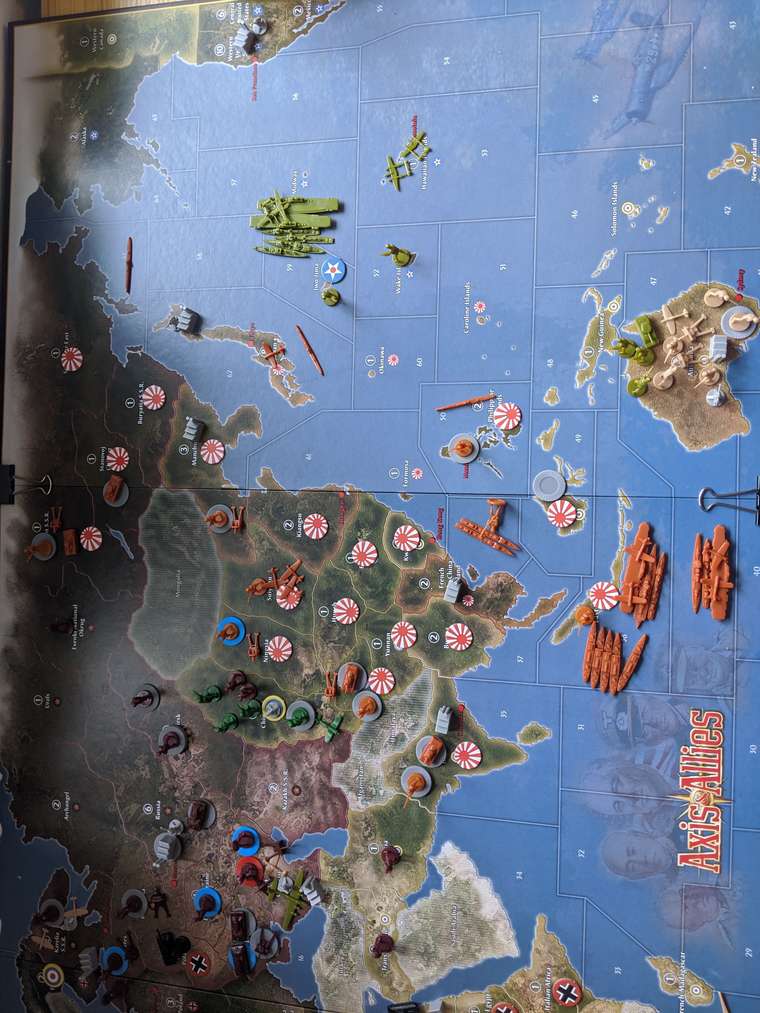
Update: finally got a live playtest in, with @Corpo24 and Angel taking the Axis against me and Quincy with the Allies. It was a very tense and exciting game – Germany took Egypt on G1 without a single casualty, but lost 2 fighters against Task Force G in the Western Med and failed to sink the Canadian DD + transport. Britain abandoned both India and Africa, used its navy to capture and hold Scandinavia early (saving Leningrad for the Russians), and built a factory in Australia, which was reinforced by the retreating Indians and some American soldiers and planes. Italy got rich off of national objectives and built a large navy, including a fully loaded carrier, and then shucked 2 loaded transports per turn to the Ukraine, where Germany’s main stack of 15 tanks was threatening both Stalingrad and Moscow.
Meanwhile, in the Pacific, Japan sent a fully loaded carrier with no escort ships down to Queensland as part of an effort to sink the remaining British Pacific boats (I won’t dignify a few stray transports and destroyers with the name of “Pacific Fleet.”) America seized the opportunity to blow it up and establish carrier parity (2 each), and the American and Japanese Pacific fleets mostly played footsie for the rest of the game, with Japan finally wiping Britain out of the East Indies on about J5, and America taking Iwo Jima on US6. Japan slowly expanded on all fronts, making it as far as Yakut in Siberia, cutting China down to one territory, and trading Persia with Russia. Japan also landed a squad in Rhodesia to help the German tank factory in Egypt make sure that the British didn’t get any funny ideas about a factory in South Africa.
Things looked grim for the Allies during turn 6 – the British were trading France with Germany, but were unable to fill their fifth transport (no extra factory in the west and no money to buy one); America was trading Morocco with Italy each turn and looked unlikely to penetrate further than Libya for a long time. Meanwhile, Japan’s slow, steady progress was becoming a real threat – Japan was about ready to break China and break the still-holding-but-slowly-retreating Siberian Guards, which could have created a decisive income swing. Allies were up about 10 IPCs as of turn 6, but that could have disappeared or even been reversed by turn 8 if things continued according to schedule.
Fortunately for the Allies, the back-and-forth trading in France left the Axis stack in Ukraine exposed to a Russian counter-attack. Russia attacked with 75% odds to win, and rolled better-than-expected, taking back the Ukraine with 3 artillery, 6 tanks, and 1 fighter remaining. At the same time, lightly supported Russian infantry rolled out of Leningrad to take the Baltics and Belorussia, rolling the Germans back in the northeast. The Germans and Italians had no forces available to counter the advancing Russian front – they could not both hold eastern Europe and keep trading France, so the Axis surrendered.
One fun gambit that we didn’t get to see the result of was the American bomber attack on the Italian fleet – the Americans built 3 extra bombers in the Eastern US and stacked land forces in Libya with the idea of holding it for a turn using British fighters that were no longer needed to defend Russia. The US bombers (including a couple that flew from Australia to Stalingrad to join the party) would fly 5 spaces to the central Med, and then land in Libya – which would then be permanently secured, because the Italian navy would no longer have the transports to help the Germans take it out. That attack could have gone quite badly for the Americans; the extra turn of setup meant that the Italians got a chance to build, so they could have dropped another 3 destroyers or something in the sea zone, and they might have won that battle, with disastrous results for the Western Allies – but we’ll never know, because Axis morale collapsed in the wake of the Russian victory in Third Battle of Kharkov.
Everybody had a good time, and we don’t feel that any changes are needed to the national objectives – they seemed to give everyone a fair chance to win and to choose their own style. There was a little grumbling about how German got ganged up on, but what do you expect when Egypt, Burma, Pearl Harbor, and the San Diego navy all fall turn 1 without a single Axis casualty, and the Luftwaffe bites the dust on turn 1 without a single Allied transport getting wet? I blame the dice, rather than the NOs, for that particular strategic decision.
-
RE: Balanced Mod [Anniversary 41]posted in House Rules
OK, we are live in TripleA! You can download Anniversary Balanced Mod normally, just like any other TripleA map. It’ll be near the bottom of the list of “Good” quality maps. I wrote an Objectives tracker for the mod that will help you keep track of which objectives you’re meeting. If anyone wants to play a game of it with me online, just let me know! :)

-
RE: France and Canada as one Power, two Economies.posted in House Rules
CWO_Marc, as you can probably guess, I don’t intend any disrespect for your province or its history. I just think that on a superficial level, Quebec is an attractive choice for a French capital-in-exile because it’s the only industrialized, Francophone region that wasn’t within immediate reach of the Nazis during 1940.
Putting the capital-in-exile in London, as you and Black_Elk have suggested, reduces the importance of the Free French to the point where they’re hardly worth modeling – filling London with about 5 IPC / turn of blue French pieces that can’t join in an attack with the khaki pieces or travel efficiently on khaki boats is just a waste of everybody’s time – if you’re going to have London administer the French colonies anyway, then it makes more sense to just give the British direct control of French Africa like the designers did for Classic and Revised and 1942 2nd Edition.
For players who prefer historical accuracy to the consistency/simplicity of the rules, we could set the French capital-in-exile in the West Indies, which would shift from American control to French control, and which would start with a minor industrial complex even though it’s only got a territory value of 1 IPC.
-
RE: Oil Derricksposted in House Rules
I do like the idea of trying to include oil in the game, and having oil boost movement seems like a good contribution to the discussion – I haven’t heard that one before.
I think at the Global 1940 scale, it makes little sense to think about oil production without also thinking about oil reserves. Japan didn’t literally have zero oil available before it conquered Borneo – but it had a small and dwindling supply that threatened to run out after the equivalent of about Round 2 or Round 3 of the game.
With that in mind, here’s how I would set up oil derricks:
STARTING OIL RESERVES
Each country starts with a certain number of oil tokens – you can use small black poker chips or whatever else is handy.
America – 15
Russia – 10
Germany – 10
UK Europe – 10
UK Pacific – 5
ANZAC – 5
France – 5
Italy – 5
Japan – 5OIL DERRICKS
Each oil derrick generates 2 oil tokens per turn as part of your collect income phase, but only if it has fewer than 3 industrial damage. Oil derricks are considered facilities and may be bombed by tactical and/or strategic bombers. Their maximum damage is 6. Damage can be repaired for 1 IPC per damage as normal.
SPENDING OIL TOKENS
Each turn, at the start of your turn, you must decide whether to allocate an oil token to your army, navy, and/or air force. Each branch of the military you want to fuel costs 1 oil token. For example, fueling your navy and your air force would cost 2 oil tokens.
If you do not fuel a branch of your military, then all units in that branch (except infantry, artillery, cruisers, and AAA guns) are -1 on all combat rolls and -1 on all types of movement, to a minimum of 1. For example, if you do not fuel your army, then your mechanized infantry will fight at 1 on both offense and defense, and can only move 1 space per turn. Your tanks would fight at 2 on both offense and defense, and can only move 1 space per turn. Alternatively, if you do not fuel your navy, then your destroyers would fight at 1 on both offense and defense and move 1 space per turn, plus 1 more space if they start their turn at a functioning naval base. Failing to fuel your army does not affect your navy or air force, and failing to fuel your navy does not affect your army or air force, and failing to fuel your air force does not affect your navy or army. All of these penalties apply until the start of your next turn.
In addition, if you wish, you may spend 2 oil tokens to move one additional unit of any type up to one extra space during your non-combat move only. You may repeat this process as often as you like as long as you have the oil available, but you may not use oil to boost the exact same unit twice in the same turn.