
Axis & Allies .org Forums
    • Home
    • Categories
    • Recent
    • Popular
    • Users
    • Register
    • Login
    1. Home
    2. AndrewAAGamer
    3. Best
    • Profile
    • Following 0
    • Followers 9
    • Topics 64
    • Posts 5,109
    • Best 581
    • Controversial 0
    • Groups 6

    Best posts made by AndrewAAGamer

    • RE: League General Discussion Thread

      @gamerman01 said in League General Discussion Thread:

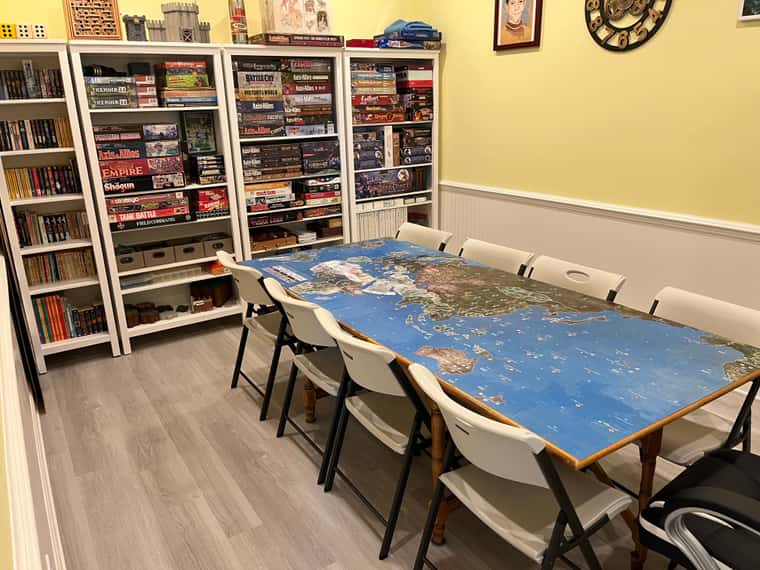
      I am already in awe that @AndrewAAGamer owns and/or works at a proper board gaming store, or one of his older brothers let him use it as a prop, not sure yet

      That is my gaming room. It helps to be older and have bought the games over a long time when the first came out.

      Andrew Gaming Room.jpg

      posted in League
      AndrewAAGamerA
      AndrewAAGamer
    • RE: Warfare Principles of Axis & Allies (By AndrewAAGamer)

      Global 1940 2nd Edition OOB - The Beginner’s Learning Guide
      Let’s move from talking about general Warfare Principles to Global 1940 itself. Oh, by the way I am not going to be talking about gambits or odd play. What we want to achieve is consistent play to win as many games as possible. Gambits do not fall into that category because either a) they require the opponent to not have seen the gambit before or react poorly to it to be successful or b) have low overall odds of success. We want to win every time! Not some of the time. In addition, this general overarching discussion is regarding strategy, not tactics.

      So, open the Global 1940 Board and what do we see? As usual the Axis have centralized position. The Axis have greater firepower to begin the game. The Axis have the initiative; they will be the ones to determine the overall battlegrounds of the game. The Allies have more territory and money initially. What this means is the Axis will be trying to win the game and the Allies will be doing their best to slow them down, then hopefully stop them, and then push them back for an ultimate Allied victory.

      WINNING THE GAME:
      There is no argument that the Axis has the advantage in Global 1940 2nd Edition OOB. This is due to two factors.

      1. The Axis only need to win on one side of the board to win the game. If we want a balanced game where either faction wins half of the time then the Axis can only have one third of a chance of winning the game on either side of the board. NOTE: It is easier for the Axis to win on the Europe side of the board than on the Pacific side of the board.

      2. The Axis have five scenarios that can lead to winning.
        • Germany takes Moscow.
        • Germany takes London.
        • Italy gets big in the Mediterranean.
        • Japan wins in the Pacific.
        • The game develops into a long-term money game and the Axis prevail due to collecting the same or more money than the Allies.

      For the Allies to win they must stop the Axis on both sides of the board by stopping all five of their scenarios. Just one is enough for the Axis to win but it takes all five to make the Allies happy.

      The key for the Allies is to put more pressure on one side of the board to gain an advantage while stalling the other side of the board. This balancing act is easier said than done. As one of my gaming group members once said, “Axis and Allies is like a balloon; if you push too hard in one area it bulges in another.”

      1. GERMANY GOES FOR MOSCOW
        Germany starts with enough units on the board, and quickly gains enough money to buy additional units, that Germany can take down Moscow. Once Moscow falls the Germans push to Egypt and the game is over. Unfortunately, there is no way to stop the Germans from taking Moscow without giving the game to the Axis elsewhere. The key issues for the Allies are a) how long does it take and b) how much does it cost. Losing Moscow does not lose the Allies the game. Losing Moscow too cheaply or too quickly does as it makes the fall of Cairo inevitable. The Allied defense is fourfold. 1) Knowing it is a main target Russia builds and acts accordingly; buying tons of infantry and harboring every unit for the final Moscow battle. 2) Assistance in the form of UK units come to Moscow via the Middle East to delay the inevitable. 3) An Allied fleet reduces German reinforcements aimed for Moscow by attacking the Atlantic Wall. 4) The Allies prepare a defense of the Middle East and Egypt so that once Moscow falls the Axis still cannot win the game. This is the most difficult winning scenario the Allies face.

      2. GERMANY GOES FOR LONDON
        Personally, this is the one scenario I love to see the Axis try as the Allies. The reasons being are it is a) a lot easier for the Allies to come back from the fall of London than it is the fall of Moscow and b) unlike Moscow once the Allies see the Germans going for London the Germans have a limited window of Opportunity to take London. Also, it is easier to defend London than Moscow because the Germans need to build and protect their transport fleet to be able to move their ground units against London. The key for the Allies here is not to lose London on the cheap. It must cost the Germans a ton of money and units so even once it falls the Germans are in a weak position because the Bear of Russia is going to come knocking on the door. Surprisingly, once Russia gets into German territory they collect more money than Germany does. Ouch. As long as the Allies do not leave London weak this is not the scenario to worry about.

      3. ITALY GETS THE MEDITERRANEAN
        If Italy gains control of the Mediterranean then the Axis will be collecting too much money and will overpower the Allies. This is the easiest way for the Axis to win but luckily it is also the easiest scenario for the Allies to stop. Once UK blows up the Italian fleet in the Med, kills the Italian ground troops in Africa and convoy disrupts SZ97 the Italians are basically removed from the game.

      4. JAPAN WINS IN THE PACIFIC
        Though Japan is surrounded by four enemies and has far less income than the four combined Japan can become a monster if left unchecked. For Japan taking India and China is not that difficult. And, as before, the Allied strategy is forcing Japan to spend time and cash accomplishing those goals so that by the time they turn to go for Sydney or Hawaii they are now contained by a large US Fleet.

      5. AXIS COLLECTS ENOUGH MONEY TO WIN LONG-TERM
        The final scenario for the Axis comes about when the Allies have performed admirably and have stopped the previous four game winning scenarios. However, the Axis was still able to take enough territory to be close to or even with or, heaven forbid, ahead of the money the Allies are collecting. That is bad news for the Allies. Due to their centralized position and for the most part more efficient use of Land Units and Air Units versus Naval units the Axis do not need to be collecting the same or more than the Allies to win. The Allies need to be ahead by about $10 a Round. If that is the case they are winning a long-term money game and if not, they are losing.

      ROLES OF THE POWERS
      So, what does each Nation or Power have to do to be successful? What is their role in the game?

      AXIS: Win the game by achieving one of their five scenarios…

      GERMANY is the main antagonist on the Europe side of the board. It is up to them to win the game. As a land centric Power, with lots of money available to them in the east, typically their goal is to take Moscow and then drive for Egypt. They must defend their coastline from Allied Landings to maintain their income and to deprive the Allies of the opportunity of getting France back into the game. Or even worse losing Berlin.

      JAPAN all by herself in the Pacific, will either try to win the game, if the US ignores it too much, or be a constant irritant forcing the US to spend monies in the Pacific that they desperately want to be spending in the Atlantic. While outnumberd Japan can knock out one or two of its weaker opponents and become sizable if the Allies are not careful.

      ITALY is the weak sister of Germany. In fact, every true German wishes Italy was just more German territory to feed more income to German Factories and remove the dreaded possibility of Rome falling to the Allies. Normally Italy’s role is reduced to defending German and Italian territory and producing some limited can openers for the march to Moscow and Cairo. It is not unusual for Italy to be doing everything it can just not to be taken. Played correctly by the British Italy should be a non-factor in the game.

      ALLIES: Win the game by pressuring one side of the board more than the other to gain an advantage on one side while stalling on the other side…

      RUSSIA is the main target of the Axis. Thus, they need to play defensively unless the Germans go for Sealion. The longer Russia lasts, and the more money it collects and puts down in troops, gives the Allies time to gain advantages elsewhere on the board and be ready to repel the Germans once Moscow finally falls.

      USA is the key to the game for the Allies. How and where the US spends their money is the difference maker. The US will collect more money than any other Allied Power and unlike every other Allied power its capital is safe from the Axis. Depending on Allied strategy the US will either a) go all out in the Atlantic for a few Turns then turn its full attention towards the Pacific, b) go 100% into the Pacific for many Turns to rout the Japanese and then turn towards Europe or c) have some balance between the two sides of the board.

      CHINA is one of the minor Powers that has a lot of importance in the game. Its role is to kill Japanese ground troops. While it cannot stand against a concerted Japanese effort the more troops it kills the harder it is for Japan in the Pacific.

      UK EUROPE has the toughest job in the game as it is the closest Power to Germany, is immediately at war with the Axis, and has the most critical initial missions. UK must protect its Capital, knock Italy out of the game, assist Russia in the defense of Moscow, distract Germany and protect the Middle East from Germany after Moscow falls or is turtled. Simple right? Job one, after defending London, is taking Italy out of the game by taking control of the Med, Middle East and Africa. Once that is accomplished it can move on to reinforcing Moscow and start landings on the Atlantic Wall. But Italy comes first! The benefit of playing UK is at least you know what you need to do.

      UK PACIFIC Like China there is not a lot India can do to stay alive if Japan focuses on capturing it. India’s mission is to stay alive as long as possible and make any capture of Calcutta a Pyrrhic victory.

      ANZAC is the other minor Power that plays a big role. ANZAC is the death by a thousand cuts for Japan. Making them trade the Money Islands and acting as US Fleet blockers. ANZAC’s job is to force Japan to spend money on them so the US can concentrate on getting a superior fleet versus Japan’s.

      FRANCE is, well, ummm… does not really have a role in this game except to die on G1.

      Remember as the Allies all you are trying to do is slow the Axis down, kill as many of their units as you can, so that when they come for the final push your money advantage overwhelms them.

      GERMANY 1 (G1)
      As I mentioned earlier it is important for the Allies to recognize what the Axis is doing to be able to counter it. Since Germany is the main antagonist here are some prime examples of G1 options:
      • 100% ground unit buy for Germany. The Germans are going to go for Moscow on G6, G7 or G8.
      • Major IC in Romania. The Germans are going for Moscow on G6.
      • Carrier and two transports in SZ112 or SZ113. The Germans are going for Sealion.
      • Submarine, destroyer and carrier in SZ112. The Germans may be going for Sealion though more likely they are building a fleet to contest the British and fight for the Med. This is more a long-term strategy than a short-term strategy.

      TAKING YOUR TURN
      Here are the four steps to consider when you prepare to take your Turn:

      1. First and foremost, always look to see if your capital is safe. What can the enemy do to you this Turn and the next Turn? No matter how important some other objective is if you fail to protect your capital you just messed up.
      2. Are there one or more VIP areas that must be taken or protected to protect my capital down the road or to achieve my main objective?
      3. As part of my main objective what can I do to the enemy and what do I need to buy to accomplish it?
      4. Are there any attacks of opportunity that, while not part of my main objective, assist me in accomplishing my main objective? As tempting as it may be, any attack that does not assist in accomplishing your main objective, should be ignored.

      THE BID
      As discussed, the Axis has the advantage in Global 1940 2nd Edition OOB; significantly. How much of a bid the Allies receive is up to each Player’s desire to be the Axis or the Allies. Whatever amount the bid is, it should be used to accomplish the Allied goals of slowing the Axis down and making life more difficult for the Axis and to assist the Allies in accomplishing their own goals. Bids should be used to:

      • Protect the British Fleet – as I already said ships cost a lot and saving ships means not having to buy them later. Protecting the UK fleet not only makes it easier for the British to fight for the Med and make Atlantic Wall landings later it also protects London. Any bid placement should include a fighter for Scotland and a submarine for either SZ 111 or SZ 110. (Mandatory)
      • Taking Italy out of the game is job #1 and a submarine in SZ 98 to maximize Taranto assists in that. (Mandatory)
      • Ground troops for taking out Italian units in Africa or a transport in SZ 71 to do the same.
      • Submarine or destroyer in SZ 91 to defend the UK cruiser and assist in the attack on SZ 96.
      • Submarine in SZ 106 to defend the UK destroyer and transport.
      • Infantry in India/West India/Burma to bolster defense. Or a mechanized infantry in Burma to threaten FIC on UK1 if the Japanese do a J1 declaration of war.
      • Submarine in SZ 62 to protect the transport.
      • Infantry in Russia to defend Moscow.
      • An artillery in Amur to pin more Japanese troops in Manchuria.

      I hope you learned something reading this paper. The goal was to highlight key points regarding how to play Global 1940 that will help you win more games.


      ADDENDUM #1

      The Neutrals

      If, or when to, activate the Neutrals, is a very big part of any OOB Global 1940 game. While it does not happen in every game, it certainly happens enough to prove that it is an important dynamic to the game.

      Both sides should be consistently paying careful attention to “Should I go for the Neutrals?” as the game progresses. Looking for the key indicators that show the Player that “Yes, now is the time to attack the Neutrals.”

      Typically, there are three reasons to go for the Neutrals:

      • Axis #1: The Allies have left their SZ91 fleet exposed if the Neutrals are attacked by Italy, specifically Spain, and that allows the Germans to annihilate a large Allied fleet on the cheap.
      • Allies #1: The game has come to a standstill and neither side may improve their position as the board is deadlocked. By accepting a short-term disadvantage, the Allies will gain a long-term advantage that may swing the game in the Allied favor.
      • Allies #2: As you mentioned, the Allies are not making sufficient progress in landings on the European coast so they revert to the simpler strategy of landing in Spain.

      Normally, it is the Allies who are attacking the Neutrals and typically they will set up such an attack by being prepared to hit Spain (USA), Portugal (USA), Venezuela (USA), Saudi Arabia (UK) and Turkey (UK) all on the same Turn. In later Turns Chile plus Argentina (USA) and Angola plus Mozambique (UK) are taken. Typically, killing these 28 infantries results in about 11-13 Allied losses or about $36 worth of troops on average.

      The gain in income for the Allies is $15 a Turn. The Axis will usually gain 8 infantries from Switzerland (2) and Sweden (6), or $24 worth of troops, and $3 a Turn in income from Sweden. That means the total initial loss for the Allies is 60 TUV. ($36 in troops killed plus $24 of infantries gained by the Axis). Compare this to the $12 per Turn increase in income and you can see it takes about 5 Turns for the Allies to recoup their initial losses and start making gains from their strategic decision.

      Therefore, as long as the initial loss of 11-13 troops does not prove to be a large detriment to the Allied cause, and the Allies can last at least those 5 Turns, then making the attack on the Neutrals makes sense.

      By the way, you will notice I did not include Afghanistan as usually the Axis are not able to gain those 4 troops because either they can never liberate them or the Allies kill them at a loss of usually 1 ground unit.

      Finally, I did not include Mongolia as per Krieghund’s ruling below, unless Mongolia is directly attacked by Russia any other attacks on the Strict Neutrals do not effect the Mongolian status.

      @Krieghund said in Global 2nd edition Q+A ( AAG40.2):

      Concerning the Mongolian situation after an allied invasion of other strict neutrals, I find the rules a little unclear.

      As Mongolia only becomes pro-Axis when attacked by the Soviet Union, in the case where another Strict Neutral is attacked by another Allied power, Mongolia remains a Strict Neutral. This means that an attack on a Strict Neutral other than Mongolia by an Allied power other than the Soviet Union has no effect whatsoever on the relationship between Mongolia, the Soviet Union, and Japan. As a result, the answers to your questions under those circumstances are the same as they would be if no Strict Neutrals had been attacked at all.

      (Thank you to @surfer for pointing me to Krieghund’s ruling that I included above.)
      posted in Axis & Allies Global 1940
      AndrewAAGamerA
      AndrewAAGamer
    • RE: Post League Game Results Here

      Congratulations farmboy!

      posted in League
      AndrewAAGamerA
      AndrewAAGamer
    • RE: Bid for both Scenarios

      Okay, the first thing I want to say is everything was intentional. Matt and Larry had a great base to start with but as we play tested, we found we had to change a great many of the parameters to make the game work.

      Game Flavor: One of the main goals was to make the focus of the game a land campaign which was heavily influenced by logistics aka supply.

      Broken Strategy: We soon found out that the players wanted to fight for the Med. By controlling the Med, it denied the opponent any reinforcements so he who controlled the Med won. We were having epic sea battles and a water-based arms race between the combatants. Since we did not want this to be a sea battle game, but a land battle game, that is where the limits on the number of sea units came from.

      Broken Strategy: Another problem we discovered was air power was too powerful. One of the play testers invested heavily in axis fighters and bombers to take Cairo. Since none of us could figure out a counter to that strategy that is when we decided to also limit the number of air units in the game.

      Only land units can be chipped out and now you know why.

      Broken Strategy: Originally, there were more convoy zones, for example Tobruk had one. We found that, once Tobruk was taken by the Axis, that made it too easy for the Axis to bring up reinforcements quickly and overwhelm Cairo’s defense so we removed it. The whole idea was we wanted there to be a logistics problem for both the Axis and the Allies to fight over Cairo.

      As for game balance we had to constantly make revisions as we improved our strategies:

      • The stacking limits of Tunis and Cairo are directly related to how many units we decided it would be necessary to have a reasonable chance of holding. Originally, those territories had much lower stacking limits.
      • The number of reinforcements coming through the Suez Canal. That was adjusted multiple times until we felt we had the right balance that Cairo had a chance to hold against an axis Rush versus giving them too many units to push the Axis back easily. This was determined by multiple playthroughs were Cairo first fell and fell again and then after revisions couldn’t be taken at all so more revisions were needed.
      • The stacking limit of Malta was brought up as a solution to the problem of the British simply stacking it with so many units the Axis dared not attack it and limiting the number of supply tokens available to the island to force a need for constant resupply. We wanted it to be difficult, but not impossible, to keep Malta supplied to get their income booster.

      I think every unit had a change made to it either by cost or abilities. For example, we would increase the attack firepower of a unit and then play test it to see if it was too powerful. (BTW, we purposefully made the German 88 gun a great weapon to match historically its capabilities but had to be careful it was not too powerful.)

      How scout cars worked, how targeting worked and which units received it was constantly changed. One, Broken Strategy was to bomb the heck out of supply so we had to change how many units had the ability to target supply and how often to remove that strategy.

      How the US entered the war and how the US convoy zones worked was changed multiple times too.

      In essence, every aspect of the game as you see it now was brought about by multiple testers playing hundreds of games to test its balance. I am pleased you like the game and feel it is the most balanced Axis & Allies game out there. I do to.

      posted in Axis & Allies North Africa
      AndrewAAGamerA
      AndrewAAGamer
    • RE: League General Discussion Thread

      Throwing in my 2 cents here, even though it is not my game, since this is being discussed in an open forum.

      As I said in my thesis, the less experienced player should play more risky to beat top opponents. Since @axis-dominion you are so good, your opponent really has to go for that low risk battle to beat you so you should not be surprised or upset when he does go for it and gets lucky. If he does not play risky he is probably going to lose 100% of the time so going for a 30% battle to win the game is way more than he could win if he didn’t play risky.

      BTW, I will point out that a 30% battle is not that risky. You are barely winning more than 2 times to every 1 times he wins.

      Also, that -32 is the AVERAGE TUV result. Therefore, it is assuming you win 7 times to his 3 times. For a more accurate view of the possible ramifications if your opponent gets lucky, as @Stucifer referred to, you should look at when he wins the number of units he has left over. Then compare his TUV loss without losing those units versus you losing all your units and you will see the result is vastly different than the average TUV loss.

      Finally, in my opinion, if you two do decide to play on and change any results it should only be for fun. The game should absolutely be recorded as a win for @peirce as far as League Play is concerned. He took the risk and it paid off. He should not be punished by being a nice guy and having his good luck reversed. I doubt anyone would be asking for any changes if it failed miserably.

      posted in League
      AndrewAAGamerA
      AndrewAAGamer
    • RE: Warfare Principles of Axis & Allies (By AndrewAAGamer)

      @aequitas-et-veritas said in Warfare Principles of Axis & Allies (By AndrewAAGamer):

      A.) It will be a 50/50 chance each time, b/c either you won or you lost.
      B) even if you play as much as possible without taking risks, if your opponent makes a risky move, doesn’t this call off your whole riskfree playstyle and awareness??

      Good questions… Thank you for contributing.

      A) It is only a 50-50 chance if the Players are of equal caliber. The stronger Player is always going to win more than 50% of the games. Thus the stronger Player does not need to take as many risks and the weaker Player does have to take risks to win.

      B) That depends. If you are the stronger Player than you may still be able to play conservatively even if the other Player is succeeding in risky attacks. Case in point. I had a face to face AA50 game where our Opponents had a dramatically aggressive G1. They attacked Egypt and every Allied fleet they could get their hands on. None of the battles were greater than 65% and one of them was under 50% yet they won them all. Our Allied position was frankly terrible. Germany was going to swoop through Africa and there was no Allied fleet to do anything about it for multiple Turns. Our team huddled and since it was the very beginning of the game, and night, my partners wanted to concede and start over so we could play at least one game where we might win. I disagreed. My point was the reason they had such an aggressive opening was because they knew we were the better team. Thus they will either a) make a mistake down the road that we can take advantage of or b) they will continue to make very risky attacks and eventually the dice will turn against them. So we continued and I was correct. They made a strategic error the very next Turn and the following Turn had two risky battles go against them so by the beginning of Turn 4 we were right back in the game and eventually won. So we did not have to play risky because we were better than them.

      On the other hand I have been in games where the caliber of the Players was about the same and my Opponent started making risky attacks and was successful and you are correct. I had to change from my conservative strategy and start making risky attacks to try and stay in the game. For example while personally I would never like to attack Moscow with anything less than an 80% chance of victory against a really good Player I would go all the way down to 60% because after all, against a really good Player winning 60% of the time is a good thing. In fact if you are playing the best of the best winning 51% of the time is all it takes to be happy.

      The point I am trying to make in my article is if you do not have to make a risky attack to win; why make it? I never said risky attacks were bad; many times they are necessary. I said do not make them if you do not have to.

      posted in Axis & Allies Global 1940
      AndrewAAGamerA
      AndrewAAGamer
    • RE: The new ELO-based ranking system

      Personally, I don’t like the idea of the lifetime tracking to have any decay in it. If a person needs some time off why should their lifetime ranking be affected? Or, even if they stopped playing entirely, why wouldn’t we want their history to stay unaffected so we could go - “wow, look how good xxx was when he/she played here.”

      I am all for a separate yearly ranking that would determine playoff position and of course affect the lifetime ranking.

      The best thing I like about his system, as a high ranking player, is there is no detriment to playing anyone from any tier. Yes, there is a gigantic risk to your score if you lose, but there is no penalty to your score, just because you played somebody in a lower tier. I think everyone being able to play everyone will be good for the community.

      posted in League
      AndrewAAGamerA
      AndrewAAGamer
    • RE: ANZAC planes on US carriers

      @shkoboo said in ANZAC planes on US carriers:

      @gamerman01 As a passionate player of AAA over years, let me give you my opinion on this - Not only that this is not a sneaky tctics, but this looks like an exploit in rules that is ruining your whole game mehanics turning one perfect balanced and before all game of STRATEGY in a game of ‘oversights’. Sneaky tactic is when I am planing in round for example 5 how to win something in round 8. In placing Ansac fighters on US carrier, I’m counting that my oponent: wont reckognise them, make mistake in counting movements…etc And this is all basic - not brilliant nor sneaky.
      And is ruining game - You are not giving more options - you are making confusion!
      Hope this willbe removed in next version.
      (carryed plans must have less moves, according on host carrier movement)
      (we already homeruled this in our boardgame sessions)
      all the best

      • Does this scenario make the game more complicated - yes.
      • Does it provide greater options for attack - yes.
      • Does it require a Player to determine where an Allied plane might be able to go - yes.
      • Does that break the game - no.

      Adding complexity to the game while keeping the game mechanics simple is one of the beauties of Global. The more nuances a game has the more likely the higher skilled Player is going to win. Keeping a game “simple” means the luck factor is going to be an ever greater determining factor.

      There are a myriad of items that create complexity and nuance in the game.

      • Italy being a can opener for Germany.
      • USA being a can opener for UK and ANZAC.
      • UK and ANZAC planes on USA carriers.
      • UK troops on US transports.
      • Being able to land fighters and tacticals on newly built carriers.
      • Being able to declare war on the Neutrals.
      • Being able to attack from multiple areas and retreat to one area.

      All of these are capabilities that can be taken advantage of by a superior player. That does not make them game-breakers, that makes them strategy scenarios that everyone should try and learn, comprehend and master to become a better Player.

      posted in Axis & Allies Global 1940
      AndrewAAGamerA
      AndrewAAGamer
    • RE: League General Discussion Thread

      @Stucifer
      Hmm, that looks really familiar. :)

      Andrew Gaming Room.jpg

      However, OPEN GLASSES ON THE TABLE!?!?!?! What are you thinking???

      posted in League
      AndrewAAGamerA
      AndrewAAGamer
    • RE: Warfare Principles of Axis & Allies (By AndrewAAGamer)

      @Saber25 said in Warfare Principles of Axis & Allies (By AndrewAAGamer):

      What makes Bryansk a better hold point?

      Bryansk is the point where the original German advance forces and fast moving reinforcements are at their limits to get to Moscow in comparison to the Russians who have been building infantry waiting for them to arrive. It takes some Allied fighters to tilt the battle to the Allies favor to hold for a little bit. Even one Turn is helpful though.

      posted in Axis & Allies Global 1940
      AndrewAAGamerA
      AndrewAAGamer
    • Thank you!

      Thank you @farmboy and @Arthur-Bomber-Harris for your strong play in our recent games.

      Both games began about the same time and you both used similar overall strategies:

      1. Stacked Yunnan with the Bid with Russian air.
      2. Broke into China using Russian troops via Manchuria.
      3. Were very aggressive in the Pacific attacking at every opportunity even with negative TUV odds.
      4. Spent significant resources in Europe with the US, since with the loss of China Japan could not win the game in the Pacific, thus preventing Germany from winning the game.

      Both games resulted in a loss for me and caused me to reconsider the Axis strategy I have been working on for the last 5-6 years. Due to your great play I was forced to come up with a second, or Plan B, strategy for the Axis.

      If the Allies do not stack Yunnan I think I can still use the same Axis strategy as before with a tweak by adding Item #2 below. So, Plan A and Plan B both now include Item #2. If the Allies do stack then I would go with Plan B by including Item #1 below.

      Plan B:

      1. If Yunnan is stacked with Russian air then instead of a J1 it converts to a J3. This provides Japan with more time to build up against China as China is much tougher by holding Yunnan. It also allows Japan to do this without the US Navy breathing down its neck. My mistake previously was to still do a J1 and with the UK, ANZAC and US all beating on Japan they were unable to make any headway. This changes the Pacific from a get India quick strategy to a “take the Money Islands and make slow progress against China and India” strategy. Or in other words a long term game. This revised strategy does keep Japan in the game versus my previous strategy.
      2. Build a Minor Industrial Complex in Manchuria and stack Manchuria against the Russian Far East Troops. Previously, I kept my Japan stack in Korea and you both showed me the error of my ways. By stacking Manchuria instead and keeping a force there large enough to defend against the Russians it keeps those Russian troops from breaking into China. Again, this expenditure slows things down for Japan’s expansion, but it protects their inner perimeter from being compromised.

      While it is no pleasure for me to lose, I do thank you both for teaching me something. As they say, “You learn more from losing than winning”. Whether or not my opponents stack Yunnan in the future I have learned how important it is to protect Manchuria from Russia and that knowledge is gold for my future games. Through adversity you have made me a better Player and for that…

      THANK YOU!

      posted in League
      AndrewAAGamerA
      AndrewAAGamer
    • RE: Allied Playbook - G40 Collection of Essays - Compiled by jacobgeo24 Nov 18-19 2023

      @jacobgeo24 said in Allied Playbook - G40 Collection of Essays - Compiled by jacobgeo24 Nov 18-19 2023:

      What we need to do is just make sure that US is pumping defenses into Hawaii, they don’t have to be going out and assaulting anywhere in the Pacific, just sandbagging Hawaii as much as they can. Same for ANZAC, they need to sandbag Sydney as much as they can, and they can ask for help from USA in doing so.

      This strategy won’t work. Trying to defend Hawaii and Sydney with ground troops is a recipe for failure. If Japan is not being contested in the water than they will collect the Money Islands, take over China and India. They will be collecting a ton of money and then will turn their attention to taking the 6th victory city. To defend both victory cities requires a duplication of effort that ANZAC and USA cannot afford.

      @jacobgeo24 said in Allied Playbook - G40 Collection of Essays - Compiled by jacobgeo24 Nov 18-19 2023:

      But things may work out if the US and ANZAC challenge the Pacific and can make their way to the Carolines and establish operations there. This could be game over for Japan because from the Carolines, you can reach the money islands, Philippines, China, and most importantly, Japan itself.

      This is the correct strategy.

      Forcing Japan to spend money on ships helps both India and China survive. Forcing Japan to send their air units out to sea to combat a large Allied fleet removes them from threatening China and India.

      Once the US/ANZAC combined fleet cannot be destroyed by the IJN, Japan is in big trouble. From the Carolines the Allied fleet can either move to Japan or Java. Both locations cost the Japanese heavily.

      US strategy should be to gain superiority in fleet assets with ANZAC assistance. How quickly this is done is up to the US player.

      Two equally valid strategies exist.

      1. Send significant forces to Europe early on to assist UK in controlling the Med, taking Norway and Normandy. Then, once this is accomplished, spend 90% of US money in the Pacific to gain fleet supremacy. Only additional ground troops are sent, or built, in Europe going forward.
      2. Spend 90% of USA money in the Pacific and beat down the Japanese with Russia, China, ANZAC, India and US overwhelming Japan’s resources. Then when Japan is weak enough, around $35 or less being collected, swing 100% US monies to Europe to stave off the German win. A minor fleet with a few transports is all that is sent early on to Europe to force Axis defense against a 1-2 punch on Berlin and assist the UK in fleet defense.

      The one strategy that will fail every time is to try and balance a response that gains no superiority anywhere.

      As I said in my Essay, the key for the Allies, is to stalemate one side of the board while gaining an advantage on the other side, then using a monetary advantage to go back to the stalemated side and knock the Axis out. That is the road to glory for the Allies.

      posted in Axis & Allies Global 1940
      AndrewAAGamerA
      AndrewAAGamer
    • RE: Post League Game Results Here

      @gamerman01 said in Post League Game Results Here:

      Care to share a summary? Maybe just a paragraph or two?

      Sure…

      Actually, it was pretty simple. The Allies collected far more money than the Axis did for the entire game and the difference eventually overwhelmed the Axis. Highlights were:

      • J1 – Japan fails on their J1 DOW to take The Philippines. Japan losses 2 inf, art, armor, fighter vs 2 inf USA. This allowed the USA to focus more on the Europe side of the board with a significant investment.

      • US+UK4 - Allies land and take heavily Normandy Bordeaux which made life difficult for Germany. Germany was forced to spend too may resources in the west reducing pressure on Moscow in the east.

      • Round 11: Moscow still holds and the Russians build an airfield in Belarus which allows UK to sack Berlin. This disaster, and transfer of monies from Germany to UK of $69, is somewhat mitigated by trapping the UK fleet of $139 TUV in the Baltic for the rest of the game. However, the loss of the subsequent German build allowed France to be liberated on Round 12.

      • Round 13: Rome falls for the rest of the game.

      • Round 20: Moscow finally falls.

      • Round 33 France falls again.

      • At this point the Axis concedes (Round 35) as even though France and Volgograd are retaken by the Axis they lose Norway and cannot take back the Caucasus. Thus they are still $50+behind in TUV with no hope to win.

      The Allies collected $40+ more per Turn than the Axis for the bulk of the game. This allowed the Allies to fight battles at a TUV loss and still gain ground on the Axis. For example, the Allies continually traded and blocked the Japanese islands at a TUV loss that still was in their favor. Specifically, 4 Allied DDs would die to prevent the Japanese from retaking the islands at a cost of 3 Jap subs for a negative TUV of $14 that did not matter to the Allies since they were collecting more than $40 than the Axis. Another specific example, UK and French mechanized infantry would trade territories in Europe via a US taken Northern Italy and while a loss of TUV versus the German infantry overall it was a winning strategy. As the Allies could afford to lose more in TUV in their battles while the Axis could not. Basically, the Allies could suffer significantly more TUV losses than the Axis could and still be winning as they had more money to buy reinforcements whereas the Axis did not. The Allies bleed the Axis to death until the Axis collapsed.

      posted in League
      AndrewAAGamerA
      AndrewAAGamer
    • RE: Warfare Principles of Axis & Allies (By AndrewAAGamer)

      I have added ADDENDUM #1, The Neutrals, to this article. It is embedded at the end of the original postings, just before the questions begin on Page 1.

      posted in Axis & Allies Global 1940
      AndrewAAGamerA
      AndrewAAGamer
    • RE: League General Discussion Thread

      @axis-dominion said in League General Discussion Thread:

      interesting discussions. would love to hear more about why andrew and maybe others think bm “radically changed” the game. for me at least, i feel the team behind it did an amazing job of enhancing it in very thoughtful ways that achieved certain goals beyond just trying to balance it, eg, nudging it a bit more toward looking like the history. and when i play bm i very much feel like i’m playing global but with great enhancements that give the allies a real chance without just throwing ever more loads of money at the problem. by the way, i agree very much the bid is not only great for variability/replayability but also an exciting aspect of the game. so i’m glad bm still requires a somewhat substantial bid, but just not too ridiculous imo like 50+ would be.

      anyway, for me, besides more balance and a more reasonable bid, i like bm because

      1. i never liked the re-looting rules in the original where if you regain your capital and then lose it again, the money again goes to the captor
      2. the intercepting rules that simon pointed out, how dumb is it that a bomber and a fighter both fight at a 1?
      3. vichy adds some historic realism to the game very nicely, while also adding more opening strategies and variability… it’s just a very fun aspect of the game imo
      4. same for the chinese guerillas, gives china a standing chance will also opening up another potential strategy for the allies (via american airstrikes… love this option)
      5. LOVE the new marine unit, gives back some much needed love to those capital ships and who doesn’t like cool new units? when has anyone ever complained about having artillery when they came out, or any of the other numerous new units that rolled out over time with new editions?
      6. bomber cost at 14, altho i resisted it at first, did away with that stupid utterly ridiculous dark skies that some ppl exploited in the past… so i welcome it, but cost of units is easily negotiable between players and i’ve been experimenting with costs of cruisers and battleships being cheaper, making them great again

      anyway i can go on, but all of these additions/enhancements don’t at all make the game feel “radically” different… eg you still have all the basics… G going for Russia or occasionally a SL if brits are careless… Japan going for india and china first, then turning on anz/hawaii… allies building up in 110 or first clearing out the med. all the basic fun strats are there and then some.

      Okay, perhaps your definition of “radically changed” and mine are different. However…

      Yes the map is the same - that is good.

      In addition to the six rule changes above you mentioned, capturing capitols, interception, Vichy, Chinese guerillas, Marine unit and bomber cost there were a total of 28 National Objectives in OOB. BM4 added, removed or changed a Total of 26 National Objectives. That is an almost 100% difference. That is radically different.

      The Victory conditions were changed.

      A new unit was added that also changed the way battleships and cruisers work.

      When there are THAT many changes I think it is safe to say that is a radically different game. This is not 1 or 2 House Rule revisions.

      And due to all these changes, as stated by fans of BM4, the game is played vastly differently than OOB. BM4 is a long term strategy game. In OOB there is the race to win for the Axis, that makes the first 7-8 Turns exciting and tense; then and only then if the Axis fails does it turn into a long term game.

      It is a completely different game.

      posted in League
      AndrewAAGamerA
      AndrewAAGamer
    • RE: Warfare Principles of Axis & Allies (By AndrewAAGamer)

      @Saber25 said in Warfare Principles of Axis & Allies (By AndrewAAGamer):

      @AndrewAAGamer This is a really interesting analysis. Along these lines, I assume you oppose using russian infantry to picket/block the German advance towards Moscow? Based on your analysis it seems clear that it is wasteful, but how would you measure the value of time/turns? Perhaps via incoming British aircraft added by the turn saved? Great analysis!

      Thank you for the question and kind comments. You are correct I oppose leaving single infantry to block the path to Moscow because it does not block the march at all. The German mass just steamrolls those individual blockers virtually for free. Now if you can garner enough forces to actually HOLD a territory a Turn or two before being forced back than I am all for that. The usual key area is Bryansk. The Allies, depending on how the Axis and Allies play it, do have a chance of holding Bryansk for at least a little bit and if so that is a good thing. At least if you are the Allied Player. :slightly_smiling_face:

      posted in Axis & Allies Global 1940
      AndrewAAGamerA
      AndrewAAGamer
    • RE: Post League Game Results Here

      Thank you for your consideration. It is not my intend for anyone else to have any opinion regarding Trulpen or myself regarding our game. This is a game just between us and unfortunately a private game is open to public disclosure since we are playing online. How I feel about Trulpen is my business so please do not let my feelings or experience affect your opinion of him.

      Without getting into details I think everyone can agree the game got out of hand and there are many reasons, beyond edits, that I am unwilling to play against Trulpen any longer. Again, that is just my business. Not finishing the game was my way to remove myself from what was a very negative experience. If that cost me a loss so be it.

      I fully intend to continue playing in League games. I am trying to decide how best to move forward to minimize any future potential disagreements because I, like I am sure most everyone here, just wants to play and have fun.

      Please consider this matter over.

      posted in League
      AndrewAAGamerA
      AndrewAAGamer
    • RE: Warfare Principles of Axis & Allies (By AndrewAAGamer)

      @J-o-C said in Warfare Principles of Axis & Allies (By AndrewAAGamer):

      Would you ever consider using an infantry to block a potential blitz? That would mean Germany would not be using artillery or regular infantry for the attack, which may not be a good idea on their part. I guess it would depend on the situation.

      Good question and yes it depends. As I said in my article…

      @AndrewAAGamer said in Warfare Principles of Axis & Allies (By AndrewAAGamer):

      to lose a unit for any purpose outside of that big battle is a waste of the unit unless it takes more units with it than it loses, or has extraordinary ramifications, such as protecting a vital monetary area, or slowing down the route of march.

      So not to be wishy washy but it depends. What does the blitz of the armor gain versus the loss of the armor on the counter attack? What is the loss of the infantry versus the gain of stopping the blitz? It is situational so without an example I cannot answer the question except to say sometimes it makes sense and sometimes it does not.

      posted in Axis & Allies Global 1940
      AndrewAAGamerA
      AndrewAAGamer
    • RE: Post League Game Results Here

      @Myygames said in Post League Game Results Here:

      @Myygames surrendered to @Arthur-Bomber-Harris in L22 OOB FINAL LL Myygames (X) VS ABH (L+50)

      Masterfull played, hail to the OOB champion!

      Congratulations ABH! Takes a little of the sting off knowing that I lost to the eventual champion!

      posted in League
      AndrewAAGamerA
      AndrewAAGamer
    • RE: Stopping Japan?

      @Saber25
      OOB? Three things if OOB. 1) $34 is not enough of a bid. Needs to be at least $50. Buying 2 fighters for Russia is not the way to go as that would be far better used as infantry. These two things combined sound like you are having to over commit the US to the Atlantic.

      In the Pacific Calcutta holding till Turn 7 or 8 is actually great. Normally they go down on Turn 5. 2) The US needs to spend the bulk of their money in the Pacific so by the time Japan knocks out or beats down China and India a large US force is there to stop them from winning the game. 3) With a large US presence ANZAC can be aggressive instead of defensive. Trading the Money Islands and forcing Japan to spend money against ANZAC is a must.

      Get the US fleet to Queensland or Carolines as quickly as possible without being destroyed. That forces the Japanese to combine their navy or get picked off in detail.

      posted in Axis & Allies Global 1940
      AndrewAAGamerA
      AndrewAAGamer
    • 1
    • 2
    • 3
    • 4
    • 5
    • 29
    • 30
    • 1 / 30