

yea is real surprising King didn’t convoy from the get go. USA did the same thing in WWI, not learning from their allies. A bunch of guys got slaughtered because of it.
On this day during W.W. 2
-
@barnee There weren’t enough of them available, but theoretically, there were enough for most Troops (Platoon) of 4 Tanks to have one. There were 4 Troops per Squadron (Company) and 3 Squadrons per Regiment (Battalion). Would have meant a full strength British or Canadian Regiment had 59 Shermans, 12 of which were meant to be Fireflies.
The Germans tended to look out for the Fireflies amd target them first . They were feared. -
June 26,1944 Normandy
Troops of 6th Royal Scots Fusiliers, 15th (Scottish) Division, fire from their positions in a sunken lane during Operation ‘Epsom’, 26 June 1944.

-
Nice. Looks as if they have their firepower distributed correctly. :)
-
American 105mm Howitzer shelling German forces near Carentan, France. July 11, 1944.

-
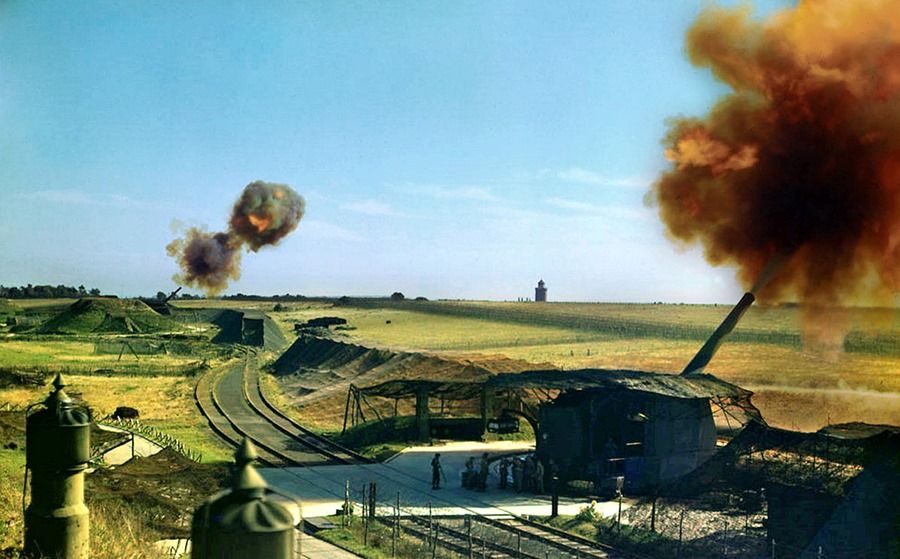
August 13, 1940. German long-range coastal artillery fire their first shells from France over the English Channel towards Dover. The British responded with their own guns. This gunnery duel became known as “Hellfire Corner”, and ended in September 1944 with the liberation of France & Belgium.
-
After 4 days of rain, August 25th, 1944 was a perfect summer’s day in Rouen, northern France.
Although there were many places where German soldiers could cross the Seine river and escape the incoming Allied armies, only a few heavy ferries and one damaged rail bridge big enough to allow heavy armour to cross were still operational in the northern sector.
Many were those who converged on the Quai Jean de Bethencourt at Rouen cramming the long quayside with vehicles of all sizes and shapes. It is estimated that at least 4,000 vehicles were massed at a time in the Rouen area.
With the sun came the Allied air force. 24 Mitchells and 10 Bostons medium bombers of RAF’s No 137 and 139 Wings arrived over Rouen at 7 p.m and bombed the left bank. The bombs landed amid the queued vehicles destroying more than 500 with a few bombs falling on the right bank killing some of those who had already crossed the river.
Four hours earlier an SS man sitting on bollard 230 smokes his pipe while he waits his turn to cross. An almost peaceful scenario were it not for the machines of war parked in the background. They comprise a PzKpfw VI ‘Tiger’, a PzKpfw V ‘Panther’ and a PzKpfw IV of unknown units.
If they managed to get across or burned in the incoming inferno it is unknown.

-
August 25 is also the day on which Paris was liberated. The film “Is Paris Burning?”, which depicts the liberation of Paris, includes the most badly dubbed sequence I’ve ever seen in a movie, the one in which Kirk Douglas as Lieutenant General George S. Patton is having a conversation with someone.
-
September 13, 1943. Italy
German troops near Salerno, launch a counter offensive against the recent Allied landings, striking at the region near Battipaglia, pushing US units back toward the beach, and re-capturing Altavilla 14 kilometres northeast of Paestum by nightfall. Allied leadership began to prepare, but did not execute, evacuation plans.
-
September 18, 1942. Eastern Front
Fighting continues at Stalingrad with house-to-house and even room-to-room combat. Soviet General Vasily Chuikov orders his troops to remain in permanent contact with the Germans (“hugging tactics”) to reduce the effectiveness of German artillery and aerial bombardment. However, the German assault has been held by Soviet 62nd Army mainly due to their reinforcement by 13th Guards Rifle Division 3 days ago. The cost to 13th Rifles is severe and only 320 of the 10,000 men sent into Stalingrad will survive the battle. North of the city, 3 Soviet Armies (including 1st Guards Army) attack XIV Panzer Corps (part of General Paulus’s 6th Army) but they are decimated on the open steppe by the Luftwaffe.
-
Ya Ya Attack !!! Lol
Thanks my Captain ! -
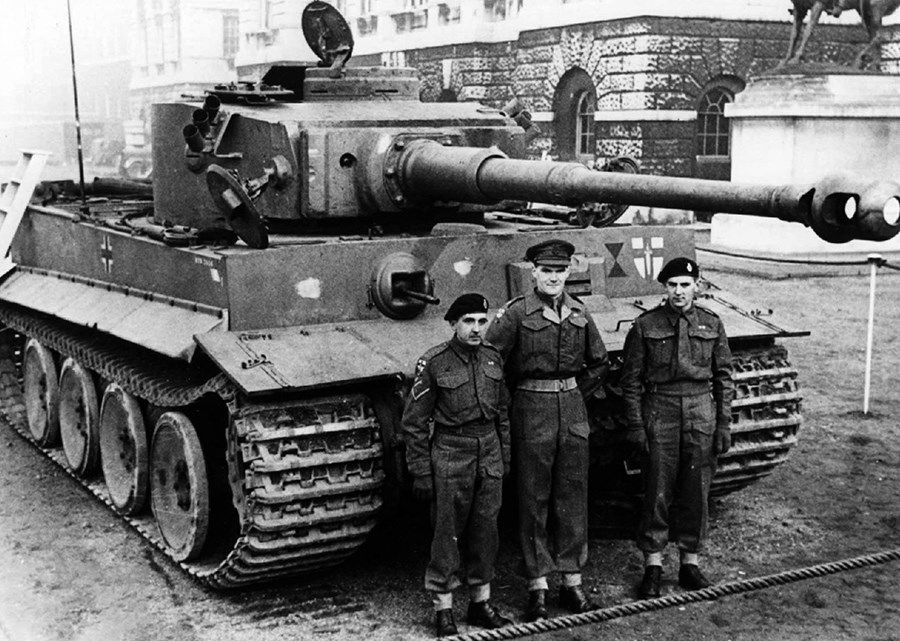
On this day in 1943, the now famous captured German Tiger tank “131” arrived in the UK at the Department of Tank Design, Surrey. The tank was completely dismantled for technical evaluation.
-
@captainwalker and I have seen it in action at Bovington Tank Museum. Was great to see and hear it move.
-
25 November 1941
While steaming to cover an attack on Italian convoys, the Queen Elizabeth-class 15in gun Battleship - HMS Barham was hit by three torpedoes from the German submarine U-331, captained by Kapitänleutnant Freiherr Hans-Diedrich von Tiesenhausen. As she rolled over to port, her after magazines exploded and the ship quickly sank with the loss of over two-thirds of her crew.
(841 men lost their lives when this battleship was sunk according to the HMS Barham Association website).
https://www.youtube.com/watch?v=YdrISbwy_zI -
@captainwalker very nice . Thanks Steve.
-
Pearl Harbor Attack - Sunday 7, December 1941
Panoramic view of Pearl Harbor, during the Japanese raid, with anti-aircraft shell bursts overhead. The photograph looks southwesterly from the hills behind the harbor. Large column of smoke in lower right center is from the burning USS Arizona (BB-39). Smoke somewhat further to the left is from the destroyers Shaw (DD-373), Cassin (DD-372) and Downes (DD-375), in dry-docks at the Pearl Harbor Navy Yard.
Observers quote, “This must be the second wave, because of all the flak that’s up. Apparently one of the reasons that there wasn’t a third wave was that American antiaircraft fire had greatly improved in effectiveness on the second wave, and that’s when most of the 29 Japanese aircraft were shot down.”
Official U.S. Navy Photograph, now in the collections of the National Archives. Catalog #: 80-G-32792
Color by Facundo Filipe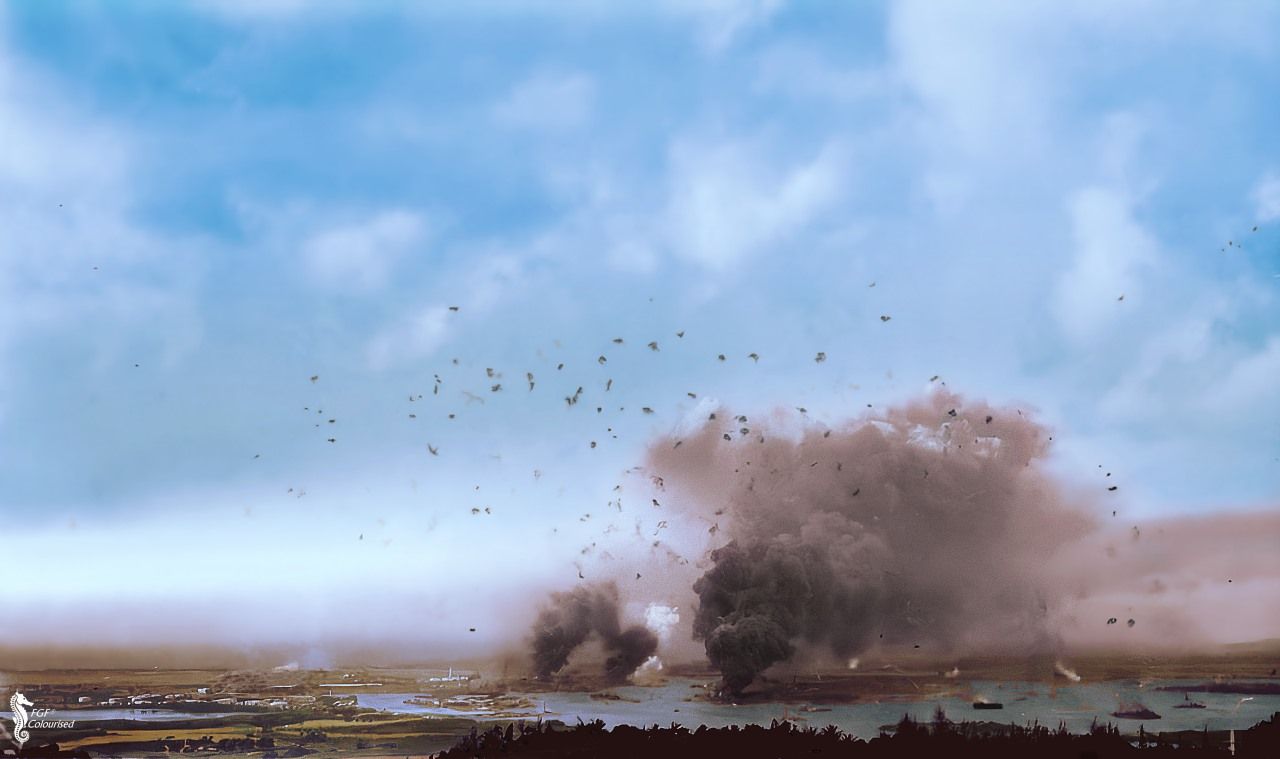
-
Hmm. The flak bursts are fairly uniform in size and seem to occupy a single plane of the image, instead of being of multiple sizes and at multiple locations all over the harbor – which makes me wonder if this picture was doctored for propaganda purposes at the time of its original release, possibly to support the quote about “all the flak that’s up.” It might be a completely authentic picture, or it might have been retouched. The part of the quote which says “Apparently one of the reasons that there wasn’t a third wave was that American antiaircraft fire had greatly improved in effectiveness on the second wave, and that’s when most of the 29 Japanese aircraft were shot down” is something which could reasonably have been believed at the time, though we know in retrospect that Nagumo didn’t launch a third wave out of timidity, even though his officers urged him to do so. But at any rate it’s certainly a great panoramic view, and the colorization was nicely done.
-
I think timidity is harsh…there are plenty of examples where the IJN took a ton of chances just to get to the battle, and then refused to take even more chances to seal the victory (transports at guadalcanal, savo island, samar). In retrospect, a 3rd PH wave wouldn’t have slowed the US much despite the great stories about how it would have crippled them, and its not impossible for the US to have staged an impromptu CV counterambush on the PH fleet…since the US set up devastating carrier ambushes at almost every major later battle, his concerns were pretty legitimate.
-
I was admittedly oversimplifying things when I described Nagumo’s decision as timidity. The situation was more complicated than that. Nagumo went into the Pearl Harbor attack fully anticipating (and, to his credit, being mentally prepared for) the possibility that his task force would suffer heavy losses. When the operation ended up going fantastically well – two successful aircraft waves inflicting heavy damage to the enemy with minimal losses of their own, and with no counterattack against his ships – he found himself in the position (as one author put it) of a man who was running at a door to bash it in with his shoulder and who ended up having the door unexpectedly opened for him at the last moment. He went from being prepared lose a couple of his carriers to wanting to preserve his task force from harm…and indeed, he got all his ships back to Japan without even a scratch in their paint. Unfortunately, it was the wrong call. Nagumo had been chosen for the job because he had seniority, not because he was an aggressive commander; he dutifully did what he’d been ordered to do, but he didn’t go further.
There’s a scene in the movie Tora Tora Tora where Nagumo argues to his air commanders (who were pleading for a third strike, this one targeting Pearl Harbor’s fuel depots and shipyards) that the war is going to be long and hard and that Japan must keep its precious carriers intact for that protracted struggle. I don’t know if the scene is historically factual or not. Nagumo does have a point when he says that in the film, but he’s also missing a counterpoint: even at the risk (which we now know would have been minimal, though he had no way of knowing it) of his task force being found and attacked the the Americans, a strike against the tank farms and dockyards would still have been worth it. The combat-focused Japanese military had a surprisingly poor understanding of the importance of logistics and infrastructure…something that you can get away with in a short local war, but not in a long one (especially against the most industrialized nation on earth) across vast oceanic distances.
-
@CWO-Marc We’d probably agree that the IJN combined some incredible moxy with some uncharacteristic reluctance and reticence. We didnt bring up fog of war, the Japanese captains didn’t know where the US CVs were and so in their imaginations, US counterattacks were always lurking or looming (and many times, they actually were).
While it wasn’t the main factor early on in the war, the US had broken the Japanese codes and had functional radar, very long range planes and incredibly detailed information and plans (yamamoto ambush) and other unknown technologies–I personally think that this led the Japanese to paranoia as US ships and planes kept showing up at the most inopportune times. Even when this was coincidence or luck, the IJN understood that the Americans had superior abilities and thus were always looking over their shoulders even if they never fully understood (as we do in retrospect) that the Americans had often previewed Japanese plans and set up devastating ambushes that might have appeared lucky, and with some elements that were indeed pure luck (Midway, Coral Sea, the Slot)
-
@taamvan said in On this day during W.W. 2:
While it wasn’t the main factor early on in the war, the US had broken the Japanese codes and had functional radar, very long range planes and incredibly detailed information and plans (yamamoto ambush) and other unknown technologies–I personally think that this led the Japanese to paranoia as US ships and planes kept showing up at the most inopportune times.
And interestingly, the Japanese also suffered on at least one occasion – at Midway – of what could be called anti-paranoia, which was to assume that the Americans would obligingly follow the timeline which Japan had scripted for them. Their Midway operation did not include any contingency plans to deal with the possibility that one or more American carriers might inconveniently show up ahead of schedule…so when that actually happened, Nagumo had to improvise on the spot (and do so in the absence of adequate information, a problem that haunts every military commander) and the operation started falling apart. It didn’t help that the Japanese were trying to accomplish two contradictory things at once: conducting an amphibious landing, an operation which needs to be carefully coordinated and which needs to take into account such immutable factors as the tides, and destroying a mobile enemy carrier force, an operation which involves many unknowns and which requires a high degree of flexibility. Their concept was built around a “First A, then B” scenario, but they ended up facing an A+B scenario.
I’ve sometimes wondered how Midway would have turned out if Yamamoto had dispensed with the diversionary Aleutian operation and instead had assigned the light carriers Junyo and Ryujo to augment Nagumo’s main carrier group. This would have given him added reconnaissance capabilities, a reserve attack force, and a bigger combat air patrol to protect his fleet from enemy fighters.
Suggested Topics