




Are the Canadian units in the out of box rules also converted into American units?
HBG Japan Supplement Set
-
A final decision has not yet been reached but we’re getting close. Wanted to finalize a few other projects first that had priority.
-
cool one last pitch then Nakajima Ki-43 Hayabusa. for those who think it looks like the zeke.
the Hayabusa. http://ww2drawings.jexiste.fr/Files/2-Airplanes/Axis/3-Japan/01-Fighters/Ki-43Oscar/Ki-43(III)-Ko.htm
the way to tell differences between the 2 fighters are the cockpit, and the wings. the Oscars Cockpit is smaller and shaped more like a Bubble than the Zeros. maybe the cockpit would be to hard to see in such a small scale
but the shape of the wings will be a lot different that you would be able to tell the difference in such a small scale. it looks triangular here is another picture to show
http://ww2drawings.jexiste.fr/Files/2-Airplanes/Axis/3-Japan/01-Fighters/Ki-43Oscar/Ki-43(I)-Oscar.htm.
even at a small scale you still would be able to tell the difference with the shape of the wings.the main reason i really want to see the Oscar included is that it was an iconic fighter for japan it actually was in use in 1939, so it fits the “Early war fighter” perfectly. they were also used for the kamikaze attacks toward the end of the war.
As for the late war fighters. the 2 arguments are impact vs quality
Ki-84 Hayate/Frank was considered the Japaneses best fighter through out most of the war. plus it was the 3rd most produced fighter behind only the Zero and the Oscar. the fighter was already known to be great to counter the newer allied fighters and was known to go toe to toe with Mustangs. so with the combination of being 3rd on the list of being produced AND being a beast of a fighter this would still be my first choice.but if it was about just the quality of the fighter i would still be OK with the Ki-100. appearance wise would be kinda compromise between those of us who like the tony and those of us that like the frank.
this is the frank
http://ww2drawings.jexiste.fr/Files/2-Airplanes/Axis/3-Japan/01-Fighters/Ki.84Hayate/Ki.84-1koHayate.htmthe tony
http://ww2drawings.jexiste.fr/Files/2-Airplanes/Axis/3-Japan/01-Fighters/Ki-61Hien/Ki.61-Ib-Hien.htmand finally the Ki-100
http://ww2drawings.jexiste.fr/Files/2-Airplanes/Axis/3-Japan/01-Fighters/Ki-100/Ki-100-I-Kou.htmthis is a paragraph from wiki to describe the abilities of the KI-100 against the then greatest fighter for japan the KI-84, and i know wiki isn’t truth but yeah
“During March and April 1945 experienced instructors from the Akeno Army Flying School flew the Ki-100 in extensive tests against the Ki-84(Frank), which was considered to be the best of the JAAF fighters then in operational service. Their conclusions were that, given pilots of equal experience, the Ki-100 would always win in combat.”
so there my last push for these fighters, an again i respect every one else’s opinion on this matter its just i love ww2 fighters and its the piece i collect the most out of all A&A pieces, and i just need to express my opinion on why i would love to see these pieces produced.
thanks for reading
-
I hope its not too late to chip in here…
CV: Soryu or Taiho class
BB: Ise (prerefit) or Kongo class
Tank: Type 3 Chi-Nu or Type 4 Chi-To
SPG/SPA: Type 4 Ho-Ro
Tactical Bomber: Aichi B7A
These are on my top list. 8-)
-
Although just a dream(for me and the Japanese) the very long range bomber could have been filled by the massive Fugaku 6 engine beastie.There is some decent art out on this thing but little else.Hard to believe at that stage of the war there would be any interest.Raiden Models considered doing one for their Luft 46 range in 1/600
but later dropped the scale altogether.I think one of the Japanese mini toy outfits did a nice one. -
Lunarwolf, I really like the design for the Ki-100, and hope it is included.
Maybe both companies could split the task of fighters (Army and Navy) respectively. One could make the Ki-100 and the other could make J7W1 Shinden.
That would really give the Japanese an interesting, and unique unit. Of course, the latter is just my dream and I think it qualifies more as a interceptor than a fighter, but it could still work. Still, just my preference, though I’d love for someone to make it.
-
I found this on HGB website:
HBG is producing it’s Seventh series of plastic Gaming pieces that can used in miniature games such as Axis & Allies, Memoir44, or just Miniature War gaming. These will be done in the same scale approx. . They will be done in 2 colors, Burnt orange to match the Out of Box color and Yellow Gold for veteran pieces.
Set will have 28 pieces.
Infantry - SNLF Marine
SP Artillery - Ho-Hi
Tank Destroyer- Ho-Ru
Armored Car-Type 87
Battleship-Kongo
Escort Carrier-Unyo
Tac-Kate Torpedo Bomber & Val Dive Bomber
Heavy Bomber-G8N
Truck-Type 94 (6 Wheel)
Mech-Ho-Ha
Light Tank-Type 92, or 97
Transport Plane-Ki-57 -
Can’t wait till we start talking about the British set….HMS Hood, M3 Lee tank… :-D
-
Personally, I would rather each country have units that were designed and built by that country. For example, for British armor I would rather they have Crusaders, Matildas, Churchills, Comets, etc. I know that the Brits got a lot of M3 Lees and M5 Stuarts through Lend-Lease, but those are still American built tanks. I think it’s better for this game if each country has their own unique stuff. It just seems like more fun to me and you get a wider variety of sculpts.
After all, that is why FMG went to all the trouble for the Italian set. Sure, Italy got a lot of stuff from Germany during the war, but it’s cooler to have actual Italian units to play with. -
“Coach”,
I applaud all of your hard work and research for your Japanese supplement set.
But, I couldn’t help but notice that you don’t have an Airborne Paratrooper unit listed in your future Japanese set. I thought that a Paratrooper was a “standard” unit in your country supplement sets. I truly hope that I don’t have to wait for a 2nd or 3rd set to have this “standard” unit. Thanks again.
“Tall Paul”
-
Hey Tall Paul,
I know you want dedicated Airborne troops, but I think the SNLF Marine Unit that Coach is planning could also be used as an Airborne troop for Japan. The SNLF did do some paratroop drops. In fact, in one of my A&A Miniature sets, there is a unit called “SNLF Paratrooper”. You could use Coach’s SNLF unit as Airborne and the regular OOB infantry as regular infantry. Just an idea. -
KNP,
Thanks for your input. I realize that I could just use some “other” piece and paint it differently or something, and as far as that goes we could just paint everything and NEVER NEED ANY NEW UNITS,…BUT, that’s not the case here, nor is it what I(and probably others) would prefer.
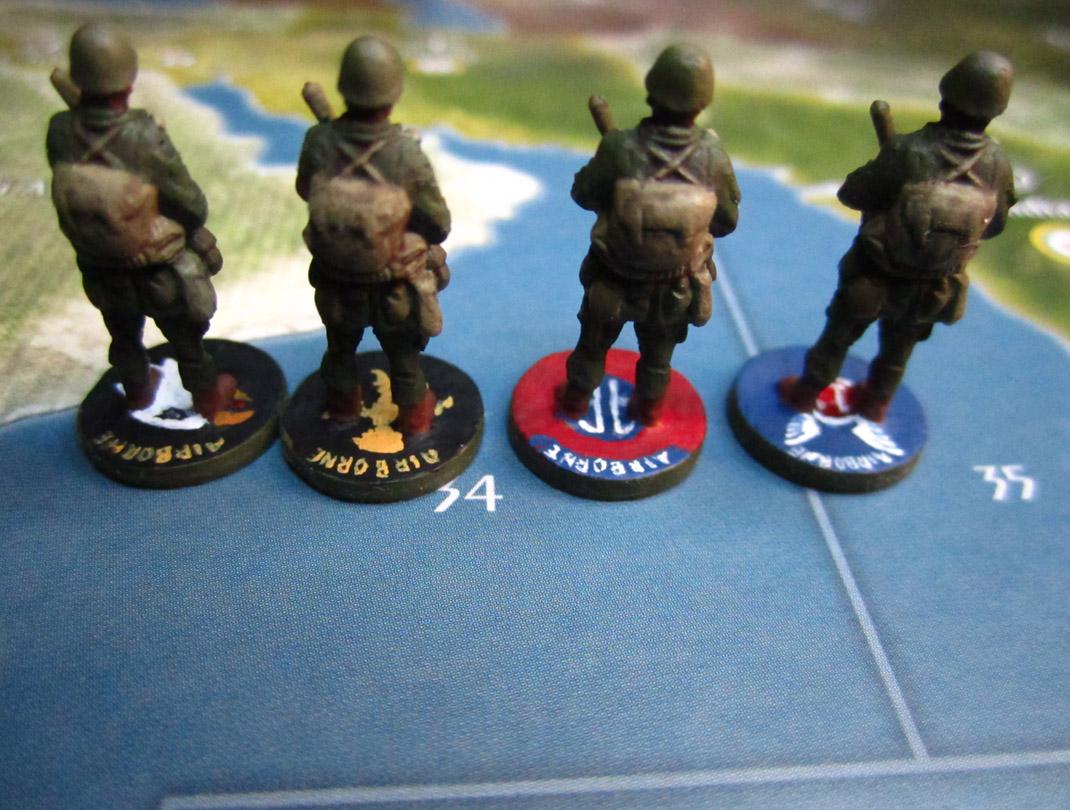
In the U.S. Supplement Set, the first from HBG ,they included an Airborne Paratrooper in it. The discussion that followed it’s production lead me to believe that HBG would continue to produce Paratroopers for every country in their Supplement sets. I’m only hoping that they continue to include the Paratrooper in the FIRST SET from every nation rather than the second or third set from each nation. I think the Paratrooper unit is that important.
Don’t get me wrong,…I intend on buying several of EVERYTHING that HBG and FMG produce. I just want a Paratrooper in the FIRST SET from each nation like they have already done with the U.S. Set.
I’m not trying to influence HBG to CHANGE their unit selection for my wants,…I’m simply asking that they KEEP things as they already were. It would seem a logical selling point for their Air Transport planes IF they had something to use them(Paratroopers). Anyway,…my two cents and REQUEST.
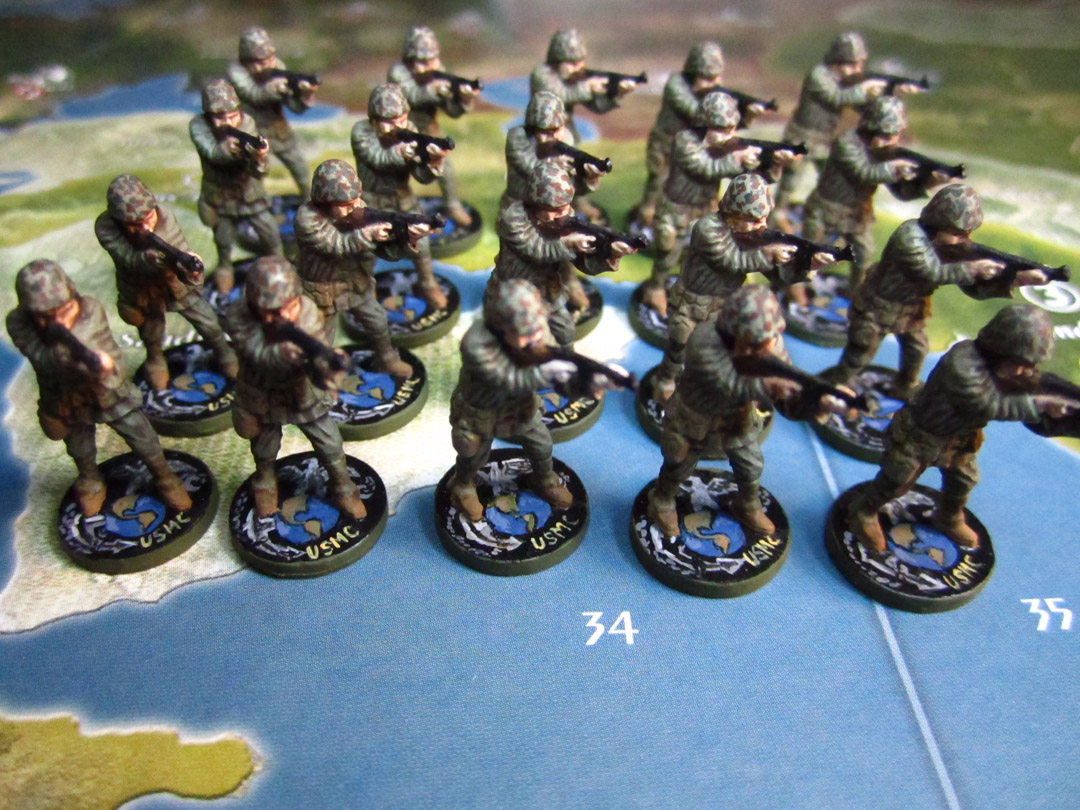
I believe a Marine and a Paratrooper are visually very distinctive and quite different in their looks. Check out the LARGE parachutes on these below……
“Tall Paul”
-
They look quite different than these Marines.
-
Very Nice!!!
-
Thanks “Coach”,
How about the possibility of a Paratrooper in your first Japanese Supplement Set?
My gaming group won’t let me use my “Screamin’ Eagles” until I have some for ALL of the countries. Can you please help me out?
“Tall Paul”
-
@Tall:
Thanks “Coach”,
How about the possibility of a Paratrooper in your first Japanese Supplement Set?
My gaming group won’t let me use my “Screamin’ Eagles” until I have some for ALL of the countries. Can you please help me out?
“Tall Paul”
Will you buy 1000 of them?
-
i use a normal inf. with a control marker under it for paratroops while i wait for paratroopers for each nation.
-
“Coach”,
The obvious answer to your question is no, and I don’t think you’d expect anyone else would buy 1,000 of anything either. But I believe that Paratrooper units would be enough of an asset to help the sales of the Supplement Set.
Why are you changing the “formula” of units produced from the first supplement set(U.S.)? Do you think other units are more important or would sell better?
I’m simply voicing my concerns regarding Paratrooper units from ALL countries here on this forum which is set up for that purpose. I hoped you’d accept my views as “customer input/preferences”.
“Tall Paul”
-
My opinion on the Japan set is this… Japan has been neglected for a long time in getting specialized units when they really deserve quite a few. While the set is still not yet finalized, we have discovered that there are more units we want to make than will fit into one mold. Therefore, we have to choose what goes in set 1 and what goes in set 2. Coach has assured me that they WILL be made as long as there is demand.
Keep in mind that the US Supplement set was really the 2nd US set. The Marines were first. I have a feeling that demand for Japanese pieces will determine the amount of time between Japan sets. You may not get paras in the firs set, but you will likely get paras.
To Tall Paul and others who have commented here: You have great ideas! You always have. Trust me when I tell you, we DO listen. Your opinion, as well as the opinion of others here, drives every decision we make. Without all of the requests and opinions we see here, we wouldn’t know what you want! But, we can’t always make everything happen. Remember, I wanted the US Naval set as bad as you did! But, it has to wait until there is enough interest in it. You did your part by helping to spread the word about the project every chance you got. I did my part by making more games to use those pieces. Fingers crossed buddy, we may get it yet!
Again, since this set is not final, we still want everyone to weigh in on what you need out of this first set. We want to keep it balanced so that it fits into a Global game role, not just air and naval heavy. But if you see something not on the current list you think we need, TELL US! If you like what’s on the list already, TELL US!
-
HBG Guys,
I truly hope that my comments don’t come off as “combative” or abrasive. That isn’t how I meant them. I KNOW for a FACT that ya’ll LISTEN to us, the customers, and I offer a big THANK YOU for that.
I think EVERYONE would agree that there are far more unit types than can be produced in one set. I myself wouldn’t be supprised if it took three sets. As such, there probably is no “correct” answer as far as unit selection goes, but perhaps the most A.) Popular B.) Necessary, or C.) New units would be the guidlines.
As far as marketing goes,…I think it would be better(for everyone) to produce the
Air Transport and Paratroopers together at the SAME TIME.
Either BOTH NOW,…or BOTH LATER. There are many worthy units to be produced.Personally, I’d prefer to post-pone ONE of the other listed units(maybe the Truck) and get the Paratroopers, but that’s just me. Check everyone elses opinions on units, perhaps.
I will obviously buy whaterever is produced, but look forward to using my Paratroopers which I can’t do until we have them for ALL nations. Again,…
Thank You for all of your efforts and investments so far.“Tall Paul”
-
I completely disagree with postponing the truck to add paratroopers. In the scale of A&A, airborne troops are rarely used, but a truck (motorized inf, move 2) unit is incredibly useful.
Suggested Topics