
• @The_Good_Captain said in "East & West" by Imp Games - Discussion:

    @RogerCooper also, since this map is so obviously inspired by Xeno World at War, that map has the same error. Rename them out of artistic license if nothing else imo.

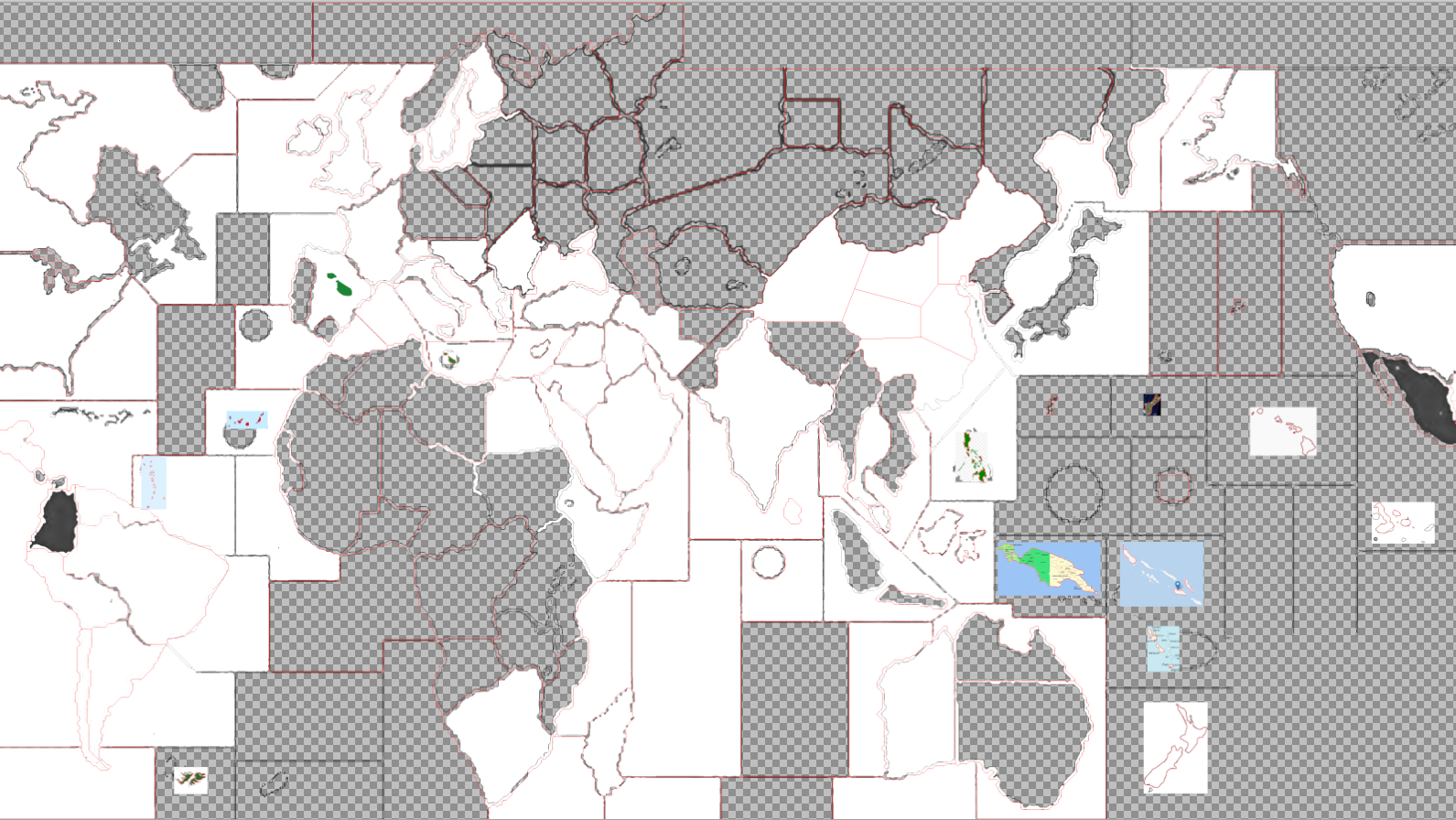
    As mentioned in the podcast, the Canary Islands (Spain) on the E&W map are exactly where the Cape Verde Islands (Portugal) are, on the W@W map. The island grouping is even drawn exactly the same as on the W@W map, but they’re colour-coded to Western Europe in E&W. Go figure. 🙃


  • @The-Janus said in "East & West" by Imp Games - Discussion:

    On the topic of homebrews, would anyone be interested in my rules for playing an E&W scenario, using the RISK: Reinvention boardgame?
    It’s definitely a lot more of an abstraction, but the idea was to keep some of the same feel as the original.


    @The-Janus said in "East & West" by Imp Games - Discussion:

    I really had fun with the version of E&W that I came up with for RISK: Reinvention


    @The-Janus said in "East & West" by Imp Games - Discussion:

    Honestly, if you feel the need to strip things down, but maintain the flavour of it, I can definitely give you some suggestions in that regard – I’ve written an E&W scenario for Risk.

    So, as you can see, I’ve been threatening to do this for a while, and the YouTube algorithm recently bit me with the RISK bug again.

    Sometime in the coming weeks, I’m going to do a writeup on this topic – an East & West mod, for RISK. Way back in the day, when I was first playing RISK (and E&W, for that matter) my friends owned the original, Parker Brothers-style version of the game. When I decided to pick up a copy to own for myself (probably around… 2010?) the “Reinvention” version of RISK is the one I ended up purchasing.

    I still have some documentation of the rules for both the “classic” RISK and the “Reinvention” versions of the E&W mod, but I’m going to focus on the latter, since I think the additions of cities and capitols actually help with a lot of the mechanics/balance.

    From my experience, this version of RISK actually makes for a really great marriage between the very specific cold war flavour of E&W, but with the speed and abstraction that are really RISK’s great strengths. Since it’s still a 3v1 scenario, there are some changes to the usual RISK formula, but it all still feels familiar.


    Anyways, stay tuned for that to show up in this thread, sometime later this month.


  • @The-Janus said in "East & West" by Imp Games - Discussion:

    an East & West mod, for RISK. […] the “Reinvention” version of RISK is the one I ended up purchasing.

    Part One:

    RISK-isms

    Probably the first thing to address in any “team game” modification to RISK is how to determine who gets credit for controlling the continents. As RISK-isms go, if you aren’t going to include continents as a mechanic, why even bother? The iteration of the rules that I settled on is pretty simple:

    1. if NATO controls North America or South America, those bonuses go to the US
    2. if NATO controls Europe or Africa, those bonuses go to WE
    3. if NATO controls Asia or Australia, those bonuses go to the UK

    The other thing to address in a 3v1 is some measures to prevent the USSR from just getting dogpiled. The solution I came up with is that NATO can only attack from territories they have controlled from the start of their turn. So, the US could attack from Alaska to Kamchatka, but could not continue attacking from Kamchatka on that turn.

    With the ‘Reinvention’ version of the rules, cities and capitols increase the overall production capability on the board, but I felt a few more changes were necessary. When totaling up territories, the USSR does not divide their value by 3 (loosely meant to simulate 2-IPC infantry). Also, the “minimum 3 armies” rule is ignored. So for example, if your territory total as NATO is 6, 7, or 8 you would only get 2 armies.

    NATO can reinforce (i.e. non-combat move) through each others’ territories, but cannot share territories. So, for example, US troops in Alaska could reinforce through the Northwest Territories to Greenland or Iceland; they cannot end in the UK or Western Europe.

    Reinvention-isms

    So the real big additions in this version of RISK are cities and capitols.
    Cities effectively increase the “IPC value” of a territory; when drafting troops, a city counts the same as 1 additional territory (i.e. 1/3rd of an army, for NATO.)
    A capitol grants you an additional 1 army; this means that controlling your own capitol immediately raises the floor on troop generation (in the base game) from 3 armies to 4.

    For all intents and purposes, the capitols are placed roughly where they would be in E&W, and cities are placed where Industrial Complexes would be – notably, this includes some being in neutral territories.

    Reinvention also does the more “modern” rule for card trades, whereby the symbols cashed in prescribe the number of armies you get. In this mod, the blank cards are used as nuclear weapons. A recurring theme is that I didn’t want to have to create any separate play-aids for this game to work, and this is one example of that.

    Also, I’ll mention here that because Reinvention doesn’t use infinitely-escalating unit production (via cards) the armies are in denominations of 1 and 3, instead of the 1/5/10 of older versions. This will come up in a few small places, for this mod.

    Capitols:
    Red (USSR) - Urals
    Blue (WE) - Western Europe
    Yellow (UK) - Great Britain
    Green (US) - Eastern United States

    Cities:

    • Russia
    • Urals
    • Kamchatka
    • Western Europe
    • Ontario
    • Great Britain
    • Eastern United States
    • Western United States

    Now, in E&W there is an IC in Italy, so you would expect there to be a City in Southern Europe. The thing I found was that it over-incentivizes the USSR to attack through this route – and they’re already incentivized to not “open” Britain or Iceland. The rationalization I used is that since Middle East is controlled by the Arab League, Southern Europe is more meant to represent Greece and Turkey in this scenario, with Western Europe representing France and Italy. I realize the adjacency doesn’t make as much sense that way, but… I also didn’t want to reinvent the map.

    E&W-isms

    I mentioned the continents right off the top, but clearly there are going to be a bunch of neutral territories – so how do those figure in?

    Naturally, we don’t want a game that incentivizes NATO just bowling over neutrals, as that’s not really in the spirit of E&W. So here’s what I came up with:
    Each neutral alliance can support either one NATO power, or the USSR. Originally, I had figured there would be a +0/+1/+2 support level to either side, but to make things easier to track (again, without adding any play aids to the game) the support scale is instead a 5-point slider (i.e. -2/-1/0/+1/+2)

    • If a neutral alliance is giving +1 support to a power, that power places a 1-army marker of their colour on that neutral’s city.
    • If a neutral alliance is giving +2 support to a power, that power places a 3-army marker of their colour on that neutral’s city.

    This is simply our way of tracking support, using the materials the game comes with. At the start of the game, the OAS should be set to +1 towards the US, and China should be set to +1 towards the USSR.

    Now, what does this actually mean, mechanically?
    +1 support means that when counting up your territories and cities, you can add the territories and cities of that neutral to your total; you can also count their territorial ownership towards your control of one continent.
    So, since the OAS straddles North and South America, on the US turn if the OAS is at +1, then the US can choose to count the OAS territories towards their control of either North America or South America. Likewise, with the Arab League straddling Africa and Asia, having a +1 support level allows them to contribute towards control of either one of those continents.

    At the +2 support level, the number of cities and territories for the neutral is doubled before being added to the total; you can also use their territories as your own, for the purposes of pathing your reinforcement (i.e. non-combat move). You can also count the neutral’s territories towards your control of 2 continents; obviously for China, this last stipulation would have no actual consequences.

    For the purposes of support/influence, Indonesia is treated as part of the Arab League, as long as it remains neutral. If attacked, however, Indonesia and the Arab League are treated as separate neutrals. If the Arab League is at +1 to NATO, they can choose to count Indonesia (if neutral) towards their control of Australia.

    Now, that all being said, most of the testing I did in the past didn’t have the support levels change all that much – so a lot of the assumptions around the economics of the game work around the OAS and China always being at +1. If you add in influence rolls to the game, there is going to be more randomness… but that might also allow for more replayability.

    The general idea was that the USSR would get one influence roll at each of the 3 neutrals, to start their turn; each NATO power would get one roll towards their affiliated neutral, at the start of their turns. Since this is RISK (where you want to roll high) success would be on a 6.

    Since the support level for the Arab League/Indonesia could conceivably increase from +1 on the WE turn to +2 on the UK turn (and more generally, just because the Arab League crosses 2 different NATO powers’ zones of influence) just make a note to only let them be used to a maximum of +2 per round. The chances of being able to count them towards 3 continents in a round without the USSR being dumpstered is pretty low… but for the sake of posterity, I should mention that it is not intended for NATO to be able to cash in on all 3 continents in a round.

    Neutral Armies

    Now, to determine how many armies to put in the neutral territories, I basically took the total number of units for each neutral power in E&W, and then divided them evenly among their territories. For the Arab League, I believe the numbers for Iran, Afghanistan, and Ethiopia were also included; likewise, Indonesia basically includes Thailand and Tibet.

    As said before, since Reinvention uses 1-army and 3-army markers, I decided to round off the neutral armies to increments of 3.

    • OAS: 3 armies per territory
    • Arab League: 12 armies per territory
    • China: 15 armies per territory
    • Indonesia: 6 armies

    With ICs being in Brazil, Egypt, and Manchuria in E&W, cities are placed in Brazil, Egypt, and Mongolia.
    As in E&W, the USSR can attack neutrals at any time, but NATO can only attack them if they are giving full support (+2) to the USSR.

    It’s worth noting that each colour comes with 80 armies in the Reinvention version. This neutral setup uses 75 armies.
    I think if there was one change to be made, it could be to say, “actually, the North Korea contingent for China should be included in the neutral numbers,” which would also have the effect of making China notably stronger than the Arab League. (Assuming that something like this might be needed for balance reasons, after additional testing…)
    In order to facilitate adding these 6 armies to China (bringing the total to 18 per territory – unless you really had your heart set on putting a higher number in Mongolia than in China…) I’d simply reduce Indonesia’s total armies down to 5.


  • Part Two:

    Basic Setup

    Now, if memory serves, I think the idea with the starting forces was to use only the number of infantry for each country, and sort of rounding those numbers off.
    Since the starting territories are pre-set, there isn’t the “claiming territories” phase from the original game. But to simulate something similar, the placement is done in a “you go-I go” fashion.

    After putting 1 army onto each of your starting territories, count out 60 red armies for the USSR, 30 green armies for the US, 25 yellow armies for the UK, and 20 blue armies for WE. Then, take turns placing those armies over 5 rounds, as follows:

    • 3 Soviet
    • 4 WE
    • 3 Soviet
    • 5 UK
    • 3 Soviet
    • 6 US
    • 3 Soviet

    Starting Territories

    Some of the names are changed from earlier versions of RISK, but for the sake of uniformity, I have used the territory names as they appear in the Reinvention version.

    USSR: Northern Europe, Russia, Urals, Afghanistan, Siberia, Yakutsk, Irkutsk, Kamchatka
    WE: Western Europe, Scandinavia, Southern Europe, North Africa, Central Africa, Madagascar, Southeast Asia, New Guinea
    UK: Great Britain, Northwest Territory, Alberta, Ontario, Eastern Canada, East Africa, South Africa, India, Western Australia, Eastern Australia
    US: Eastern United States, Western United States, Alaska, Greenland, Iceland, Japan

    There’s an argument to be made that Northern Europe could be given to WE. The problem is that it leads to kind of a boring opener for the USSR, because the obvious thing is to just heavily stack in Russia (aka Ukraine). Giving the USSR control of Northern Europe gives them more options for how they can position their start… but also this gives NATO a bit more information as to their intentions than the situation of just, “I stack everything in Russia; you’ll find out which of the 3 lanes I’ll attack when it’s my turn.”
    It also means that the USSR is “open” to attack from the UK, in Europe, right out of the gate – rather than being able to possibly avoid such contact by routing through Southern Europe, into Africa

    Balancing / Rationale

    Not counting capitols, here’s what everyone would start with (before any attacks)

    WE: starts with 8 territories and 1 city, so that makes for 3 armies
    UK: starts with 10 territories and 2 cities, so that makes for 4 armies
    US: starts with 6 territories and 2 cities + 5 territories and 1 city (for the OAS contribution) = 14 / 3 = 4 armies; adding in one continent bonus means either 5 armies for North America, or 2 for South America
    USSR: 8 territories and 3 cities + 2 territories and 1 city (for China’s contributions) = 14 armies

    Once you add in capitols, that makes it 19 for NATO vs. 15 for USSR – however, keep in mind that the USSR can break North America to cut NATO’s number down by 3; losing any 1 territory would reduce WE or UK’s production by 1 army – 2 if it’s their capitol. Barring some extreme results from influence rolls, the opening of the game has the potential to be pretty balanced.

    The OAS contribution to the US feels out of place w/r/t how it typically plays out in E&W. However, to balance off the massive number of territories the UK has, with how few the US should have…? I’m not sure there’s a better solution, within the RISK framework. Even the possibility of OAS territories counting for double at a +2 contribution doesn’t make for a huge swing, since this bonus works out to only 4 armies.

    Nuclear Weapons

    I mentioned before that the blank cards in the deck are used as nuclear weapons. Each side (NATO or USSR) can only use 1 nuclear weapon per round. Basically if you have one of these cards in your hand, you can target any space on the map; if you succeed at the complication roll, you remove 10 armies from the targeted territory. If this leaves no armies on that territory, it effectively is not owned by anyone and cannot be counted for the purposes of drafting troops. It can be claimed by anyone, by “attacking” an adjacent army into the territory.
    As with regular E&W’s rules, you cannot make a conventional attack against a territory on the same turn that you target it with a nuclear attack.

    The complication roll is a simplification of the 2d6 roll in E&W, using 1d6 instead:
    1: No Attack - this basically accounts for detonation, malfunction, and campus protest complications. Return the card to the deck if you get this result.
    2 or 3: Outrage - works like a normal attack, with the following drawback:

    • If the attack is made by or directed at Western Europe, the Arab League and Indonesia are influenced one point away from the aggressor.
    • If the attack is made by or directed at the UK, China is influenced one point away from the aggressor.
    • If the attack is made by or directed at the US, the OAS is influenced one point away from the aggressor.
    • If the attack is directed at a neutral territory, ALL other neutrals are influenced one point away from the aggressor.

    4, 5, or 6: Normal Attack - remove the 10 armies, no other effects.


  • Part Three:

    Victory Conditions

    Obviously a bunch of mechanics tend to fall apart (particularly pertaining to neutrals and influence and such) if a NATO power is completely wiped off of the map…

    So that’s basically the win condition for the USSR – to eliminate (at least) one of the NATO powers. 2nd option is just taking the US capitol. 3rd option is for USSR to be controlling at least 3 continents. All 3 victory conditions require that the USSR still controls their own capitol.

    NATO VC’s are:
    a) controlling 5 continents, including all NATO capitols
    b) controlling all 4 capitols

    Most of the caveats pertaining to capitols were, obviously, added in with the Reinvention version of this mod. I felt it helps to make them important, the same way that they are in E&W.

    Basic assumption for these win conditions (pertaining to continents) would be that NATO controls everything except Asia, and USSR would control Europe, Asia, and one other (likely Africa or Australia.) Neutral contributions would count towards control of continents, so they are not necessarily required to be conquered.

    Neutral Notes

    Fun fact: Reinvention only ships with 5 colours of armies, unlike the typical 6 you could expect in earlier versions.

    In case it needed to be said, all neutral armies are meant to be represented using the black armies; the black capitol is not used in the E&W scenario.
    The territories for neutrals (I would hope) are pretty obvious, too…

    • OAS: Central America, Venezuela, Peru, Argentina, Brazil
    • Arab League: Egypt, Middle East
    • China: Mongolia, China

    As in E&W, if a neutral is attacked and not completely destroyed, their remaining armies are replaced with those of the power they become aligned with (i.e. USSR, if attacked by NATO; if attacked by USSR, OAS joins US, Arab League and Indonesia join WE, China joins UK.)

    Liberating Capitols

    As per the normal Reinvention ruleset, you get 1 army for any capitols you control. My sense is that in the E&W mod, a capitol owned by one NATO partner but liberated by another NATO partner should still contribute its 1 army to the original owner… but I’m willing to have my mind changed on that, depending on playtesting/feedback.

    Trading in Cards

    I’ve always liked the rule that you can get 2 additional armies on (at least one of) the territories corresponding to the cards you trade in, if you control that territory. In the Reinvention rules, you can basically turn in as few as 1 and as many as 5 cards at a time; for this reason, I feel like a good compromise is just to say, “you gain 1 free additional army on any territories you control, corresponding to the cards you trade in.”


  • Part Four:

    FAQ / Q&A?

    For anyone who has been reading along, I’ve made a few edits here and there to the preceding posts, as things popped into my mind. So before asking any questions, maybe do one more read-through to make sure I haven’t covered it, since the original time of posting.

    If there are any further additions/clarifications need, I’ll try and keep them consolidated into this post.

Suggested Topics

Axis & Allies Boardgaming Custom Painted Miniatures

37

Online

17.9k

Users

40.6k

Topics

1.8m

Posts