

No Tiger Pilot was active US military because the Tigers were replacing the Soviet Pilots before Pearl Harbor so they didn’t want to give Japan direct evidence of an act of war.
Lend - Lease and the impact upon the Eastern Front
-
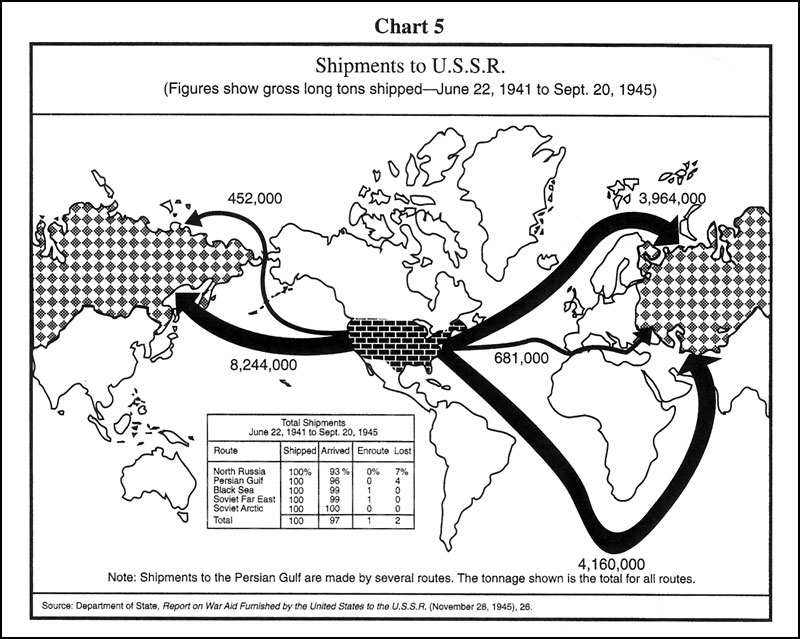
As we all know Allied Convoys from the US and the UK saved the Soviet Union from collapse during WW2. They carried many war supplies aboard their vessels.
Some of these items included:
- Boots
- Over 15 Million pairs were sent to the Soviet Union during Lend - Lease. - Trucks
- So many trucks in fact that by 1945, a third of the Red Army’s trucks were American Built - Arms (Not literal Human Arms, I know you people on the forums)
- Ammunition
- Planes
- Funny story about this, During WW2, Stalin would repeatedly ask for the US Built B-24. He didnt get any, until 3 landed right in his lap in Vladivostok during the war. The crews were held in the USSR because at the time, the Soviet Union was not at war with Japan. The crews were eventually released. The Soviet Union kept the planes, and copied the planes piece by piece, even the patches.
- A statistic on how many planes were set, about 13% of the Soviet Air Force during WW2 was made up of by other Allied Aircraft (About 18,000 Aircraft!) - Railroad equipment
- During WW2, the Soviet Union produced less than 500 locomotives, in fact less than a 100 were built during the 3 year period of 1942 to 1945. The war basically halted the production of railroad equipment. This was to prove vital as the Soviet Union used rail as their primary mode of transportation.
- The US and the UK sent about 2,000 locomotives to supplement the USSR along with about 11,000 rail cars equaling to about 92% of Soviet rail cars and locomotives being provided by the Western Allies. - Tanks
- A lot of you probably went “Wait, What?” Yes the Soviet Union deployed about 7,000 of these along the Eastern Front, making up about 8% of Soviet Tank production. - Aviation Fuel
- The Soviet Union did not at the time, possess a way to make high octane fuel for their planes, so they had to import it. - Communications Equipment
- Made up of mostly Telegraph Cable and Telephones, this helped bolster weak Soviet Communication - Food and Alcohol
- The Soviet Union received over 4.4 Million tons of food supplies and about 331,000 liters of Liquor to the Soviet Union - And Much, Much more
All of this made up about 7% of Soviet Production. At the end of the war, the Soviets were billed by the US for 1.3 Billion Dollars for the Aid, while the Soviet Union claimed that they only needed to pay a fraction of that, 180 Million Dollars. The Debt remains mostly unpaid today.
Lets talk about another aspect of this, the Ships and the Men that served on them. Many ships and men were lost in the cold waters of the North Atlantic. Sunk by U-Boats on the way to Russia. These men were by no means Soldiers or even sailors in the Navy, in fact they were not even enlisted. They were Civilian merchant men, transporting supplies to the Soviet Union from points in Britain.
To end this off, a common saying:
“World War 2 was won with British Intelligence, American Steel, and Russian Blood”
- Boots
-
@Hunter:
As we all know Allied Convoys from the US and the UK saved the Soviet Union from collapse during WW2…
Disagree that we “all know” that. Russia saved themselves imo. They stopped Germany in front of Moscow and almost destroyed Army Group Centre before any of the lend lease had a chance to get there, let alone make an impact.
-
@Hunter:
As we all know Allied Convoys from the US and the UK saved the Soviet Union from collapse during WW2…
Disagree that we “all know” that. Russia saved themselves imo. They stopped Germany in front of Moscow and almost destroyed Army Group Centre before any of the lend lease had a chance to get there, let alone make an impact.
Allied Lend Lease shipping to Russia started in August 1941, before the US entrance in December 1941.
Yes, the Russians pushed back the German Army Group that threatened Moscow in 1941, it saved the Soviet Union in the Short Term. In the Long Term, the Soviet Union would need help. They needed supplies, The Russians needed trains to move their troops, Trains were the most common form of transportation for Soviet Units. The Trains?, Mostly Supplied for the Allies.
There are 3 Turning Points in the Eastern Front, 1 of which is Moscow.
The other 2 are Stalingrad and Kursk.
Stalingrad, was said by Historians, Especially Russians, to be the battle that saved the Soviet Union. Russian Historians compare this to the Battle of Gettysburg in the US Civil War, saying that it saved their nation.
Kursk, I see as a turning point. It being the Largest Tank Battle in History, took place during Lend Lease. Russian Soldiers were wearing American Made Boots, otherwise they woundnt have had shoes. Not having shoes seems trivial, but it can lower morale among troops if they are barefoot.
American Cotton and Sugar also were among the imports of Lend Lease. Cotton to make Uniforms for the soldiers, Blankets, and other things. Sugar used to make foods to feed the Soldiers. Russia couldnt produce this stuff itself, so it turned to the Allies for help.
To quote Boris Vladimovich Sokolov, Russian Historian
“On the whole the following conclusion can be drawn: that without these Western shipments under Lend-Lease the Soviet Union not only would not have been able to win the Great Patriotic War, it would not have been able even to oppose the German invaders, since it could not itself produce sufficient quantities of arms and military equipment or adequate supplies of fuel and ammunition. The Soviet authorities were well aware of this dependency on Lend-Lease. Thus, Stalin told Harry Hopkins [FDR’s emissary to Moscow in July 1941] that the U.S.S.R. could not match Germany’s might as an occupier of Europe and its resources.”
To quote someone a little more famous, Nikita Khrushchev, who was at the time a Military Commissar,
“I would like to express my candid opinion about Stalin’s views on whether the Red Army and the Soviet Union could have coped with Nazi Germany and survived the war without aid from the United States and Britain. First, I would like to tell about some remarks Stalin made and repeated several times when we were “discussing freely” among ourselves. He stated bluntly that if the United States had not helped us, we would not have won the war. If we had had to fight Nazi Germany one on one, we could not have stood up against Germany’s pressure, and we would have lost the war. No one ever discussed this subject officially, and I don’t think Stalin left any written evidence of his opinion, but I will state here that several times in conversations with me he noted that these were the actual circumstances. He never made a special point of holding a conversation on the subject, but when we were engaged in some kind of relaxed conversation, going over international questions of the past and present, and when we would return to the subject of the path we had traveled during the war, that is what he said. When I listened to his remarks, I was fully in agreement with him, and today I am even more so.”
Stalin even said at a dinner at the Tehran Conference in 1943:
“Without American production the United Nations [the Allies] could never have won the war.”
To end on another quote, here is one from one of the most famous Generals of WW2, Georgy Zhukov:
“Today [1963] some say the Allies didn’t really help us… But listen, one cannot deny that the Americans shipped over to us material without which we could not have equipped our armies held in reserve or been able to continue the war.”
-
Impressive quotes. Hadn’t heard some of those. I’m motivated to look their sources up now :) German Lines of Communication were quite challenging. Idk, but if that’s what Stalin and Zhukov believed, one can’t really argue against it.
Agree Stalingrad was a major turning point. Sounded as if Turkey was ready to jump in with the Axis had Germany won there. It also seemed that Stalin was just feeding enough troops in to keep Germany from winning. Some close calls for sure, but overwhelming Russian strength in reserve.
“When Titans Clashed” by David Glantz is a pretty good read on the German/Russian part of the war.
-
I never heard of the Turkey part before. That to me is interesting. Stalin was just feeding enough to keep from a German victory. I think the Russians lost more there than the Germans even though it was a victory.
I will take up your recommendation on the book, Thanks.
I completely understand why you believe the Russians saved themselves, because in a way they did, Morale would have plummeted if the Capital was lost. Russia is huge, they probably would have moved back into Siberia, and if the Japanese attacked, thats the end of it. There was almost no units in the Far East. So yeah, we have differing views on this. The thing about history is that it is debatable, mostly. The Eastern Front is a fickle thing, we will truly never know what really happened to some. The mostly part is there for events we know happened, like the D-Day landings, and the Manhattan Project. The little details are debatable.
The Allies would not have won if even one of their 3 major powers wasnt in the war. The US needed British Intelligence and the Russians who were sadly used as a bullet sponge in the name of peace. The Russians needed Allied Supplies from the US and British Intelligence, and the US needed the British intelligence and the Russian Bullet Sponge in the East.
They all needed each other. Anyone who says that they didnt need the other 2 major power’s help doesnt know history. Each country could not stand alone.
The Russians did save themselves just long enough for help to arrive. If it didnt they would have been doomed. Smashing an entire army group is good enough to say that they saved their nation. So in a way, they did save themselves.
-
Lend Lease did nothing to stop the German advance in 1941. Russia stopped them on her own. Japan would never have attacked Russia and LL did aid Russia, but the real cause of German defeat was Russia alone because it tied up about 80% of the total German war machine allowing the western allies to overwhelm the Germans in all the other theaters of war. Russia got lots of trucks, but compared to Germany-Russia was more mechanized even in 41 before LL aid benefited them even more.
-
That you are correct on. Lend lease did nothing in 1941. However, the Russians needed boots, cotton, arms,etc. as they could not mass produce cotton and boots own. Saying Lend Lease did nothing is a drastic understatement. And yes, I did not manage to get around to the point of tying up most of the German Forces in the East. How else would they have with out those supplies coming in? They didnt have enough to supply their reserves that were used later on in the war.
-
@Hunter:
- Funny story about this, During WW2, Stalin would repeatedly ask for the US Built B-24. He didnt get any, until 3 landed right in his lap in Vladivostok during the war. The crews were held in the USSR because at the time, the Soviet Union was not at war with Japan. The crews were eventually released. The Soviet Union kept the planes, and copied the planes piece by piece, even the patches.
Actually, it was the B-29 Superfortress, which the Soviets reverse-engineered into the Tu-4 Bull.
-
@CWO:
@Hunter:
- Funny story about this, During WW2, Stalin would repeatedly ask for the US Built B-24. He didnt get any, until 3 landed right in his lap in Vladivostok during the war. The crews were held in the USSR because at the time, the Soviet Union was not at war with Japan. The crews were eventually released. The Soviet Union kept the planes, and copied the planes piece by piece, even the patches.
Actually, it was the B-29 Superfortress, which the Soviets reverse-engineered into the Tu-4 Bull.
Thanks Mark! I accidentally put B-24 instead of B-29.
-
@Hunter:
Thanks Mark! I accidentally put B-24 instead of B-29.
No problem. I have a supplementary question about this part:
- Railroad equipment
- During WW2, the Soviet Union produced less than 500 locomotives, in fact less than a 100 were built during the 3 year period of 1942 to 1945. The war basically halted the production of railroad equipment. This was to prove vital as the Soviet Union used rail as their primary mode of transportation.
- The US and the UK sent about 2,000 locomotives to supplement the USSR along with about 11,000 rail cars equaling to about 92% of Soviet rail cars and locomotives being provided by the Western Allies. <<
I don’t have any information about those figures one way or the other, but I do have a question. If I’m not mistaken, Russian railroads in WWII used a broad gauge which differed from the narrower gauge conventionally used by British and American railroads. This would presumably mean that the British and Americans could not ship “off the shelf” locomotives and cars to the USSR. Did the British and Americans therefore set up special manufacturing plants to build locomotives and trucks specifically designed for Soviet tracks?
- Railroad equipment
-
@CWO:
I don’t have any information about those figures one way or the other, but I do have a question. If I’m not mistaken, Russian railroads in WWII used a broad gauge which differed from the narrower gauge conventionally used by British and American railroads. This would presumably mean that the British and Americans could not ship “off the shelf” locomotives and cars to the USSR. Did the British and Americans therefore set up special manufacturing plants to build locomotives and trucks specifically designed for Soviet tracks?
The Wikipedia article on the Ye class locomotive mentions that such locomotives were initially produced as early as World War I, but could not be delivered after the Russian Revolution:
Due to the Bolshevik revolution in 1917, 200 locomotives were stranded in the United States; these were fitted with wider tires (locomotive driving wheels had iron tires which were heated to expand them, then driven over the wheels so that they shrank into place. By fitting wider tires with a deeper tread width, the effective wheel gauge could be decreased from the Russian standard of 5 ft (1,524 mm) to 4 ft 8 1⁄2 in (1,435 mm), (the US standard) to fit the American gauge and were sent to various railroads. The locomotives were nicknamed “Russian Decapods.”
So apparently, they had indeed been originally produces according to Russian specifications. According to the same article, this line of locomotives was then revived for Lend Lease during World War II, with some improvements but mostly unchanged. So it seems like they were indeed built for the Russian gauge.
-
Ah, okay – thanks for the information, Herr KaLeun.
-
The research I did just said locomotives, nothing about gauge or russian models being built in the US. Then again, Austria - Hungary had different gauges during WW1,its one of those things that I forget.
@Herr:
@CWO:
I don’t have any information about those figures one way or the other, but I do have a question. If I’m not mistaken, Russian railroads in WWII used a broad gauge which differed from the narrower gauge conventionally used by British and American railroads. This would presumably mean that the British and Americans could not ship “off the shelf” locomotives and cars to the USSR. Did the British and Americans therefore set up special manufacturing plants to build locomotives and trucks specifically designed for Soviet tracks?
The Wikipedia article on the Ye class locomotive mentions that such locomotives were initially produced as early as World War I, but could not be delivered after the Russian Revolution:
Due to the Bolshevik revolution in 1917, 200 locomotives were stranded in the United States; these were fitted with wider tires (locomotive driving wheels had iron tires which were heated to expand them, then driven over the wheels so that they shrank into place. By fitting wider tires with a deeper tread width, the effective wheel gauge could be decreased from the Russian standard of 5 ft (1,524 mm) to 4 ft 8 1⁄2 in (1,435 mm), (the US standard) to fit the American gauge and were sent to various railroads. The locomotives were nicknamed “Russian Decapods.”
So apparently, they had indeed been originally produces according to Russian specifications. According to the same article, this line of locomotives was then revived for Lend Lease during World War II, with some improvements but mostly unchanged. So it seems like they were indeed built for the Russian gauge.
Thanks for the extra info!
-
another interesting detail on the Tu-4 is that the engineers copied not just the patches but even BULLET HOLES as if they were pre-drilled bolt holes but then when they assembled the planes they couldn’t figure out what was supposed to be run through them…
HLK pointed out a great article, that was very interesting re-US built Russian export locomotives.
there is also a bunch of railfan stuff about this on line -
That plane story has to be one of the funniest stories to come out of the war.
Suggested Topics