Thank you for clarifying.
New Transport Defense
-
@Baron:
@Caesar:
Plus as an example, it’s not like the crew aboard a ship is not going to return fire, even if it’s small arms. I know it seems dumb but several nations have used their squad machine guns as AA before. Plus as said before, it seems illogical that the player cannot take transports as a hit in combat.
To be fair, the other issue is that in some particular naval combat a given player would take as casualties all TPs before loosing any precious and costly warships like Cruiser or Battleship.
That would be weird.Weird but not above AA, out of all the version I have played, G40 is the first I’ve seen where you can’t just soak hits on transports to protect costly BB or Carriers.
-
It is the case since AA50 edition.
All TPs are defenseless since then. -
They are armed transport ships and second, if you take D-Day as an example, half the allied fleet that was used for Overlord was armed civilian ships.
When are they THAT?
-
Since the “Kongō Maru” was made from a Dreadnought to a Troopship ( which was an upgrade) sure lets make the other 50,000 merchant ships of the world into AA gunned, torpedo tubed, leviathans of the sea.
Hence forth all navies of the world rejoice in their newfound capabilities. The vaunted conversions to troopships is abound and all nations must comply in face of the wrath.
Battleships beware a new sheriff is in town and taking names and putting notch’s on their 50 Caliber AA guns.
The world will never be the same…
600&(^^&(^^%%–===++==3+5434=542334=-5455=)=0
-
lets get this straight:
What you want is to demonstrate that Japan had two glorious transports that they converted with a few portable machine guns ( that never shot down any planes, but were capable) and a coastal gun, then assigning the old " well transports are actually other ships too like armed troopships…. then by osmosis saying " lets give all transports that ever sailed by any navy and every navy the same capability that these two machine guns could of should of would of had and the result is EVERY SHIP IN THE WORLD THAT WAS USED TO TRANSPORT SOLDIERS TO BE ABLE TO SHOOT DOWN ANY PLANE. Knowing all the while that all the combat ships like battleships and cruisers, carriers and destroyers DO NOT HAVE THIS CAPABILITY. Just the transports can shoot down planes with the aa gun. OK lets do it. I’m convinced. Excellent! It’s well thought out and planned. -
What I’m inquiring is about what military HQ with resources want as troopships for moving troops and landing equipment.
USA clearly built armed troopships (attack Transport Ship, APA and attack Cargo Ship, AKA) and used them extensively in Pacific.Here is one older of her kind:
Like all attack transports, the purpose of the Harris class ships was to transport troops and their equipment to hostile shores in order to execute amphibious invasions using an array of smaller integral landing craft. As with all such ships, the Harris-class was well armed with antiaircraft weaponry to protect itself and its vulnerable cargo of troops from air attack in the battle zone.
https://en.wikipedia.org/wiki/Harris-class_attack_transport
Also:
Of comparable size to Landing Ship, Tank and the Landing Craft, Infantry, there were 558 LSM (Landing Ship, Medium) made for the USN between 1944 and 1945. The majority of vessels built on this versatile frame were regular transports however there were several dozen that were converted during construction for specialized roles.
Going from :
2 40 mm AA guns
4 20 mm AA guns
to:
1 5"/38 caliber gun
2 40 mm AA guns
3 20 mm AA guns
85 Mk. 51 automatic rocket launchers
LSM®-196 to LSM®-199 :
1 5"/38 caliber gun
2 40 mm AA guns
75 4-rail Mk. 36 rocket launchers
30 6-rail Mk. 30 rocket launchers
85 Mk. 51 automatic rocket launchersUS also converted merchant liner:
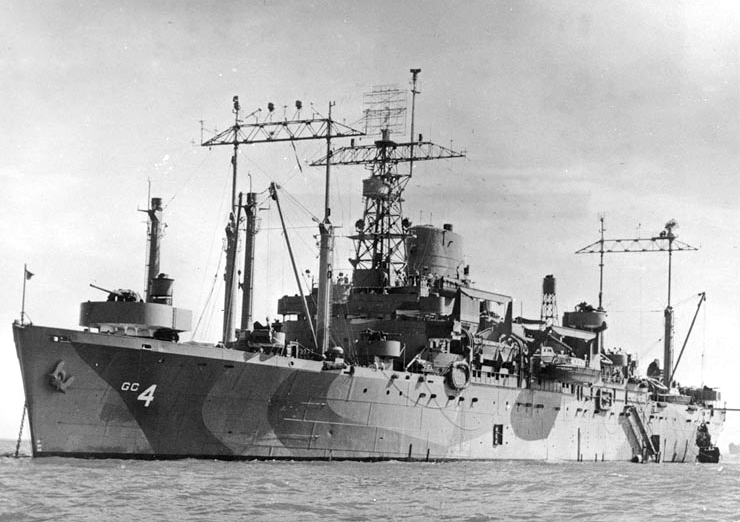
USS Ancon (AGC-4) was an ocean liner acquired by the United States Navy during World War II and converted to a combined headquarters and communications command ship.
https://en.wikipedia.org/wiki/USS_Ancon_(AGC-4)
And this armament:
two 5 in (130 mm) gun mounts
four twin 40 mm gun mounts
fourteen single 20 mm gun mounts
There is also a nice picture below.What about UK? For all I know, they seemed to prefer to use fast liners with added AAgun on deck.
It just seems natural to provide minimal armament to defend against the most probable threat.
Assuming that Troopship are clearly unarmoured, they get no chance against torpedoes and naval guns outside scattering in numbers.What I found is that for amphibious landing UK developed and use this kind of ship LST (1) Boxer class, armed with:
4 QF 2 pdr
8 20 mm Oerlikon
2 4-inch smoke mortarsLanding Ship, Tank (LST), or tank landing ship, is the naval designation for ships built during World War II to support amphibious operations by carrying tanks, vehicles, cargo, and landing troops directly onto shore with no docks or piers. This provided amphibious assaults to almost any beach. The bow of the LST had a large door that would open with a ramp for unloading the vehicles. The LST had a special flat keel that allowed the ship to be beached and stay upright. The twin propellers and rudders had protection from grounding. The LSTs served across the globe during World War II including: Pacific War and European theatre.
The first tank landing ships were built to British requirements by converting existing ships; the UK and the US then collaborated upon a joint design. Over 1,000 LSTs were laid down in the United States during World War II for use by the Allies. Eighty more were built in the United Kingdom and Canada.
…
Throughout the war, LSTs demonstrated a remarkable capacity to absorb punishment and survive. Despite the sobriquets “Large Slow Target” and “Large Stationary Target,” which were applied to them by irreverent crew members, the LSTs suffered few losses in proportion to their number and the scope of their operations. Their brilliantly conceived structural arrangement provided unusual strength and buoyancy; HMS LST 3002 was struck and holed in a post-war collision with a Victory ship and survived. Although the LST was considered a valuable target by the enemy, only 26 were lost due to enemy action, and a mere 13 were the victims of weather, reef, or accident. A total of 1,152 LSTs were contracted for in the great naval building program of World War II, but 101 were cancelled in the fall of 1942 because of shifting construction priorities. Of 1,051 actually constructed, 113 LSTs were transferred to Britain under the terms of Lend-Lease, and four more were turned over to the Greek Navy. Conversions to other ship types with different hull designations accounted for 116.https://en.wikipedia.org/wiki/Landing_Ship,_Tank
There is also Landing ship Infantry, Manoora is an example :
In Australia in mid-1942, HMAS Manoora was marked for conversion into the Royal Australian Navy’s first landing ship, infantry at Garden Island Dockyard. **Her armed merchant cruiser armament was removed and replaced with a single 12-pounder gun, six 40 mm Bofors, and eight 20 mm Oerlikons.**The Walrus amphibian aircraft was removed, and the ship was modified to carry US manufactured landing craft: 17 LCVPs, and two LCM(3)s. Manoora was initially able to accommodate 850 soldiers, but later modifications increased this to 1,250. The ship was recommissioned on 2 February 1943 with the pennant number C77, and after spending six months on amphibious warfare training in Port Phillip, was deployed to New Guinea.
https://en.m.wikipedia.org/wiki/Landing_ship,_infantry
I also found some kind of this converted Liners into armed merchant ships then troopship for Royal Canadian Navy. The most interesting thing is that one becomes a dedicated anti-aircraft escort vessel:
HMCS Prince David was one of three Canadian National Steamships passenger liners that were converted for the Royal Canadian Navy (RCN), first to armed merchant cruisers at the beginning of Second World War, then infantry landing ships (medium) or anti-aircraft escort. For three years, they were the largest ships in the RCN.
The three ‘Prince’ ships were a unique part of Canada’s war effort: taken out of mercantile service, converted to armed merchant cruisers, two of them (Prince David and Prince Henry) were reconfigured to infantry landing ships and one (Prince Robert) to an anti-aircraft escort; all three ships were paid off at war’s end and then returned to mercantile service.
In the early part of the war, as armed merchant cruisers equipped with antique guns and very little armour, Prince David and her sisters were sent to hunt enemy submarines and surface ships, tasks better suited to warships. As the needs of the RCN changed, so were the ‘Prince’ ships able to adapt to new roles.
https://en.wikipedia.org/wiki/HMCS_Prince_David_(F89)
Now, what about Japan, I also found that they use landing ship?
n June 1943, after its defeat in the Guadalcanal Campaign, the IJN realized it needed high-speed military transport vessels, and designed two classes of ship in response. One (the No.1 class) was to be the 1,500-ton mothership of the Daihatsu-class landing craft and Kō-hyōteki-class submarines, the other was to be a 900-ton amphibious assault ship, the No.101 class.
The IJA already had an amphibious assault ship, the SS-class landing ship. However, the SS craft were not suitable for mass-production, leading to IJA support for the new amphibious assault ships.
The IJN and IJA therefore cooperated on the production of the new amphibious assault ships with the IJN providing design and shipyards while the IJA offered mineral resources.https://en.wikipedia.org/wiki/No.101-class_landing_ship
https://en.wikipedia.org/wiki/SS-class_landing_shipAlso, this kind of troopship was also armed:
1 76.2 mm (3.00 in) L/40 AA gun
6 Type 96 25 mm AA guns
6 depth charges
OR
1 76.2 mm (3.00 in) L/40 AA gun
16 Type 96 25 mm AA guns
4 13 mm AA guns
12 depth chargesShinshū Maru (神州丸) was a ship of the Japanese Imperial Army during World War II. She was the world’s first landing craft carrier ship to be designed as such, and a pioneer of modern-day amphibious assault ships.
https://en.wikipedia.org/wiki/Japanese_amphibious_assault_ship_Shinshū_Maru
It was also armed:
4 75 mm (3 in) Type 88 guns
4 20 mm (0.79 in) AA gunsI’m not pretending that Troopships can compete with warships in any area.
Solely that if the original transport sculpts were those used for military operation and amphibious landing, probably people would have look differently to this unit.
Not just looking at merchant boats doing military invasion all over the map.Looking deeper into this topic about defenseless transport just provide a totally different way of looking at was going on on A&A board at this theatre of operation level.
The smaller board are just about moving troops, MIs, tanks and artillery divisions not about logistics and economic while the detailed one make an abstract concept of it with Convoy Disruption.I’m pretty sure SS might find a plausible game mechanics if there is enough evidence about what was use by armies and navies to make landing and oversea invasion.
For now, I’m just discovering the extent of human ingenuity when there is a need to develop a functional machine.
Here is what I can find about Germany:
The landing craft of the Kriegsmarine are a often neglected part of German naval history, although the over 700 crafts build played multiple roles during World War II.
During the invasion of Norway in 1940 (Operation Weserbung), the Kriegsmarine did not have specialized landing crafts, instead destroyers, cruisers and torpedo boats were used. During the following planning operation for the invasion of England (Seelwe) it got obvious that it could not be archived without such crafts. Since the development of real landing crafts would take too long, many river boat and merchant ships were provisionally modified for this role and the designs of real landing crafts was started.
Operation Sealion never took place, but the so called Marinefhrprahme (MFP) were build. They proved to be as vehicles with a universal use - besides transport and supply operations in all theaters of war, they could be operating as gun boats, mine layers or Sperrbrecher.
The Naval Landing Crafts - called “Marinefhrprahm” in German were the largest landing craft used by the Kriegsmarine. Although required for Operation Sealion (Invasion of England) in 1940, the first of this transport ships were delivered in 1941. The development of this ship went through several Types (A-D), whose size and armament grew from class to class.
They were mainly used for transport and supply duties and not for their initial invasion role and could transport 200 Soldiers or 140ts of equipment, including Tiger tanks.
Marinefhrprahme were used in almost all Kriegsmarine operational areas, the British Channel, the Mediterranean and the Black Sea.
http://www.german-navy.de/kriegsmarine/ships/landingcrafts/index.html
http://www.german-navy.de/kriegsmarine/ships/landingcrafts/mfp/index.html
Clearly not the biggest of ship, as the name says: craft not ship.
-
HA
I found a rule in another 39 game from a fellow AA member and his liner ship values are A0 D2 M3 C8 2Hits transport 3 inf non combat. :evil:
-
Can I find this a little OP, 2 hits for a liner ship?
:-D :-o :-D -
@Baron:
Can I find this a little OP, 2 hits for a liner ship?
:-D :-o :-DNo Its not over powered when your the rules designer and love UK !!! Must be 400 yards long and has 77 Artillery guns. :-D :-D :-D
I haven’t heard from him in over a year and a half now. He came out with his 39 game back in 97. I played this game and the Liner Ship never really got attacked. The transports in game had D1 shot at a plane for D6 system. But they had options to escape in certain scenrios with subs and planes. But the transports carried ground pieces and there were convoy routes they had to follow.
Each country had to have a certain amount of transports at start of every turn. If you didn’t, you had to pay 2 icps to bank. So sometimes just cheaper to pay to the bank then to buy a tranny and then get it killed in convoy but then no Lend Lease ground pieces. -
Since military TPs seems to be equipped with a minimal armaments, it may be played that only when they are directly hit, each get @1 on D12. As long as any escort is present, they don’t roll.
Once escorting warships are all down in a given combat round, the next one all TPs roll for defense against aircraft. All attacking units have to roll, the combat continue until all TPs are sunk. Attacker can never loose warship, but may lost many planes if plenty of TPs in stack.
If air retreat, it is the end of battle. And a few TPs survived then. -
@Imperious:
lets get this straight:
What you want is to demonstrate that Japan had two glorious transports that they converted with a few portable machine guns ( that never shot down any planes, but were capable) and a coastal gun, then assigning the old " well transports are actually other ships too like armed troopships…. then by osmosis saying " lets give all transports that ever sailed by any navy and every navy the same capability that these two machine guns could of should of would of had and the result is EVERY SHIP IN THE WORLD THAT WAS USED TO TRANSPORT SOLDIERS TO BE ABLE TO SHOOT DOWN ANY PLANE. Knowing all the while that all the combat ships like battleships and cruisers, carriers and destroyers DO NOT HAVE THIS CAPABILITY. Just the transports can shoot down planes with the aa gun. OK lets do it. I’m convinced. Excellent! It’s well thought out and planned.IL, from what I read, here what I saw as the common stages about military troop and vehicule transports, provided a given Power had enough resources (mainly Allies, but also Japan within the level of resources).
First, converting as much as needed Merchant Cruisers and Liners into Armed (mostly AA) merchant Cruiser and incorporated into Navy services.
Second, using available but obsolete AA gun armed Troopships for all earlier invasion of WWII, or use Destroyers in dire straits.
Third, designing and building better Landing ships (with AA armement) for both Infantry, Tank and Amphibious Assault. Also, designing and building Landing Crafts to be put on board of these ships.
Meanwhile, unarmed merchant cargo Transport were use as far as possible from frontal conflicts for logistics, oil, supplies and economical exchanges. If possible with dedicated escort warships, and in Convoy as much as possible.
None of these merchant cargo ships were suited or built for amphibious landing, Allies rely unto Landing ships and APA or AKA for direct combat and frontal assault.Now, if you have other facts or contradictory proofs, they are welcome.
My understanding of WWII is far from that of an historian even if it is above the average Joe.
-
Using Enigma formula here is what I get about TP defending @1:
@Baron:The on going discussion:
http://www.axisandallies.org/forums/index.php?topic=40520.msg1693864#msg1693864
on Transport with defense roll makes me wonder about actual combat strength of Classic Transport and an escorted TP:Transport and Destroyer A2 D2 C15, 1 hit
Offense & Defense factor:
36*(2/15^2) = 0.32Classic Transport A0 D1 C8, 1 hit
Defense factor:
36*(1/8^2) = 0.5625As comparison points, a Fighter A3 D4 C10 off/def is 1.08 / 1.44
Destroyer A2 D2 C8, 1 hit
Offense & Defense factor:
36*(2/8^2) = 1.125Submarine A2 D1 C6
Offense:
36*(2/6^2) = 2.00
36*(3/6^2) = surprise strike 3.00
Defense:
36*(1/6^2) = 1.00
36*(1.33/6^2) = surprise strike 1.33You need to send 2 Destroyers to get a similar defense value with Classic Transport strength of 0.5625:
Transport and 2 Destroyers A4 D4 C23, 2 hits
Offense & Defense factor:
36*(2/11.5^2) = 0.544Or make defenseless Transport a 4 IPCs unit to reach the defense factor of Classic:
Transport C4 and Destroyer C8: A2 D2 C12, 1 hit
Offense & Defense factor:
36*(2/12^2) = 0.50Now, if you want to introduce a Classic TP with the same strength of actual DD+TP combo 0.32:
You need to make TP cost 10,5 IPCs:Classic Transport A0 D1 C10, 1 hit
Defense factor:
36*(1/10^2) = 0.36At 11 IPCs, it would be 0.30 though.
Transport defending A0 D1 might be interesting at a clean cut 10 IPCs.
For purist, this make me think about another option:
Make defenseless TP at 3 IPCs but loading only 1 unit.
That way, it makes it easier to sacrifice one here and there and protecting with warships remains the same.
But, it will not solve the issue caused by no hit value.
However, more small TPs can be widespread and require more attacking units to get ride of them in multiple SZs. -
@Baron:
Using Enigma formula here is what I get about TP defending @1:
@Baron:The on going discussion:
http://www.axisandallies.org/forums/index.php?topic=40520.msg1693864#msg1693864
on Transport with defense roll makes me wonder about actual combat strength of Classic Transport and an escorted TP:Transport and Destroyer A2 D2 C15, 1 hit
Offense & Defense factor:
36*(2/15^2) = 0.32Classic Transport A0 D1 C8, 1 hit
Defense factor:
36*(1/8^2) = 0.5625As comparison points, a Fighter A3 D4 C10 off/def is 1.08 / 1.44
Destroyer A2 D2 C8, 1 hit
Offense & Defense factor:
36*(2/8^2) = 1.125Submarine A2 D1 C6
Offense:
36*(2/6^2) = 2.00
36*(3/6^2) = surprise strike 3.00
Defense:
36*(1/6^2) = 1.00
36*(1.33/6^2) = surprise strike 1.33You need to send 2 Destroyers to get a similar defense value with Classic Transport strength of 0.5625:
Transport and 2 Destroyers A4 D4 C23, 2 hits
Offense & Defense factor:
36*(2/11.5^2) = 0.544Or make defenseless Transport a 4 IPCs unit to reach the defense factor of Classic:
Transport C4 and Destroyer C8: A2 D2 C12, 1 hit
Offense & Defense factor:
36*(2/12^2) = 0.50Now, if you want to introduce a Classic TP with the same strength of actual DD+TP combo 0.32:
You need to make TP cost 10,5 IPCs:Classic Transport A0 D1 C10, 1 hit
Defense factor:
36*(1/10^2) = 0.36At 11 IPCs, it would be 0.30 though.
Transport defending A0 D1 might be interesting at a clean cut 10 IPCs.
For purist, this make me think about another option:
Make defenseless TP at 3 IPCs but loading only 1 unit.
That way, it makes it easier to sacrifice one here and there and protecting with warships remains the same.
But, it will not solve the issue caused by no hit value.
However, more small TPs can be widespread and require more attacking units to get ride of them in multiple SZs.I only see a few guys like us going for these values. Gets away from kiss.
I think its best for the history and non history in games to be for all A&A games is the Transport rolls 1 d12 die for D1 against any attack. D6 = 16.7 % D8 = 12.5 % D10 = 10 % D12 = 8.33 %
Taken last for casualties. They have no AA gun.
Happy medium.
-
Your trying to find the rule by demonstrating the exception. The examples you show do exist, but the level of which they exist compared to the huge majority of what “transports” represent could never in any case raise the aggregate of assigning ALL transports with a combat value of one. These weapons you list are so rudimentary and basic and do little more than fight limited actions. What you should do is leave the transport alone and instead make a new unit… the armed transport which can defend only against other transports and submarines. To allow this unit to have any capability to sink units like the battleship is just silly.
It should be a new unit costing +1, defends at one, still cannot be brought into battle , but can be used as a raider against other shipping and defend against sub attacks ans still carry the cargo.
-
Knew would chime in. I’m still undecided yet. Half group wants defense less tranny and half want something but weaker than the A0 D1 at planes only or D1 against any attack.
-
@Baron:
@Imperious:
lets get this straight:
What you want is to demonstrate that Japan had two glorious transports that they converted with a few portable machine guns ( that never shot down any planes, but were capable) and a coastal gun, then assigning the old " well transports are actually other ships too like armed troopships…. then by osmosis saying " lets give all transports that ever sailed by any navy and every navy the same capability that these two machine guns could of should of would of had and the result is EVERY SHIP IN THE WORLD THAT WAS USED TO TRANSPORT SOLDIERS TO BE ABLE TO SHOOT DOWN ANY PLANE. Knowing all the while that all the combat ships like battleships and cruisers, carriers and destroyers DO NOT HAVE THIS CAPABILITY. Just the transports can shoot down planes with the aa gun. OK lets do it. I’m convinced. Excellent! It’s well thought out and planned.IL, from what I read, here what I saw as the common stages about military troop and vehicule transports, provided a given Power had enough resources (mainly Allies, but also Japan within the level of resources).
First, converting as much as needed Merchant Cruisers and Liners into Armed (mostly AA) merchant Cruiser and incorporated into Navy services.
Second, using available but obsolete AA gun armed Troopships for all earlier invasion of WWII, or use Destroyers in dire straits.
Third, designing and building better Landing ships (with AA armement) for both Infantry, Tank and Amphibious Assault. Also, designing and building Landing Crafts to be put on board of these ships.
Meanwhile, unarmed merchant cargo Transport were use as far as possible from frontal conflicts for logistics, oil, supplies and economical exchanges. If possible with dedicated escort warships, and in Convoy as much as possible.
None of these merchant cargo ships were suited or built for amphibious landing, Allies rely unto Landing ships and APA or AKA for direct combat and frontal assault.Now, if you have other facts or contradictory proofs, they are welcome.
My understanding of WWII is far from that of an historian even if it is above the average Joe.
@Imperious:
Your trying to find the rule by demonstrating the exception. The examples you show do exist, but the level of which they exist compared to the huge majority of what “transports” represent could never in any case raise the aggregate of assigning ALL transports with a combat value of one. These weapons you list are so rudimentary and basic and do little more than fight limited actions. What you should do is leave the transport alone and instead make a new unit… the armed transport which can defend only against other transports and submarines. To allow this unit to have any capability to sink units like the battleship is just silly.
It should be a new unit costing +1, defends at one, still cannot be brought into battle , but can be used as a raider against other shipping and defend against sub attacks ans still carry the cargo.
Strangely IL,
I saw that Germany used Q-ships as a disguised armed Transport (as Corsairs) and that a few US Troopship survived after being torpedoed.
But what you are suggesting seems more an oddity than what was massively built by Canada, UK, Australia and USA.
Q-ships were armed merchants aimed at laying traps to others merchants vessels, not intended to carry military units for invasion and amphibious assault.
Also, I rarely see any relevant anti-sub weaponry (depth-charge or hedgehog) added on Landing ships, which were the most armed amongst Transport. I may be wrong on that point, but it was mostly AA guns and one or two deck guns for dual purpose against Aircraft or Small surface vessels. It doesn’t seems very effective against any Sub prowling below surface ready to launch torpedoes at this transport. Maybe this dual purpose gun might work when a Sub was rampaging in a Convoy firing with his single deck gun, IDK.I agree that Landing ships are no match against Battleship, Carrier and Cruiser or even Destroyer.
They don’t have armor nor enough deck guns to have any chance.All I saw, is that any Transport which was specifically built for military purpose always received Anti-Aircraft guns and one or two deck gun(s).
What does it imply for game house rule on defense for Transports?
The game mechanic make things into a conundrum:
A side) giving a low @1 (on D12) defense against aircraft to figure what Landing ships can counter somehow, is now improving the game unit defense above an ordinary roll, since hitting specifically planes is a bonus when your opponent would have use 6 IPCs Sub or 8 IPCs Destroyer as fodder instead of loosing a costly 10 IPCs Fighter.B side) giving a low @1 (on D12) as minimal defense to allow the enemy’s to choose the lowest and weakest naval unit in game as casualty.
But this would imply that most of the time a Submarine or a Destroyer will be sunk. And since Landing ships does not have enough firepower to sink them, an effective Landing ship defense is not depicting accurately this naval warfare: it let believe military Transport were able of such a feat.C side) not giving any combat value to TPs also create an unhistorical depiction because it let you believe that when all escorting Warships were destroyed, all Troopships were immediately obliterate and sunk. This is not either accurate from a realist POV because TPs against overpowered enemies usually scattered and partially survived. Nor it is a game-wise effect, because in a matter of 1 combat round all your TPs and money-worth in a given SZ are taken as casualty if only a single enemy’s unit survived a monstrous naval battle, you may have an infinite number, or 10 units for 70 IPCs or more or less, it does not matter at all. All IPCs invested in TPs in this once protected SZ are now wipe out of the board.
TPs purchasing is the only unit which does this trick when attacked. Even AAA get a 1 hit value, as long as it share a TT with another ground unit type.D side) giving an escape capacity to TPs would be more accurate, also the game allows TPs and Subs to be ignored and to share a SZ with enemy’s units. But, in game, Submarines loose this escaping capacity if only 1 single enemy Destroyer is present. If any Transport survived a naval clash, this would make TPs better at hiding than Submarines themselves!
E side) using TPs as first line casualty seems to contradict the very mission of warships, as defending TPs not the other way around.
Solving these issues can be done, if there is other tweaks about Sub vs DDs, or Fighters.
For example on D, if you give Subs vs DDs a 1:1 ratio to limit DD blocker capacity.
Then, you can make Transports with no defense roll but give each unit-type a specific ratio of kill against TP.
For instance, any 1 aircraft sink 1 TP max (limited ordinance and fly time) while all warships sink 2 TPs max (carrying a lot of ammos and stay on SZ without going to port).
Or you can decide to be more specific:
Destroyer or Cruiser (or 1942.2 Carrier with A1) sink Transport on a 1:1 ratio
Battleship or Submarine sink Transport on a 1:2 ratio.
So, after a large battle, the number of surviving units chasing Transports will matter.If you prefer to roll, it can be that once a TP can be directly attacked, there is only two other combat rounds before any remaining TP survived in SZ.
So, if a the start of a combat, 2 TPs are caught without escort by 1 Strategic bomber, you get 3 rolls (this combat round and the others two) before TPs escape by scattering into this SZ.For A, in my game, I can play it because:
Fighter are Attack 2 (4 on D12) Defense 2 Cost 6,
TcB are Attack 3 (6 on D12) Defense 2 (4 on D12) Cost 7.
In that case, they already assumed a fodder role.
Hence, allowing a Transport Defense against aircraft only is functional.
Destroyers and all other warships would blast them out.For B, you have to assume that there is always a minimal close escort to military Transport. And this was certainly true. Troopships were apple of one’s eye for Navy and Army.
As I suggested elsewhere, you still take Transport casualty last, but treat all as 1 hit value and give only a single roll @1 each combat round if there is at least 1 Transport present in a given attacked SZ.It can still be minimalized by rolling this @1 defense for TPs group when there is only TPs remaining on the battle board.
There is certainly other tweaks which people can think about.
-
@SS:
@Baron:
Using Enigma formula here is what I get about TP defending @1:
@Baron:The on going discussion:
http://www.axisandallies.org/forums/index.php?topic=40520.msg1693864#msg1693864
on Transport with defense roll makes me wonder about actual combat strength of Classic Transport and an escorted TP:Transport and Destroyer A2 D2 C15, 1 hit
Offense & Defense factor:
36*(2/15^2) = 0.32Classic Transport A0 D1 C8, 1 hit
Defense factor:
36*(1/8^2) = 0.5625I only see a few guys like us going for these values. Gets away from kiss.
I think its best for the history and non history in games to be for all A&A games is the Transport rolls 1 d12 die for D1 against any attack. D6 = 16.7 % D8 = 12.5 % D10 = 10 % D12 = 8.33 %
Taken last for casualties. They have no AA gun.
Happy medium.
To get a glimpse of the strength of this 1 out of 12, or 0.5 on D6:
Defense factor:
36*(0.5/7^2) = 0.367
Which is near the strength of actual DD+TP combo (0.32).
A Sub has strength of 2 or 3 if first strike, a DD is 1.125 power*hit -
I saw that Germany used Q-ships as a disguised armed Transport (as Corsairs) and that a few US Troopship survived after being torpedoed.
I pointed this out from the get go. They had a few of these and they didn’t shoot down planes. What they did was pretend to be transports, sail near enemy transport and sink with very small deck gun. Against subs they could do nothing except us the deck gun in the event the sub was trying to save torpedoes and finish off ship with their own deck gun on sub. The few examples you brought up did somewhat exist, but again these are extremely few compared to the total quantity of transport/merchant ship types.
-
@Imperious:
I saw that Germany used Q-ships as a disguised armed Transport (as Corsairs) and that a few US Troopship survived after being torpedoed.
I pointed this out from the get go. They had a few of these and they didn’t shoot down planes. What they did was pretend to be transports, sail near enemy transport and sink with very small deck gun. Against subs they could do nothing except us the deck gun in the event the sub was trying to save torpedoes and finish off ship with their own deck gun on sub. The few examples you brought up did somewhat exist, but again these are extremely few compared to the total quantity of transport/merchant ship types.
From what you say here and in earlier posts and past threads when this topic arise, it gives the impression that Navy and Army asked to merchantmen to help them carrying Troops and Tanks into shore and beaches. That Pacific Island Hopping depends on Merchants Cargos and Operation Torch and D-Days was performed with civilian unarmed transports.
But, what I read is that civilian ships duty was to carry lend-lease supplies from US to UK or US to Australia or US to USSR.
Military operations were given specifically to military designated Landing Ships, Infantry or Tank (UK) or Attack Transport APA or Attack Cargo Ship AKA (US).
So, when looking at what is important in A&A strategy game, it is all about moving combat ground units into enemy’s territories with Transport units.
The part played by merchant navy is very abstract and only displayed with Convoy Disruption rules in the more detailed Global 40.
So, is there any unarmed civilian merchant ships which take part into military operations for moving troops purpose?
This is where I’m actually.
I always thought it was the case because of this defenseless transport rule and the lack of enough acknowledgement displayed toward Canadian merchant marines risking their lives while delivering goods to UK as part of a war effort worthy of any Royal Canadian Navy members.However, my limited readings and scrolling makes me think that specific armed troopships were built to deliver a fast coordinated blow into enemy’s coastal defense and shorelines by carrying all combat units and equipment near the shore as possible. And Allies use exclusively this military ships to do invasion landing.
Now, they may have use regular civilian transportation to move operational military units from Los Angeles to Hawaii, IDK.
But, into a warzone, it seems Allies used the best available to protect their men. -
The transport unit represents the most common type of vessel carrying troops. It was defenseless and slow and needed protection from Destroyers and Escorts. The few cases pointed out where they had a couple of deck guns could become a new unit:
Escort vessel
Armed Raiderbut this would be a different unit with a different sculpt and a different cost and probably capability in transport ( just one unit)