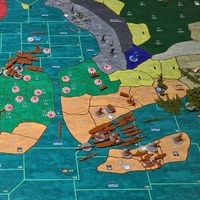

Many of the ideas in this thread are incorporated into my rules set.
National advantages. Each nation is unique. The Soviets receive more manpower points than any two other nations combined, allowing them to field substantially larger infantry forces than can any other nation. However, Soviet infantry receive a modest penalty to combat effectiveness.
Japan starts the game with a bonus to the effectiveness of its torpedo bombers, because Kates were very good planes. The Soviets’ Ilyushin Il-2 tech means its dive bombers are harder to shoot down than anyone else’s. The Germans are able to advance farther than any other nation in rocket and jet technology, though available British advances in jet technology are nothing to sneeze at!
Light and heavy tank. This rules set incorporates four different classes of tanks: light tanks, medium tanks, battle tanks, and heavy tanks. The game starts off with China unable to build tanks, Japan able to build light tanks, and the Soviets, Germans, British, and Americans able to build medium tanks. Soviet medium tanks are somewhat harder to kill than the others because they had the T-34. It is possible to upgrade the quality of one’s tanks over the course of the game. For example, a level 5 light tank has twice the firepower, and is twice as hard to kill, as a level 1 light tank.
Japan can upgrade its light tanks to medium tanks. The Soviets, British, and Americans can upgrade their medium tanks to battle tanks. The Germans can upgrade their medium tanks first to battle tanks, and then to heavy tanks. However, all this upgrading would require a substantial investment in scarce, valuable EUs. EUs can be used to research new technologies, to upgrade your nation’s income, to upgrade its rail network, or to build or upgrade minor production centers. The Japanese may want to stick with light tanks, the Soviets with medium tanks, and the Germans with battle tanks, in order to free up EUs for use elsewhere. (EUs cannot be used to directly purchase military units–that’s what production units are for!)
Terrain. This rules set’s terrain system is rather simple. Level 0 terrain means no defensive bonus, level 1 terrain means that for every ten hits the defender scores, a bonus hit is added. Terrain can be up to level 10.
Atomic bomb. EUs can be used to research nuclear technology. One your level of nuclear technology is sufficiently advanced, you can use EUs to build nuclear production facilities. Each such facility produces one nuclear bomb per turn. The United States can load its nuclear bombs onto strategic bombers, which must survive a dogfight for one round before they can deliver their lethal payload. Germany must also deliver its nuclear bombs in this manner–until, that is, it gets around to researching rockets level 15. At that point, it will be able to use ICBMs to deliver nuclear payloads to any target anywhere in the world. Fortunately for the Allies, Germany cannot research rockets level 15 until the 15th game round at the earliest. Even after Germany reaches this point, the Allies can always try to use strategic bombing raids to destroy Germany’s nuclear production facilities. Of course, by this point Germany’s jets will likely be very advanced, and equipped with air-to-air rockets. That will make strategic bombing raids against Germany difficult. On the other hand, the U.S.'s late game income is nearly double that of Germany.
I’m interested in feedback about this rules set. If you have any comments or suggestions about it, please post them here. Thanks.










 _The Conflict is a global-strategy based game designed around the economic and military conditions of Europe in 1914. Players play in one of two alliances, The Central Powers or The Allied Powers, to defeat their opponents. Players choose among seven nations (Austria-Hungary, Germany, Great Britain, France, Italy, Ottoman Empire, and Russia). After selecting a nation, players take turns completing their objectives during each round.
 The Conflict has been extensively tested and designed by gamers for gamers. Players will take their turn each round to strengthen their tactical advantages and defend the borders of their nation. Each turn is broken down into Phases. Players must complete each previous phase in order to proceed onward with the rest of their turn. If a player decides to enter into combat with another player, they must, along with their opponent, roll a set number of D12 dice to determine the outcome of each individual battle. The Conflict uniquely deducts a combat penalty from the player with the weakest military strength in a territory. This combat penalty is taken off all of their dice rolls during the individual combat. The combat penalty allows for the strongest opponent to have a real-world advantage over their enemy, if they have a larger military presence in the area. Players can develop multiple (land, naval, and air) strategies to succeed. They can utilize 11 military units with unique capabilities to complete specific goals, upgrade technology, play one of three victory scenarios, as well as try a variety of player preferences.